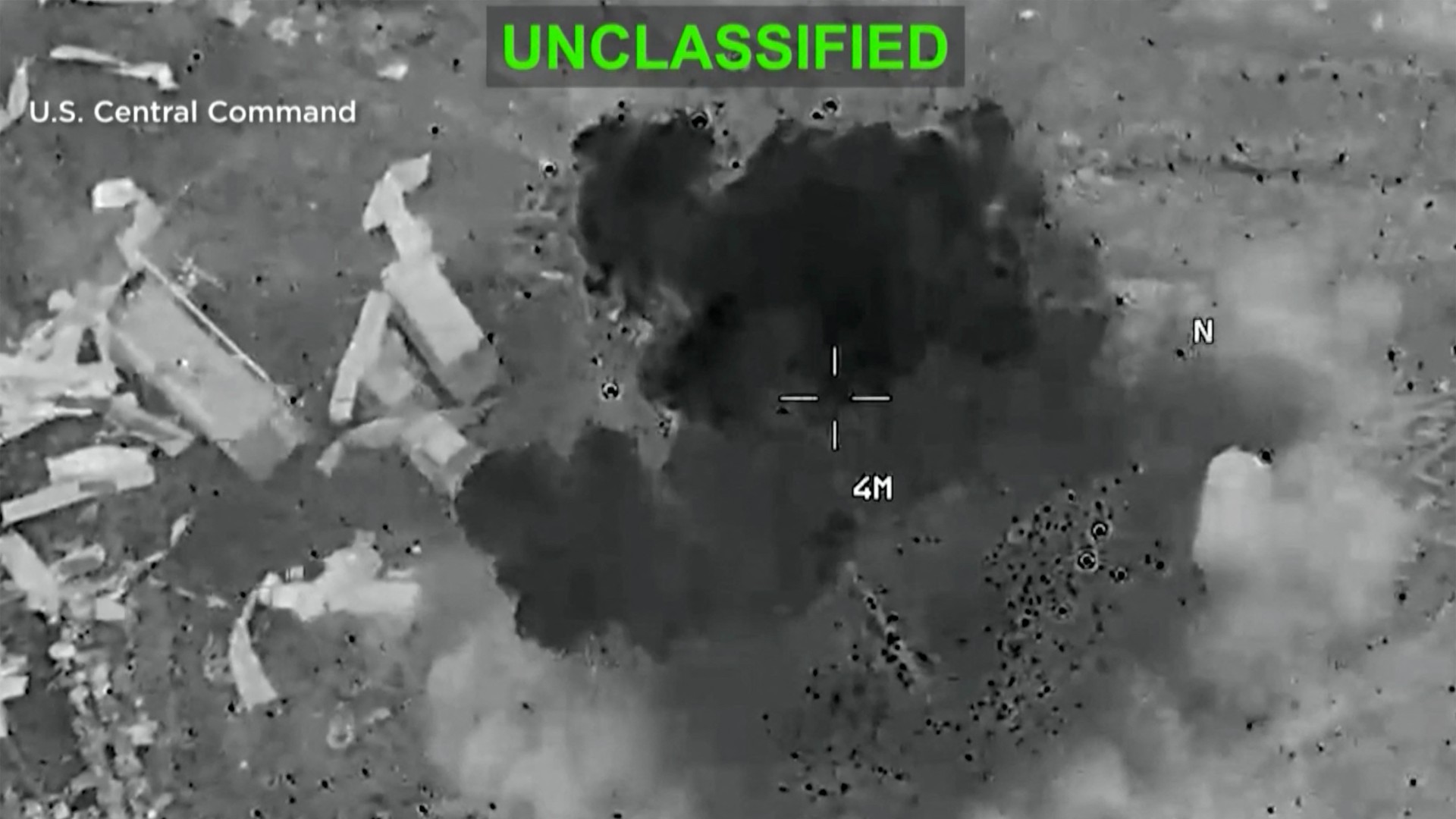
Tensions across the Middle East have surged to new heights this week, after the United States carried out its 12th consecutive day of strikes on Iranian territory, prompting Tehran to formalize a retaliatory “an eye for an eye” defense doctrine in response to explicit threats from former President Donald Trump to target Iranian civilian infrastructure.
Iranian state media confirmed Thursday that a U.S. strike on the border town of Shalamcheh, which lies along Iran’s frontier with Iraq, left two civilians dead and at least 11 others injured. The strikes also extended to Bushehr, the site of Iran’s only operational civilian nuclear power plant, where two U.S. missiles impacted the area.
U.S. Central Command has publicly confirmed the 12th straight night of offensive operations, framing the campaign as an effort to “further degrade Iran’s ability to threaten civilian mariners and commercial vessels transiting regional waters.”
In a provocative social media post, Trump laid out an explicit new red line for future U.S. action: every time Iran targets a vessel moving through the Strait of Hormuz — the strategically critical global chokepoint through which roughly one-fifth of the world’s total oil and liquefied natural gas supplies transit — the U.S. will destroy key Iranian civilian infrastructure. “Any time the Islamic Republic of Iran shoots at a ship in the Strait of Hormuz, whether it be by Missile, Rocket, Drone, or any other device or weapon, the United States will bomb and destroy ONE BRIDGE OR POWER PLANT,” Trump wrote.
Iran’s foreign minister Abbas Araghchi pushed back immediately on the social platform X, making clear Tehran’s new position: “Our defense doctrine is clear: eye for an eye. Any aggression against Iran, including our infrastructure, will compel a powerful and decisive response.” He added that any third party providing support to the U.S. campaign would also be treated as a legitimate target for retaliation.
Iranian military spokesperson Mohammad Akraminia, speaking on state television, reinforced this stance, noting: “The armed forces’ retaliatory attacks will continue as long as the US attacks on the country’s infrastructure and coastal areas continue.”
Retaliatory strikes have already spread beyond Iran’s borders. On Thursday morning, both Jordan and Kuwait confirmed they intercepted incoming attacks, which Iran’s Islamic Revolutionary Guard Corps (IRGC) confirmed targeted U.S. military assets hosted in both countries. The Iranian army announced it deployed “destructive drones” to strike multiple U.S. facilities across Kuwait, including ammunition and logistics depots at Camp Doha, fuel storage tanks at Ali al-Salem Air Base, and an ammunition depot at Camp Arifjan.
In the Strait of Hormuz itself, the IRGC announced it had halted three transiting oil tankers on Thursday, asserting full control over the waterway. “The Strait of Hormuz is under our control… and any ship that is deceived by the US and intends to pass without coordination with the Islamic Republic of Iran will suffer the same fate,” the corps said.
The conflict has now expanded to the Red Sea, where Yemen’s Houthi movement — which recently entered the fray and declared a blockade on Saudi ports — claimed responsibility for missile and drone strikes on two Saudi oil tankers overnight. The Houthi movement identified the targeted vessels as the *Encelia* and the *Layla*. UK Maritime Trade Operations (UKMTO), the British body that monitors naval security in the region, confirmed the master of one tanker reported being struck by an unidentified projectile roughly 70 nautical miles southwest of Saudi Arabia’s Al Shuqaiq, adding that the projectile sparked a fire that the crew was working to extinguish. Saudi Arabia has confirmed the *Encelia* was hit, but has not yet issued comment on the second tanker.
U.S. Secretary of State Marco Rubio accused Iran of manipulating the Houthis into joining the conflict, saying, “The Houthis largely were smart and stayed out of all this throughout the conflict, but they now apparently have gotten themselves suckered into this, going after Saudi Arabia and their ships. I hope they will de-escalate, because I think the Houthis, frankly, got snookered into this thing by the Iranians.”
As regional powers move to contain the escalation, Oman announced Thursday it is facilitating the resumption of de-escalation talks between the Houthi movement and the Saudi government to lower tensions in the Red Sea and Yemen.