On a single Thursday, multiple interconnected developments unfolded across the Middle East, touching on long-running conflicts, diplomatic standoffs, and fresh rounds of international condemnation. From Tehran’s rejection of U.S. pressure to a somber mass gathering in Gaza for long-unrecovered victims, the day’s events underscored the region’s persistent volatility. The full breakdown of these updates is as follows.
First, Iran pushed back sharply against escalating economic threats from former U.S. President Donald Trump. Hours after Trump pledged what he called unprecedented, crushing economic measures and widespread isolation for the Islamic Republic, Iranian Foreign Minister Abbas Araghchi dismissed the threats as a failed tactic that would only deepen public hostility toward the U.S. and lead to further American setbacks. In a public social media statement, Araghchi argued the threats were designed to distract U.S. voters from growing domestic economic problems inside the United States. He added that what he labeled U.S. “economic terrorism” poses a broader threat to the global economy and the national sovereignty of nations across every region.
Across the Israeli-occupied West Bank, a long-planned Israeli settlement expansion project drew sharp condemnation from multiple world capitals. Israel’s Construction and Housing Ministry had recently issued a tender for more than 1,200 new residential units on open land east of Jerusalem, advancing a proposal that has sat under consideration for more than 20 years. Critics warn the project would effectively split the occupied West Bank into two disconnected segments, eliminating any possibility of forming a geographically contiguous Palestinian state, a core goal of long-stalled two-state peace negotiations.
British Foreign Secretary Ed Miliband called the tender’s publication “an unacceptable and destructive act,” and also denounced ongoing settler violence against Palestinian communities in the occupied territories. The British government summoned the Israeli chargé d’affaires to formally demand an immediate reversal of the tender. Egypt and Jordan joined the condemnation, with Cairo noting the project would cut off East Jerusalem from surrounding Palestinian communities. In response, Israeli Foreign Minister Gideon Saar defended the plan, asserting the Jewish people hold a historic right to build a national home across all of what Israel considers the Land of Israel, including the disputed area east of Jerusalem. Saar also criticized the British government for singling out Israel for blame while ignoring what he called Palestinian extremism.
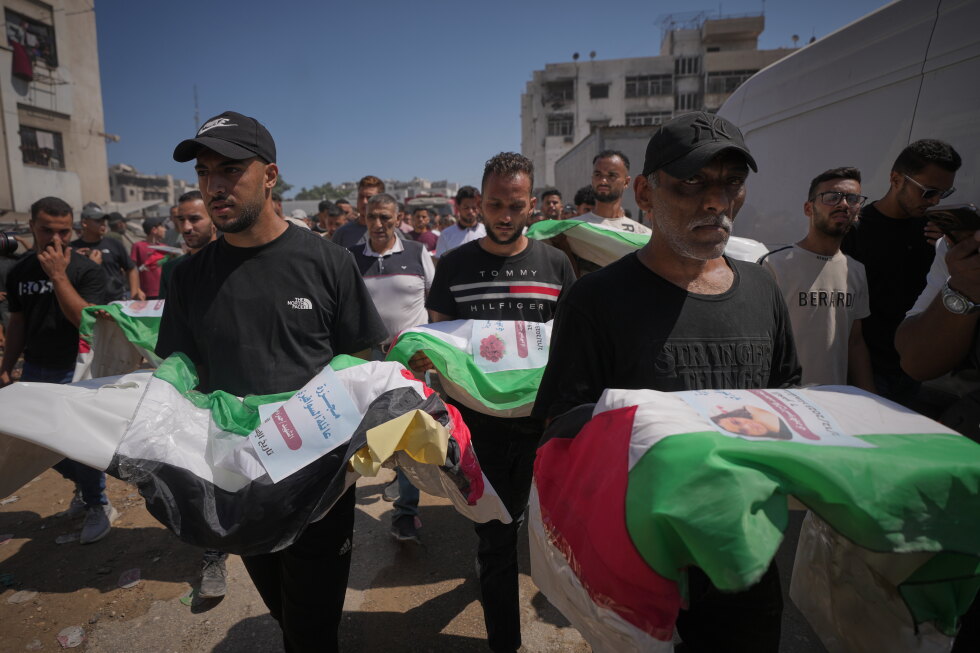
In Gaza City, thousands gathered for a somber mass funeral for 50 Palestinians who were killed in Israeli airstrikes during the opening months of the Israel-Hamas war, but whose remains were only recovered from collapsed rubble in recent weeks. Mourners carried the flag-draped remains through streets still strewn with debris from three years of conflict, many holding portraits of the deceased to honor their memory. Lina Karam, who lost her father and multiple other family members in the 2023 strikes, spoke to reporters about the long wait to lay her loved ones to rest. “We were able to recover them after three years of war, after three years of anguish, pain and torture,” Karam said. “We were able to recover them, and dignify them in their final resting place.” All 50 victims belonged to three extended families killed in airstrikes carried out in November and December 2023. Gaza’s Hamas-run Health Ministry reports that the nearly three-year conflict has killed more than 73,400 Palestinians, a count that U.N. agencies and international observers consider broadly reliable. While the toll does not distinguish between civilian and combatant deaths, the ministry notes that women and children make up roughly half of all those killed.
In northern Syria, a recent Israeli airstrike on the Abu Duhur air base sparked diplomatic pushback from Turkey. The strike, carried out early Tuesday, caused significant infrastructure damage but no reported casualties. Israeli Prime Minister Benjamin Netanyahu’s office justified the attack by claiming Syria was close to violating long-standing security arrangements by allowing Turkish troops to deploy to the base. While Syrian officials claimed a Turkish military delegation had visited the base to inspect ongoing rehabilitation work before the strike, Turkey issued a formal denial of the claim, and pledged to continue supporting Syrian efforts to rebuild its national military.
Meanwhile, Syria’s top diplomat, Foreign Minister Assad al-Shibani, traveled to Islamabad, Pakistan for talks focused on de-escalating regional tensions across the Middle East. His visit comes just days after the Israeli airstrike on the northern Syrian air base. Pakistan has taken a leading diplomatic role in efforts to calm tensions between the United States and Iran, following the expiration of a 60-day ceasefire and talks window that was agreed to in a June memorandum of understanding brokered by Pakistan with backing from other regional states. Pakistani political and military leaders remain in regular contact with both Tehran and Washington to push for a resumption of diplomatic negotiations. In a separate development related to regional tensions, Pakistan has repatriated the bodies of two Pakistani sailors killed in a recent Houthi attack on a Tanzanian-flagged commercial cargo ship transiting the Bab el-Mandeb Strait. Six other Pakistani sailors injured in the attack have also returned safely to Pakistan, Foreign Minister Ishaq Dar confirmed in a post on social media platform X.