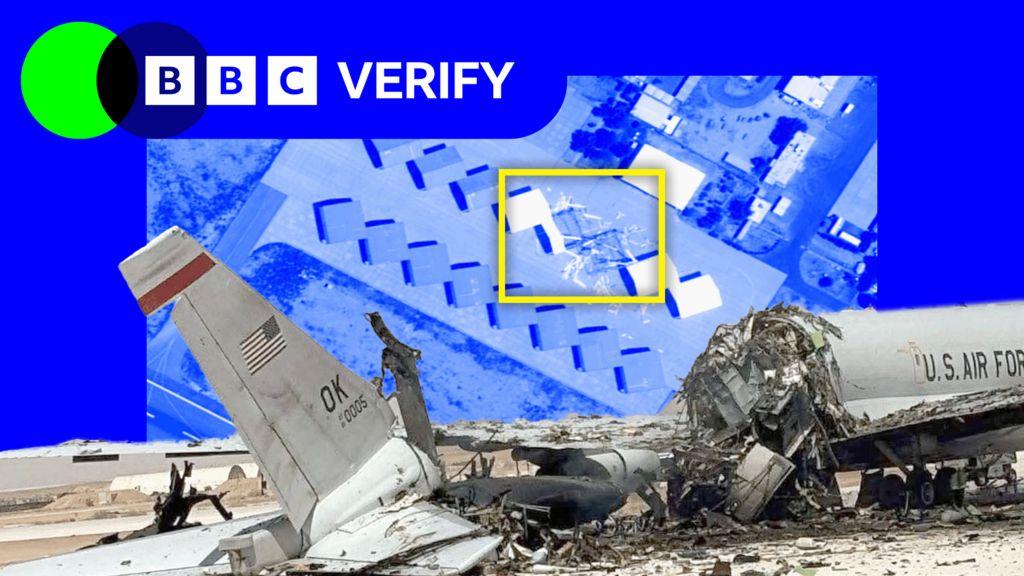
Forensic analysis of satellite imagery and on-the-ground videos conducted by BBC Verify has uncovered that Iran has carried out strikes damaging at least 20 United States military installations across the Middle East since the outbreak of the ongoing regional conflict — a scale of retaliatory attacks far larger than what American officials have publicly acknowledged. The verified findings paint a far different picture of the conflict than official Washington narratives, revealing deep gaps between public statements and on-the-ground reality.
Since late February, Iranian forces have targeted critical military infrastructure spanning eight Middle Eastern nations: Saudi Arabia, the United Arab Emirates, Qatar, Kuwait, Iraq, Jordan, Bahrain and Oman. The damage has extended to cutting-edge American military hardware, including advanced air defense systems, refueling and surveillance aircraft, and radar installations, with total losses running into millions, and potentially billions, of dollars. Independent analysts note the actual number of hit sites could be as high as 28, meaning the confirmed 20 sites represent a conservative count.
The Iranian strikes are a direct retaliatory response to three months of joint US-Israeli offensive operations across Iran and Lebanon. The Pentagon has stated that since launching Operation Epic Fury, it has struck more than 13,000 targets inside Iran. As counterattacks have unfolded, Iran’s Supreme Leader Mojtaba Khamenei has publicly emphasized his military’s operational success, declaring in a statement earlier this week that the Middle East is no longer a safe space for American military outposts.
This disclosure directly contradicts repeated claims from the White House that Iran’s military capabilities have been nearly completely degraded. Regional security analysts note that the verified damage to US facilities proves Tehran’s counteroffensive has been both more accurate and far more widespread than senior American officials have previously admitted. A senior US defense official declined to answer questions about BBC Verify’s findings, citing operational security requirements.
In a bid to restrict independent scrutiny of the conflict, the US government has pressured commercial satellite provider Planet to enforce an indefinite block on new high-resolution imagery of Iran and most of the Middle East. The company has defended the restriction, claiming it was enacted to prevent its imagery from being used by adversarial actors to target US, allied and NATO-partner personnel and civilian populations. To work around this restriction, BBC Verify combined historical imagery from Planet with fresh satellite data from other international commercial providers to map and verify the damage from Iranian strikes.
Among the most high-value assets destroyed are three cutting-edge Terminal High Altitude Area Defense (THAAD) anti-ballistic missile batteries, located at Al Ruwais and Al Sader Airbases in the UAE and Muwaffaq Salti Airbase in Jordan. The US only operates eight THAAD batteries globally, with each unit costing roughly $1 billion to manufacture. Each battery requires a 100-person crew to operate, and individual interceptor missiles cost approximately $12.7 million apiece. Vice-Admiral Mark Mellett, former chief of the Irish Defence Forces, told BBC Verify that THAAD batteries form the core of a highly integrated regional US defense network that cannot be quickly or easily replaced after sustaining major damage.
Satellite analysis also confirms that Iranian strikes caused heavy damage to US refueling and surveillance aircraft stationed at Prince Sultan Airbase in Saudi Arabia, with visible imagery showing damaged airframes and smoking impact craters. Analysts from open-source intelligence firm MAIAR identified one destroyed aircraft as an E-3 Sentry airborne surveillance plane, a platform that costs up to $700 million to replace.
Multiple strikes have also hit key US installations in Kuwait, including Ali Al Salem Airbase and Camp Arifjan. Satellite analysis from MAIAR shows destroyed fuel storage bunkers, aircraft hangars and troop accommodation buildings at Ali Al Salem, which has been targeted repeatedly throughout the conflict. At Camp Arifjan, defense intelligence outlet Janes confirmed extensive damage to critical satellite communications infrastructure.
While the full financial cost of the damage remains difficult to calculate, a May Pentagon estimate put the total cost of Operation Epic Fury at $29 billion, with the vast majority of that sum allocated to repairing or replacing equipment destroyed in combat. Congressional Democrats have repeatedly stated that this official estimate is far lower than the actual total cost of losses. BBC Verify’s analysis also confirms that at least 42 US aircraft have been destroyed or damaged since February, including F-15 and F-35 fighter jets, 24 MQ-9 Reaper drones, and an A-10 ground attack aircraft.
Unlike the high-cost, cutting-edge hardware deployed by the US, Iran has relied heavily on low-cost, easily replaceable drones to carry out its strikes across the region. Security experts note that Iranian tactical doctrine has evolved rapidly over the course of the conflict, shifting from large, widespread missile barrages to smaller, far more precision-focused strikes on high-value targets.
“Iran’s opening strikes were designed for mass volume: large waves of projectiles meant to overwhelm air and missile defenses through sheer numbers,” explained Dr. Kelly Grieco, an analyst with the Washington-based Stimson Center think tank. “Within days, however, Iran had shifted to smaller, more precisely targeted salvos, conserving remaining missiles and drones for specific high-value targets and concentrating fire where even near-misses can cause significant damage.”
A MAIAR analyst added that the US military appeared to suffer from early-war complacency, failing to reposition high-value aircraft out of the range of Iranian drones and missiles even as Tehran adjusted its tactics. The analyst noted that Prince Sultan Airbase had already been targeted prior to the strike that destroyed multiple parked aircraft, giving US forces ample warning to reposition assets that they failed to act on.
Khamenei has doubled down on Iran’s position, vowing that “the nations and lands of the region will no longer serve as shields for American bases,” adding that “America will no longer have a safe place in the region for mischief and the establishment of military bases, and day by day it will drift further from its former position.”
Khamenei’s comments came just days before the fragile existing ceasefire between the US and Iran came under renewed strain. On Thursday, Iran’s Islamic Revolutionary Guard Corps announced it had targeted another American base in the region, following fresh US strikes on southern Iran.
Dr. Grieco warned that if the ceasefire collapses and full-scale fighting resumes, the already sustained damage to US air defense capabilities leaves all American installations across the Gulf vulnerable to new strikes. “The current conflict has consumed US and partner air defense stocks at a significant rate,” she said. “There is no rapid path to replenishment, meaning any renewed Iranian assault would be met with only a fraction of the interceptors that were available when the conflict started.”