In a landmark enforcement action marking a major shift in cross-border crackdowns on migrant smuggling networks, German authorities have carried out the first-ever raids targeting smuggling groups under a landmark new law designed to disrupt the supply chain for illegal small boat crossings of the English Channel, the BBC has confirmed.
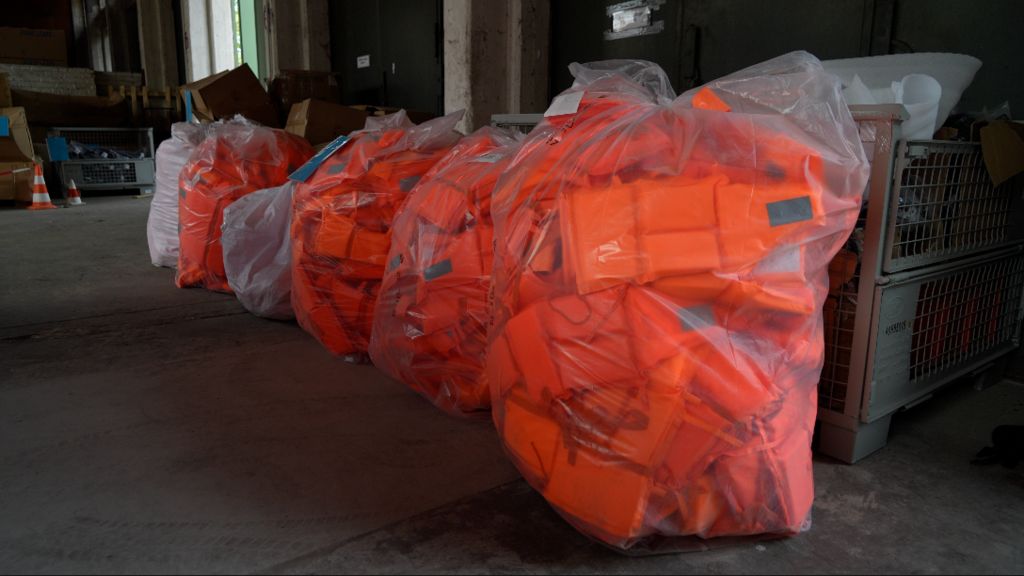
The joint operation, carried out in spring this year in North Rhine-Westphalia with coordination from UK and French law enforcement, resulted in one of the largest seizures of smuggling equipment to date: more than 9,000 substandard life jackets, dozens of inflatable dinghies, boat engines, and 360 inflation pumps. Law enforcement has stored all seized contraband at an undisclosed secure location, where the BBC was granted exclusive access to document the haul.
According to estimates from the UK’s National Crime Agency, the seized dinghies and gear would have been enough to smuggle more than 2,000 migrants across the Channel illegally, carrying an average of 65 people per vessel. This aligns with the recent trend of rising passenger numbers per dinghy, falling just below the size of the ‘mega dinghies’ detected in summer crossings this year.
The new German anti-smuggling law, passed in December 2024, closes a critical legal gap that existed after Brexit. Prior to the legislation, German anti-smuggling statutes only applied to illegal movement between EU Schengen Area member states, and did not cover smuggling operations targeting the UK, a non-EU third country. Previously, German raids on smuggling networks had to rely on arrest warrants issued by French or Belgian authorities, creating delays and legal barriers to enforcement. The legislation was finalized after a 2024 BBC investigation exposed Germany’s central role in the transnational supply chain for small boat crossing equipment, prompting a bilateral agreement between London and Berlin to tighten cross-border rules.
On inspection at the secret storage facility, the BBC found the haul largely preserved as it was discovered: deflated 9-meter dinghies packed tightly into cardboard boxes, and thousands of bright orange life jackets bundled in plastic wrapping. Experts note the life jackets are dangerously inadequate for the Channel’s rough, unpredictable waters, stuffed only with low-quality poly-foam that provides almost no buoyancy. Many of the life jackets bear Chinese manufacturing markings, consistent with longstanding law enforcement intelligence that most smuggling equipment is produced in China before being shipped to Europe via Turkey, then routed through the EU to smuggling hubs. In a recent separate seizure, Bulgarian customs officials uncovered 20 undeclared inflatable dinghies hidden between mattress pads on a truck bound for Germany at the Turkish-Bulgarian land border, the primary entry point for this contraband into the EU.
Western Germany has emerged as a key storage hub for smuggling networks for multiple reasons, investigators say. UK and German law enforcement assess that Kurdish criminal organizations hold dominant control over the small boat trade in the region, with many gang leaders and members already resident in Germany. Geographically, western Germany offers an ideal base: it is close enough to northern France’s launch beaches to transport equipment quickly, but far enough from the heavily patrolled French coastline to avoid routine detection. Gangs typically store dinghies and gear in private garages or commercial warehouses before moving the equipment north to France for launch.
Oxford University’s Migration Observatory says the trend toward larger dinghies carrying more passengers is a direct adaptation by smuggling gangs to increased cross-border enforcement. When supply lines for equipment are disrupted, gangs do not abandon their profitable operations—instead, they maximize profit by packing more migrants into each available vessel, the research body notes.
Despite the historic raid, legal experts warn that the amended German law remains largely untested. Bernhard Schmeilzl, a lawyer specializing in UK-German cross-border law, notes that the legal framework is still similar to the pre-Brexit era, and that overstretched German law enforcement agencies often prioritize domestic criminal operations over transnational smuggling cases. Even so, he says the new law creates a critical change: it explicitly grants German police the authority to investigate and prosecute these smugglers, requiring agencies to open inquiries when notified of suspicious activity.
Multiple enforcement and migration sources told the BBC that smuggling networks are facing growing pressure across Europe, including in Germany. Overall, Channel crossing numbers are on track to fall this year, with the UK Home Office reporting a 43% drop in crossings between January 1 and August 8 compared to the same period in 2024. The Home Office attributes the decline to coordinated international action to disrupt smuggling supply chains and increased law enforcement patrolling on French beaches. However, UK opposition politicians argue the drop is primarily due to unfavorable, rough sea conditions in the Channel this year, not government policy.
Germany’s Interior Ministry confirmed that the spring raid was the first enforcement action carried out under the new anti-smuggling law, but declined to comment on whether the legislation has been used in additional operations since the spring seizure.