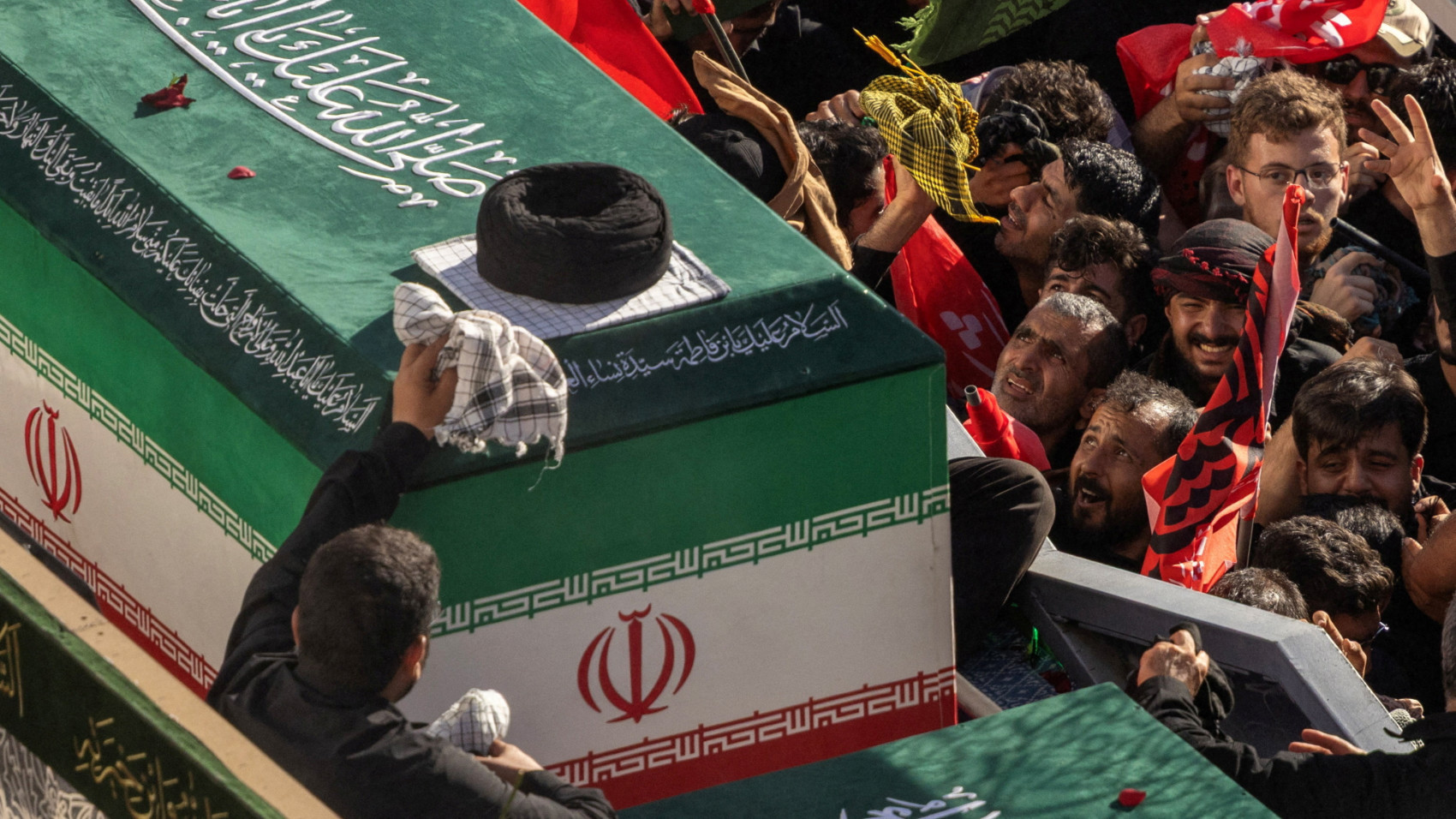
Five months after Iran’s long-serving supreme leader Ayatollah Ali Khamenei was killed in a US-Israeli airstrike in February, the 86-year-old leader who steered Iran’s politics for more than three decades was laid to rest on July 9, following a week of multi-city funeral processions that stretched across Iran and southern Iraq. His son, 56-year-old Mojtaba Khamenei, has since taken over the role of supreme leader. State media reports estimate millions of Iranians turned out for official mourning events, but beyond the public displays of grief, the week-long ceremonies laid bare underreported tensions, internal power negotiations and carefully coded political messaging that observers have since dissected to understand Iran’s shifting post-Khamenei political landscape. Middle East Eye’s on-the-ground analysis highlights the most telling of these underreported moments.
On the opening day of the procession, as foreign diplomatic delegations filed past Khamenei’s open casket, Quranic verses were recited at each stage of the ceremony — but the verse selected for the Saudi Arabian delegation sparked immediate debate among political observers. Organizers chose Verse 13 of Surah Al Imran, a passage that references the Battle of Badr, the first major military clash between the Prophet Muhammad’s outnumbered followers and the Meccan Quraysh, in which Muslim forces secured an unlikely victory against overwhelming odds. The verse reads: “Indeed, there was a sign for you in the two groups that met in battle: one group fighting in the cause of Allah and the other disbelieving. They saw them with their own eyes as twice their number. And Allah supports with His victory whom He wills. Surely in this is a lesson for those who have insight.”
A senior anonymous political source told Middle East Eye that sitting Iranian government officials criticized what they called the “deliberate, unapproved selection” of the verse, noting the choice was orchestrated by the hard-line Islamic Ideology Dissemination Organisation. The incident also drew backlash on Iranian domestic social media, with one reformist politician telling MEE that directing a thinly veiled political warning at invited foreign diplomatic guests was inappropriate, and that hospitality and respect should have taken priority over implicit political messaging.
Another notable incident unfolded involving Hassan Khomeini, grandson of Ayatollah Ruhollah Khomeini, founder of the Islamic Republic of Iran, who had long been named as a potential candidate for the supreme leadership before Mojtaba Khamenei’s appointment. Khomeini joined other members of his family for the opening funeral service to pay tribute to the late leader, but left the ceremony early just as Verse 95 of Surah An-Nisa was recited. The passage contrasts believers who avoid fighting for religious causes without just cause with those who strive in Allah’s name, granting the latter higher spiritual status and greater reward. An anonymous source close to Khomeini confirmed he was deeply uncomfortable with the targeted recitation, which was widely interpreted as a rebuke of his rumoured leadership ambitions, though Khomeini and his brothers later joined the funeral ceremonies in the holy cities of Mashhad and Qom.
Since Mojtaba Khamenei’s appointment to the supreme leadership in early March, persistent rumours have circulated that he was seriously wounded in the same February airstrike that killed his father, fueling questions about his fitness to rule. To counter these claims, Khamenei’s three other sons — Mostafa, Masoud and Meysam — made high-profile public appearances at nearly all major funeral events, all appearing in full health with no visible injuries or scars. The intentional display was widely read as a calculated signal to both the Iranian public and the international community that Mojtaba was alive, healthy and fit to govern. A senior Iranian source confirmed to MEE that while Mojtaba did sustain minor injuries to his feet and minor facial scarring in the strike, his injuries are healing well and the reports of his poor condition have been wildly exaggerated.
Mostafa Khamenei, the eldest son of the late leader, took on an unusually high public profile during the ceremonies, even leading the funeral prayer ahead of Ayatollah Ali Khamenei’s burial at the shrine of Imam Reza in Mashhad and joining events in Iraq. During the Iraqi processions, he held a high-profile meeting with the sons of Grand Ayatollah Ali al-Sistani, Iraq’s most senior Shia cleric, a moment that has fueled new speculation that Mostafa may take on a greater political role in the coming years. A senior Iranian cleric told MEE that Mostafa is a highly trained scholar who studied for decades at Qom’s prestigious seminaries, but chose to stay out of public politics during his father’s lifetime, as he held little personal interest in holding public office.
Grand Ayatollah Abdollah Javadi Amoli, one of Iran’s most senior and respected clerical figures, also drew widespread attention for his unusual remarks during the Qom funeral prayer. Rather than sticking to the customary, restrained language reserved for deceased supreme leaders, Javadi Amoli used far more elevated spiritual language to describe Khamenei. A cleric familiar with the remarks told MEE that the framing was intentional: Javadi Amoli was not only stating he had only seen good in Khamenei’s leadership, but was publicly declaring the late leader a martyr who had attained a higher spiritual status in the eyes of God after dying in the strike.
The public appearance of Ali Asghar Hejazi, widely considered the second-most powerful figure in the late supreme leader’s office, also drew significant attention, after prior reports claimed he had been killed or seriously wounded in the same February airstrike. Hejazi appeared in full good health, a choice that observers say was designed to counter rampant speculation of deep internal divisions following the leadership succession. After Mojtaba’s appointment, rumours circulated that Hejazi had backed other candidates for supreme leader and did not have a close working relationship with the new leader. Mohammad Reza Bahonar, a member of Iran’s Expediency Council, told local media that shortly after the late leader’s death, Hejazi addressed the Assembly of Experts to clarify Khamenei’s stance on succession, stating: “The late Imam never held any negative view toward Mr Mojtaba, but he emphasized that, according to both law and Islamic jurisprudence, the supreme leader does not choose his own successor. This is the religious and legal responsibility of the Assembly of Experts.” A source told MEE that while Mojtaba has offered Hejazi a new senior role in his administration, Hejazi has declined the position, saying he plans to step back after decades of public service.
Finally, the funeral events exposed open hostility toward Iran’s moderate political leadership from hard-line principlist supporters. Parliament Speaker Mohammad Bagher Ghalibaf, Foreign Minister Abbas Araghchi and President Masoud Pezeshkian were all confronted by angry crowds who chanted slogans condemning the officials for their past negotiations with the United States. In one widely reported incident, Araghchi was shouted down, called a “scumbag” and had stones thrown at him by protestors during the procession.
Middle East Eye is an independent media outlet providing original, unfiltered coverage of the Middle East, North Africa and surrounding regions.