Fifteen years ago, a small act of desperation in a central Tunisian city rippled across the Arab world and reshaped modern Middle Eastern history. In Sidi Bouzid, street vendor Mohamed Bouazizi doused himself in gasoline and lit himself ablaze, after corrupt local officials repeatedly harassed him, publicly humiliated him, and seized the only fruit cart he relied on for survival. That devastating act of protest ignited the 2011 Jasmine Revolution, which ousted Tunisia’s 23-year authoritarian ruler Zine El Abidine Ben Ali and sent a wave of uprisings across the entire Middle East and North Africa.
Today, the covered market of Sidi Bouzid hums with the same surface routines it has held for decades: traders call out their goods, haggle over prices, and restock piles of citrus and leafy greens, while customers pick through produce slowly, calculating every dinar spent as rampant inflation pushes basic food out of reach for many. On the surface, life looks unremarkable. But dig beneath that routine, and residents are quick to say the city’s mood has shifted dramatically – and not for the reasons many might expect. Tunisia’s crippling economic crisis has not softened, and public trust in national politics remains as broken as it has been for years. Instead, the change traces to a conflict more than 2,000 kilometers away: Israel’s ongoing military campaign in Gaza.
For countless residents of Sidi Bouzid, solidarity with the Palestinian people has become deeply intertwined with their own simmering anger over deepening poverty and a political system that has left ordinary people completely disenfranchised. Most surprisingly of all, the conflict has done what few political analysts would have predicted: after years of fading public political discourse, drained by widespread apathy and President Kais Saied’s growing authoritarian consolidation of power, the crisis in Gaza has given Tunisians a renewed reason to speak openly about their grievances.
“Our leaders betrayed us,” Wajdi, a fruit seller working in the same market where Bouazizi once traded, told Middle East Eye. “What have any Muslim leaders done for Palestine? Nothing. Absolutely nothing. We hear every day that Tunisia stands with Palestine, but what has our government actually done to back that up? All the president does is talk. He had every opportunity to take practical steps, to push for change internationally, to pressure other governments that back Israel, but instead we’ve seen nothing. We’re tired of his empty words.”
For Wajdi and dozens of other Tunisians interviewed by MEE across Sidi Bouzid, Gaza has emerged as a sharp new political flashpoint that cuts directly into long-simmering domestic tensions. It has become a stark measure of the growing gap between the Tunisian government’s rhetorical commitments and its actual inaction, reopening public political conversations that had gone mostly silent since July 2021. That was when Saied suspended the elected parliament, sacked the sitting prime minister, seized unilateral prosecutorial authority, and invoked a national emergency – a move widely labeled a coup by international human rights groups and Tunisian political opposition leaders.
When Saied first consolidated power, many residents of Sidi Bouzid welcomed the move, hopeful that a strong, centralized presidency would break the years of crippling political deadlock that had paralyzed the country in the decade after the revolution. But as economic hardship deepened year after year, most Tunisians lost all faith that political change could improve their daily lives. Voter turnout plummeted to historic lows in subsequent elections, public political debate faded from public spaces, and conversations between friends and neighbors increasingly centered solely on how to make ends meet.
Fifteen years after it set off a regional revolution, Sidi Bouzid remains one of Tunisia’s poorest governorates. Promised investments from the government and international donors never materialized, unemployment remains stuck at stubbornly high rates, and for most young people, dangerous irregular emigration across the Mediterranean, not domestic political reform, is seen as the only viable path to a better future. With inflation running in double digits, turning routine grocery shopping into a careful calculation of limited funds, traders report that customers who once bought enough produce to last a week now only buy what they can eat over a couple of days. “Everyone has become poorer,” Wajdi said, as he watched shoppers move slowly between his and neighboring stalls.
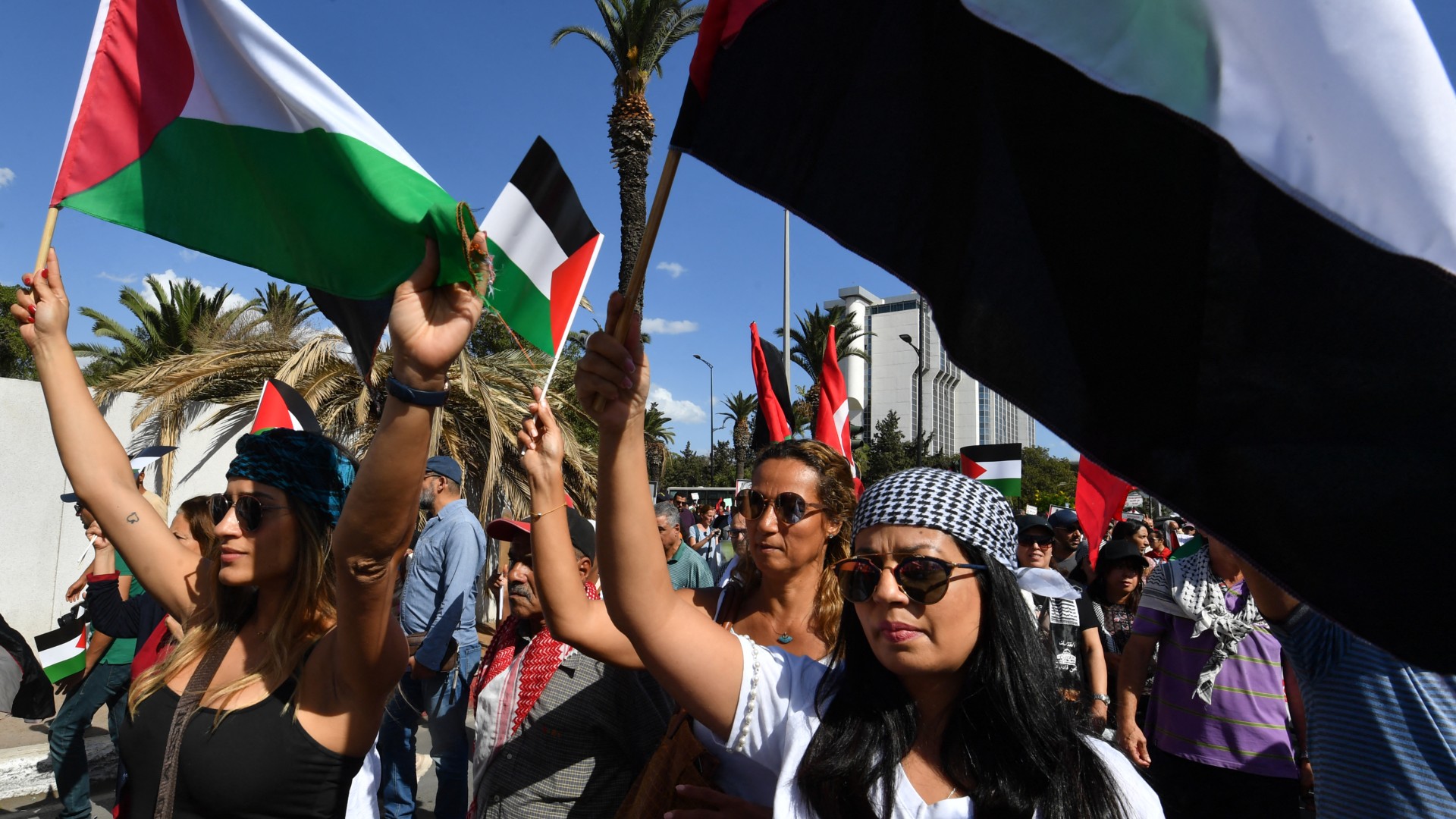
When Israel launched its large-scale military campaign in Gaza after the October 7 attacks by Hamas, mass demonstrations in solidarity with Palestinians spread rapidly across Tunisia. Tens of thousands of protesters took to the streets of the capital Tunis and other major cities, and Sidi Bouzid once again saw residents gathering in public around a shared political cause. Palestinian flags appeared across the city in unprecedented numbers, and marches drew crowds of people who had not joined any public demonstration in years. For many residents, these demonstrations became one of the only spaces where they once again felt comfortable sharing political opinions openly, after years of self-censorship and shrinking space for public debate.
But as the Palestinian death toll in Gaza climbed into the tens of thousands, many Tunisians began asking why their government’s support for Palestine stopped at rhetorical condemnation. While Saied has repeatedly issued public statements condemning Israeli actions, residents say they have seen little effort to turn that rhetoric into meaningful diplomatic action or regional leadership on the issue.
“I don’t think Tunisia has done anything meaningful at all,” said Oumaima, a 26-year-old housewife from Sidi Bouzid. “We haven’t seen serious diplomatic efforts or attempts to build a united international coalition to pressure Israel. Why wasn’t Tunisia leading efforts at the International Criminal Court or working to bring all African countries together around a common position against what’s happening?” Oumaima pointed instead to South Africa, which filed a landmark case accusing Israel of genocide at the International Court of Justice that won widespread acclaim and support across the Global South. “Other countries stepped forward while Tunisia, despite all its statements about supporting Palestine, stayed on the sidelines,” she said. “I expected much more from our government.”
Dozens of residents echoed that frustration, arguing that the government’s response to the crisis has been defined far more by empty rhetoric than tangible action. They question why Tunisia has not worked to rally African governments around a unified stance or pursued legal avenues against Israel at international bodies, while other middle-income and developing states have pushed the issue onto the global agenda. That contradiction feels even starker when looking at domestic policy, they say.
While Tunisian officials regularly frame the country as an unwavering supporter of Palestinian statehood and Palestinian rights, authorities have launched a widespread crackdown on independent pro-Palestinian activists, including organizers involved in the Global Sumud Flotilla campaign that aimed to break Israel’s blockade of Gaza. The wave of arrests has fueled accusations that the Saied regime is seeking to monopolize solidarity with Gaza, only allowing pro-Palestinian expression that stays within state-approved boundaries, while treating independent grassroots activism as a direct political threat.
“The regime displays hyper-sensitivity towards any street mobilisation, even when protesters raise officially endorsed slogans like supporting Palestine,” Khalil Lahbibi, a Tunisian activist involved with the Global Sumud Flotilla, told MEE. “It refuses to allow the public to organize independently or outside official, directed mobilization frameworks. Because young activists and civil society organisations have the capacity to mobilize and shape public opinion, the regime treats them as direct political threats and potential rivals. Saied is seeking to strike down the very idea of independent collective action.”
Mohammed, a 22-year-old unemployed high school graduate in Sidi Bouzid, questioned why Tunisia has largely confined itself to verbal condemnation, rather than leading any meaningful regional or international campaigns against Israel’s actions. “The government says it supports Palestine, but its actions tell a completely different story,” he said. “It has arrested activists – people who were actually trying to show solidarity with Palestinians. How can you claim to defend Palestine while criminalizing those who are standing up for it? That’s a betrayal of the cause.”
Mohammed added that Saied’s speeches condemning Israel now carry almost no weight without concrete political action to back them up. “If he was truly serious, he would have worked with Algeria, Libya and other African countries to find ways of stopping weapons from reaching Israel, whether by sea or by air,” he said. “Instead, we’ve only heard words while Gaza continues to suffer.”
It remains unclear whether the public anger sparked by the Gaza war will mark the beginning of a broader political reawakening across Tunisia. Years of economic hardship, political repression, and broken promises have left most residents of Sidi Bouzid wary of predicting another mass uprising like the one that began here in 2010. Few speak openly of repeating that revolution today. But what is certain, they say, is the blanket silence that settled over the city’s public life in recent years has been broken.
“The people will no longer be silent,” Mohammed said. “This government hasn’t done anything for Palestine or any Muslim causes. They now either need to step aside or step up, because the people have had enough. We will not back down.”