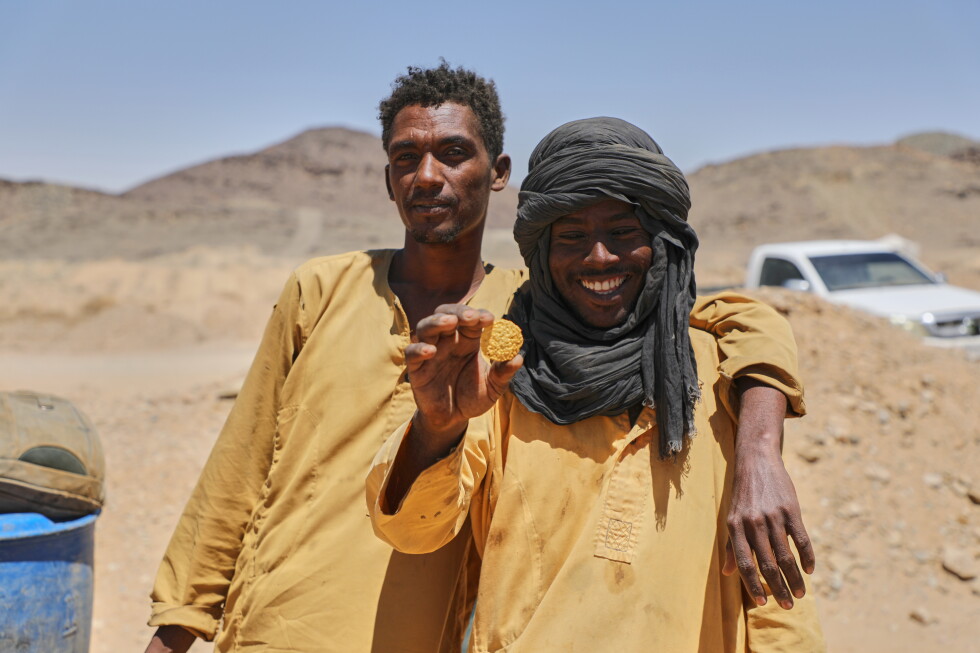
Perched across the arid, mountainous terrain of northern Sudan’s Dalgo Mahas, a small crew of artisanal gold miners moves slowly across the landscape. Each man carries a handheld metal detector, sweeping the dry earth for traces of the precious metal that has come to define their nation’s tragedy. One kneels, driving a simple digging tool into the dirt, working without hard hats, respiratory protection, or any of the most basic safety protocols that govern formal mining operations around the globe.
These unregulated small-scale miners are just a tiny fraction of the tens of thousands of Sudanese who have turned to informal gold extraction in recent years, a sector that has become both a lifeline for desperate families and the core driver of the devastating civil war that has pushed millions to the brink of famine.
Sudan’s reliance on gold traces back to 2011, when the secession of South Sudan stripped the country of more than two-thirds of its historic oil revenues. Overnight, the nation’s economy was left reeling, and gold quickly emerged as the replacement backbone of government finances. In the years following South Sudan’s independence, gold exports accounted for 70% of Sudan’s total national revenue, supplying the cash-strapped state with critical foreign currency to keep basic operations running.
But today, that same gold wealth is funding the brutal ongoing conflict between Sudan’s regular military and the paramilitary Rapid Support Forces (RSF), according to independent United Nations expert investigators commissioned to track war financing. The RSF, which maintains tight control over major gold-producing regions across Darfur and Kordofan, has overseen the smuggling of massive volumes of unregulated gold out of Sudan to fund its military operations, the experts confirm.
The human cost of the conflict has already been catastrophic. U.S.-based conflict monitoring organization the Armed Conflict Location & Event Data Project estimates that at least 59,000 people have been killed since the war began, though the group stresses this count is almost certainly a major undercount, given widespread restrictions on on-the-ground reporting and access to conflict zones. The war has also spawned the world’s largest humanitarian disaster, forcing more than 10 million Sudanese to flee their homes to escape violence. For many of these displaced people, artisanal gold mining has become the only viable way to put food on the table for their families.
“Gold mining is the only thing I can rely on,” explained 28-year-old Atta al-Khazin, who abandoned his career as a small-scale farmer when rising global oil prices made agricultural inputs too expensive to turn a profit.
Zahir Adam, a 35-year-old father from el-Fasher in Darfur who has worked in gold mining for more than a decade, said the sector has seen a massive influx of new workers since the war erupted three years ago. “They had no other option,” he said. “Many young people, and many families, depend on mining.”
Official industry figures confirm Sudan’s gold production is growing, even as its war rages. The country produced 70 tons of gold in 2025, up from 64 tons in 2024, cementing its position as one of the top gold-producing nations in Africa. State-run Sudanese Mineral Resources Company data shows the sector generated roughly $1.8 billion in revenue for 2025.
More than half of this production comes from informal, artisanal small-scale mines that operate almost entirely outside government oversight, with almost no adherence to global safety or environmental standards. The extraction process used by most informal miners carries major health risks for workers and nearby communities: after digging ore from the ground, miners crush the rock, then mix it with toxic mercury to bind gold particles into an amalgam. The mixture is then heated over an open stove to evaporate the mercury, leaving pure gold behind. The process releases dangerous mercury vapor into the air and leaches toxic waste into local water supplies, creating long-term public health risks that extend far beyond the mines themselves.
The U.N. expert panel’s 2024 report found that more than 50% of all gold mined in Sudan never enters formal, regulated trade channels, and is instead smuggled across borders to illicit markets in neighboring countries.
Lethal safety failures are also routine in the unregulated sector. Just last month, a mine collapse in Sudan’s Red Sea Province killed at least seven miners. Another collapse in South Kordofan Province in January claimed 13 lives.
Efforts to bring the critical sector under government oversight have repeatedly fallen apart amid political upheaval. After the military ousted longtime dictator Omar al-Bashir in April 2019, a civilian-led transitional government that ruled for more than a year launched an initiative to regulate informal gold mining and crack down on smuggling. Those reform efforts were cut short by a military coup in October 2021, which paved the way for the full-scale civil war that broke out in 2023, leaving the gold sector more unregulated and conflict-fueled than ever before.