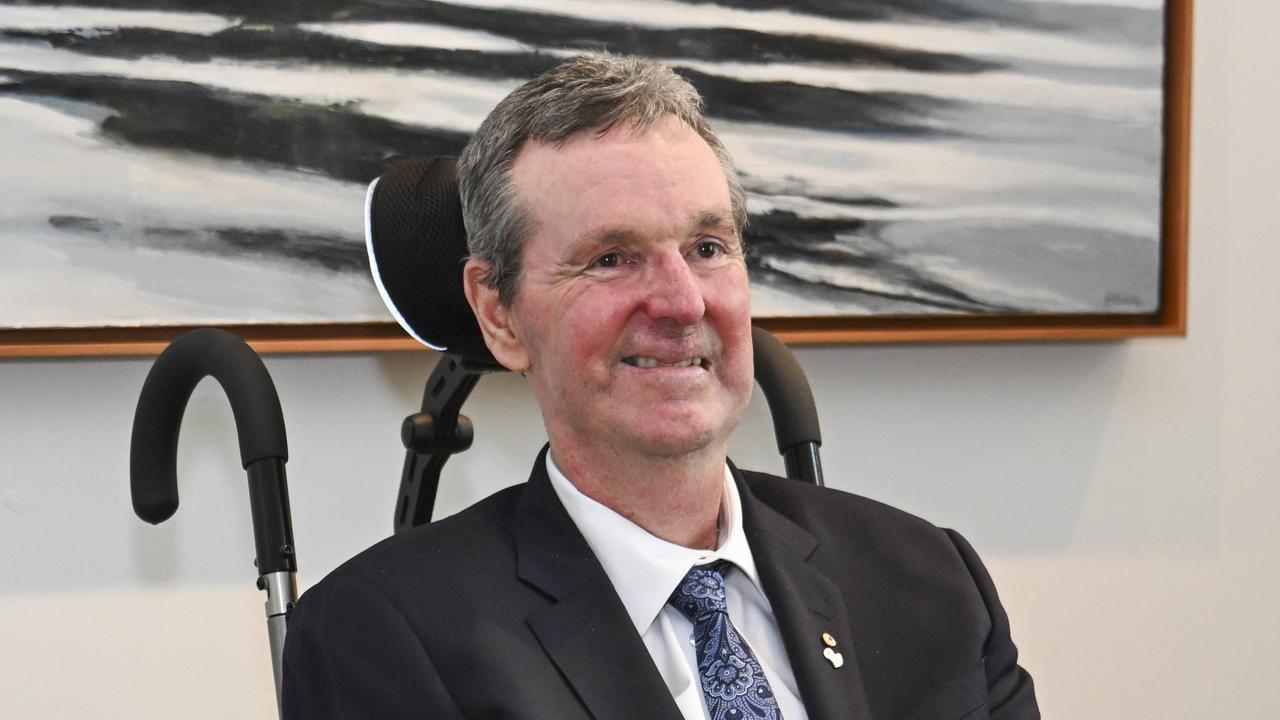
Australian Rules Football icon and one of the nation’s most inspirational public figures Neale Daniher has passed away at 65, bringing a close to a 13-year public battle against motor neurone disease (MND). He died surrounded by his immediate family, leaving behind a transformative legacy of courage, fundraising and advocacy that has changed the global fight against the devastating neurodegenerative condition.
In a public statement released Monday afternoon, the Daniher family paid tribute to the man they described as the unshakable heart of their clan. “From day one, Neale was a fighter. His determination was unmatched – choosing every day to find opportunity where others might see only challenge, and taking the fight to the Beast with everything he had,” the statement read.
Even as his illness progressed through its most debilitating stages, Daniher never lost his signature playful charm and sharp wit. “Even in the toughest times, he kept pushing forward, determined to land as many blows as he could against his toughest opponent, all with a cheeky grin and a sharp sense of humour that never left him,” the family shared.
Raised as one of 11 children, Daniher built a reputation for bringing light and connection to every room he entered long before his MND diagnosis. He first made his mark on Australian sport as a fierce, strategically brilliant player for the Essendon Football Club, before transitioning to a legendary coaching career with the Melbourne Football Club, where fans affectionately nicknamed him “Coach” and “Reverend.” Across every stage of his life, he drew people in as a natural leader, beloved far beyond his titles as a husband, father, proud grandfather, music lover, and the person with the loudest laugh in any gathering.
Daniher’s activism against MND began after his own diagnosis in 2012, when he launched the “Beat The Beast” campaign that evolved into the national FightMND movement and the iconic annual Big Freeze match held at the Melbourne Cricket Ground (MCG). Over 13 years, his work raised more than $100 million for MND research globally. This year’s Big Freeze match, scheduled to take place in just a few weeks, will mark the first edition of the event held without Daniher present.
In 2025, Daniher’s extraordinary contributions to public life were recognized when he was named Australian of the Year, an honor that Prime Minister Anthony Albanese noted was met with unanimous national approval. He left a simple, powerful legacy for current and future MND fighters: “No matter the odds, no matter the diagnosis, we all have the power to fight, to smile, and to do. Because the mark of a person isn’t what they say, it’s what they do.” The family closed their statement with Daniher’s iconic catchcry: “Play On.”
AFL chief executive Andrew Dillon described Daniher’s passing as a devastating loss for the entire Australian football community. Beyond his on-field achievements, which included leading Melbourne to six finals series and a 2000 Grand Final appearance, Dillon emphasized that Daniher’s greatest impact came from his selfless advocacy.
“His contribution to wider Australian life was simply incredible in the way he put himself at the forefront, despite the challenge of his own MND diagnosis, to raise awareness of the disease, champion fundraising efforts and search for a cure that he knew would likely not help him, but may help many thousands of other Australians in the future,” Dillon said.
Melbourne Football Club President Steven Smith echoed that sentiment, noting that Daniher’s courage extended far beyond the boundaries of the football pitch. “It is impossible to encapsulate in words the impact of Neale Daniher. His courage transcended the football field, and his determination inspired an entire country,” Smith said. “Neale was not driven by personal motivation, he was driven by helping others, right until the very end. He was a true leader and the definition of what it means to be selfless.”
Prime Minister Albanese joined tributes, calling Daniher one of Australia’s greatest modern figures. “The devastating impacts of MND stole so much from Neale, but he held onto everything that people loved and admired about him: his selflessness, his bravery, his humour, his ability to look on the bright side and his fierce determination to make a difference for others,” Albanese said. “Neale Daniher’s remarkable legacy lives all around us.”
Daniher’s death comes just days after 30-year-old NRL star Jai Arrow revealed his own MND diagnosis and immediate retirement from professional sport, a revelation that cast renewed national attention on the condition.
The Florey Institute of Neuroscience and Mental Health, a leading Australian medical research institution that has received $17.5 million in funding from FightMND, called Daniher an extraordinary force for the global fight against MND. “Through his powerful advocacy work, Neale helped to raise millions of dollars for researchers in Australia and around the world working to find a cure for MND,” the institute said in a statement.
Executive Director Professor Peter van Wijngaarden noted that Daniher turned a personal battle into a global movement that continues to accelerate research. “Even in his own battle with MND, Neale was fighting for everyone who would come after him,” van Wijngaarden said. “We will forever be grateful to him and FightMND for putting this disease in the spotlight, inspiring so many and supporting vital research at The Florey and across the globe.”