Four years after Salvadoran President Nayib Bukele launched his high-stakes war on street gangs, the Central American nation is moving forward with a sweeping, secretive mass trial process that has drawn fierce condemnation from human rights defenders over its disregard for basic due process protections. Under a nationwide state of emergency that has been in continuous effect since 2022, more than 91,000 people have been detained on alleged gang ties, and thousands of these detainees are now being judged in collective proceedings before anonymous judges in closed courts, their fates sealed in a single ruling that groups dozens of defendants together.
For many working-class Salvadoran families, the process has already become a nightmare of arbitrary justice, where innocent people face being punished alongside actual criminals. Take 35-year-old Williams Diaz, an air conditioning technician arrested by soldiers three years ago as he traveled to his job. Diaz was immediately transferred to the Terrorism Confinement Center (CECOT), Bukele’s flagship maximum-security prison built to hold suspected gang members, where more than 10,000 detainees are packed into severely overcrowded cells. Today, he waits to be tried alongside dozens of other men accused of belonging to the Barrio 18 gang, with no prior criminal conviction on his record.
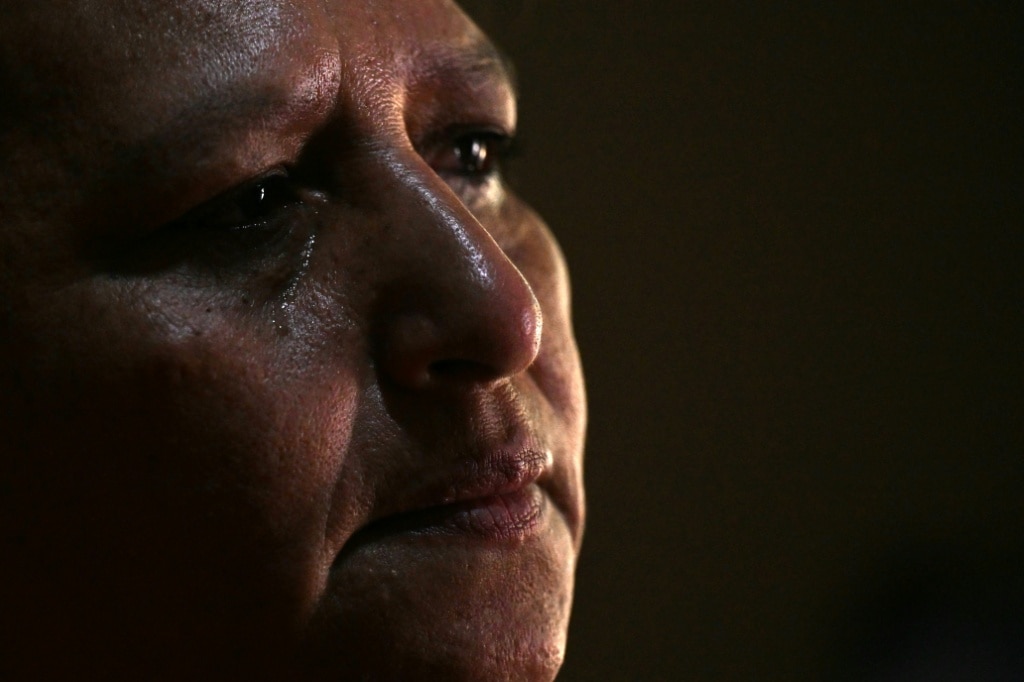
His mother, Gladis Villatoro, a tortilla vendor who lives in a modest home 12 miles east of the capital San Salvador, fears the worst. Under the collective trial system, a conviction for one defendant in the group often means convictions for all. “If they convict one, they convict the whole lot…the innocent will pay for the guilty,” she said, speaking softly to avoid distressing her 6-year-old grandson, Diaz’s son. Her anxiety has deepened in recent months after learning her son is suffering from kidney failure; she has had no update on his condition in a year, clinging only to prayers for a miracle that contradicts Bukele’s own public promise that no suspect who enters CECOT will ever leave.
A short drive from Villatoro’s home, 58-year-old baker Reynaldo Santos shares the same fear for his 24-year-old son Jonathan, a factory worker with no prior criminal record. Jonathan was arrested at home while playing the popular video game Fortnite, which law enforcement cited as evidence of gang affiliation. Though he was released pending trial, he faces arbitrary re-arrest at any moment. “It’s like Russian roulette, it’s a nightmare,” Reynaldo says of the family’s ongoing uncertainty. Jonathan, who lives with anxiety and depression, only asks for a fair chance to prove his innocence, his father adds.
Bukele’s mass incarceration policy has put roughly 1.4 percent of El Salvador’s total population behind bars without full due process, creating an unprecedented backlog that the country’s court system has struggled to clear. To address the logjam, the Attorney General’s Office launched the collective mass trial process in 2024, and pledged to finalize 3,000 indictments in the first three months of 2026. In a recent move that increased the stakes for all defendants, the Salvadoran Legislative Assembly voted to raise the maximum sentence for alleged gang members, labeled “terrorists” under government law, from 60 years to life imprisonment — a change that applies even to minors. Vice President Felix Ulloa has defended the collective trial model as an “innovative” approach to tackling El Salvador’s historic gang violence crisis, and says sentences will be adjusted to reflect a defendant’s alleged rank within a gang structure.
But human rights groups and independent legal experts warn the process is fundamentally broken, built on legal reforms that have stripped away core protections for the accused. Reforms to El Salvador’s organized crime law eliminated the requirement to assign individual criminal responsibility and scrapped preliminary hearings that are designed to weed out weak cases with insufficient evidence before they go to trial. Multiple defense attorneys, who spoke to AFP on condition of anonymity out of fear of retaliation, describe the proceedings as nothing more than a conviction factory. Before each mass trial, a co-operating imprisoned gang member with a hidden face testifies against every defendant in the group in exchange for a reduced sentence, but rarely provides any concrete evidence to back up their claims — yet their testimony is almost always enough to secure a conviction, the lawyers say. In many cases, defense attorneys are not even notified of the mass hearings or informed of the specific charges against their clients; one attorney who represented a produce vendor sentenced to 30 years in prison alongside 163 other defendants in February only got to speak to his client for one minute before the proceeding began.
Public defender offices are completely overwhelmed by the surge in cases, so many families like Villatoro and Santos have gone into deep debt to hire private attorneys rather than rely on overworked court-appointed counsel. New York-based watchdog Human Rights Watch has documented widespread patterns of arbitrary arrest, with detainees taken into custody based on nothing more than anonymous tip-offs, personal neighborhood disputes, or police officers meeting arrest quotas to earn performance bonuses. For Juan Pappier, HRW’s deputy director for the Americas, the mass trials “lack the basic guarantees of due process, which increases the risk of convicting innocent people.” Prominent Salvadoran criminal lawyer Roxana Cardona has warned that the process will turn the country’s already overcrowded prisons into “human pits.”
Bukele, who has won broad popular support at home and across Latin America for cutting El Salvador’s once sky-high gang violence rates, has repeatedly dismissed criticism from legal experts who warn his crackdown amounts to crimes against humanity, arguing that the dramatic reduction in violence justifies the extraordinary measures he has taken. AFP has reached out to the Salvadoran prosecutor’s office and national government for comment on the allegations of due process violations, but has not yet received a response. With trial proceedings sealed from public view and little information available about how the process is being carried out, families of the accused are left only with uncertainty and fear that their loved ones will pay the price for a government crackdown that targets the guilty alongside the innocent.