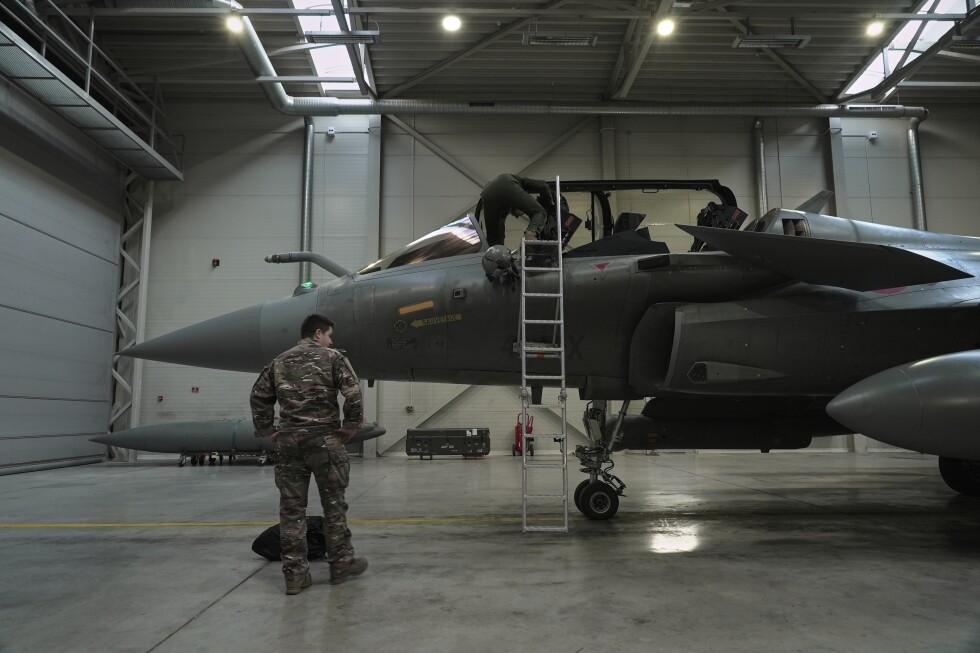
At Lithuania’s Šiauliai Air Base, the rhythm of NATO’s frontline Baltic air policing mission is defined by split-second urgency. When the alliance’s scramble alert sounds, French Rafale fighter pilots — already pre-suited to cut response times — rush in vans to prepared, missile-armed jets waiting in hardened hangars. Within minutes of lifting off from the northern European base, they are over the Baltic Sea, executing standard intercept procedures for Russian military aircraft approaching NATO alliance airspace.
On a recent busy Monday observed by an Associated Press journalist, French pilots scrambled under NATO command to intercept a coordinated Russian flight formation: two nuclear-capable Tu-22M3 supersonic bombers, which Russia has repurposed for ground strikes in Ukraine, escorted by advanced Su-30 and Su-35 fighter jets. The Russian warplanes flew a more than four-hour mission from a base near St. Petersburg, passing the coastlines of five NATO nations — Finland, Estonia, Latvia, Lithuania and Poland — before turning back near Danish airspace. According to the French detachment, the Russian aircraft never activated their transponders, filed required flight plans, or maintained radio contact with civilian air traffic controllers. Fighters from Sweden, Finland, Poland, Denmark and Romania also launched to monitor the incursion, a multilateral show of coordinated airspace security.
This high-alert cat-and-mouse game plays out hundreds of times a year, hundreds of miles from public view, as NATO seeks to avoid an accidental escalation that could pull the 32-nation alliance into open conflict with Russia amid tensions over Moscow’s full-scale invasion of Ukraine. In intercepts like this, neither side crosses into open hostility: pilots from both forces simply monitor and document one another, maintaining a cautious distance even as armed missiles remain visible on jet hardpoints. As mission commanders describe it, the dynamic is less cat and mouse than two wary cats, claws bared but holding back from a fight.
The Baltic states of Estonia, Latvia, and Lithuania — all NATO members that share borders with Russia and its ally Belarus — lack the independent air power to defend their own airspace. Since 2004, when the three countries joined the alliance, NATO has rotated national detachments through Baltic bases to maintain 24/7, year-round air policing, a mission designed to deter aggression rather than provoke conflict, and reassure frontline allies of the alliance’s collective security commitment.
Currently, the Šiauliai base hosts two detachments: a four-jet French Rafale wing, commanded by Lt. Col. Alexandre — whose full surname is withheld for security reasons — and a six F-16 contingent from the Romanian Air Force. The French detachment took over the mission from Spanish forces earlier this spring, and will hand off to an Italian unit when their four-month rotation ends in August. A wall inside the base’s temporary headquarters bears plaques and badges from every rotating detachment that has served at the base, a quiet record of the mission’s continuity.
Col. Mihaita Marin, commander of the Romanian detachment, explained that NATO forces are required to scramble whenever Russian military aircraft violate International Civil Aviation Organization (ICAO) rules for international airspace — rules that govern transponder use, flight planning, and radio communication. “There are plenty of times in which, on purpose or not, they’re not really respecting the ICAO rules,” Marin said. “So obviously we are forced to take off and just make sure that they are who they say they are and their intention is peaceful.”
The arrival of spring, which brings milder temperatures and clearer flying conditions across the Baltic region, has pushed interception rates higher. Since French and Romanian forces deployed for their rotation in early April, interceptions have become nearly a daily occurrence, a rate commanders expect to climb further as weather improves. Lt. Col. Alexandre noted that it remains unclear why Russian pilots repeatedly operate in violation of global airspace rules. “We don’t know if it’s lack of professionalism or just a means for them to test us,” he said. “But what is sure is that we need to go every time. We cannot say, ‘OK, that’s usual, this time we will just let them pass.’”
Across the tense standoff, the core goal of the NATO mission remains consistent: to maintain constant vigilance without triggering the open war both sides currently seek to avoid. “We watch each other, scrutinize each other and try to make sure that it doesn’t go any further,” Alexandre said.