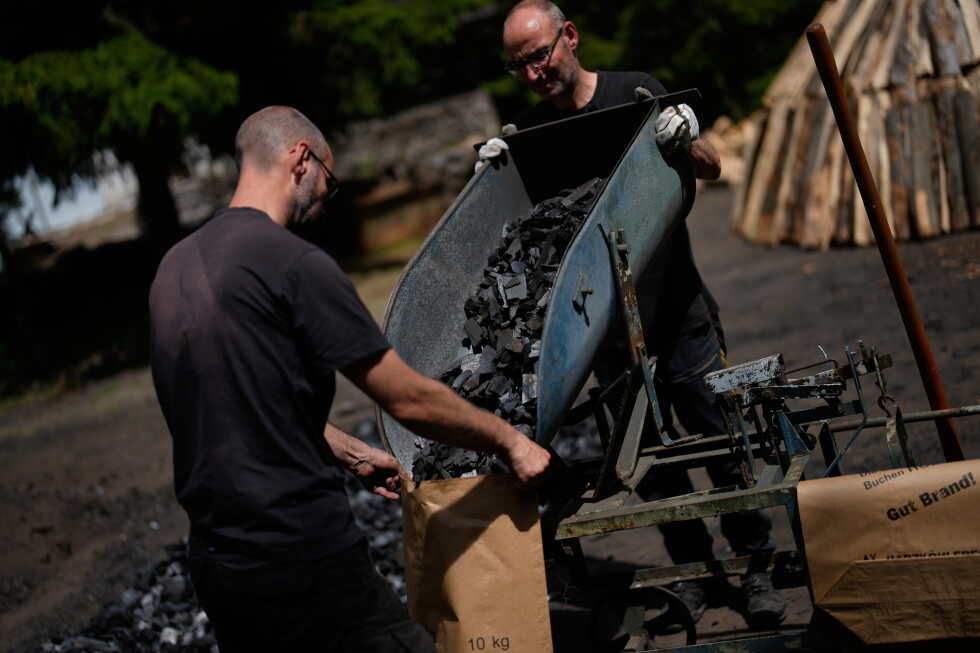
Nestled deep in the wooded landscapes of Germany’s Harz Mountains near the quiet town of Hasselfelde, a millennia-old craft is being kept alive by one family, who tend to smoldering earthen mounds to produce traditional charcoal the same way their ancestors did centuries ago.
Immo Feldmer, one of the stewards of this historic trade, recently walked AP through the time-honored process as he initiated a new batch by carefully tipping smoldering charcoal into a carefully constructed mound of earth. Inside this mound, tightly stacked high-density beech wood will slowly smolder for weeks, slowly transforming into high-quality charcoal through a method that has remained largely unchanged for more than 1,000 years in this region.
Feldmer and his brother Sascha inherited the family business, Harzköhlerei Stemberghaus, from their father, and they employ a small team of workers to maintain constant watch over the smoldering mounds around the clock. This 24/7 vigil is critical: too much oxygen can spark an open flame that reduces the entire load of wood to useless ash, ruining weeks of patient work. Once the mound is sealed with earth, controlled airflow through intentional vents lets the beech burn slowly from top to bottom. When the carbonization process is complete, workers clear any soil from the finished charcoal, let it cool fully, then package it into 22-pound bags for commercial sale.
Historically, charcoal production was the backbone of the Harz region’s dominant mining industry. For centuries, local miners relied on charcoal to generate the extreme, consistent heat required to smelt silver, lead, copper, and zinc extracted from the region’s hard rock deposits. At the peak of the trade, hundreds of local families made their entire living as charcoal burners, the craft woven into the cultural and economic fabric of the mountain region.
Today, commercial ore mining has ended in the Harz Mountains, and the ancient craft has all but disappeared across Germany, with only a handful of practicing charcoal burners remaining. Unlike their ancestors, the Feldmers now sell nearly all of their product to domestic consumers for backyard barbecuing. The brothers distinguish their product from mass-market alternatives: Feldmer notes that most charcoal sold in German hardware stores is imported, produced from cheap blends of mixed wood, scrap lumber, and industrial waste wood to cut production costs. Their charcoal, by contrast, is made entirely from local, pure beech wood, which delivers higher heat output ideal for grilling.
Even with this niche market, annual production of roughly 40 tons of charcoal is not enough to support the brothers on its own. To supplement their income and share the history of their craft with visitors, they have expanded their business to include a charcoal-burning history museum, a small retail shop, and a casual restaurant. The eatery serves local regional specialties, including steaks grilled over the family’s own handmade beech charcoal, drawing tourists interested in traditional culture and culinary experiences.
Despite the challenges facing the ancient trade, Feldmer remains optimistic that the tradition will outlive his generation. He says the family’s core hope is that their children will carry on the business, keeping the craft alive for future generations and preserving this piece of Harz Mountain cultural heritage.