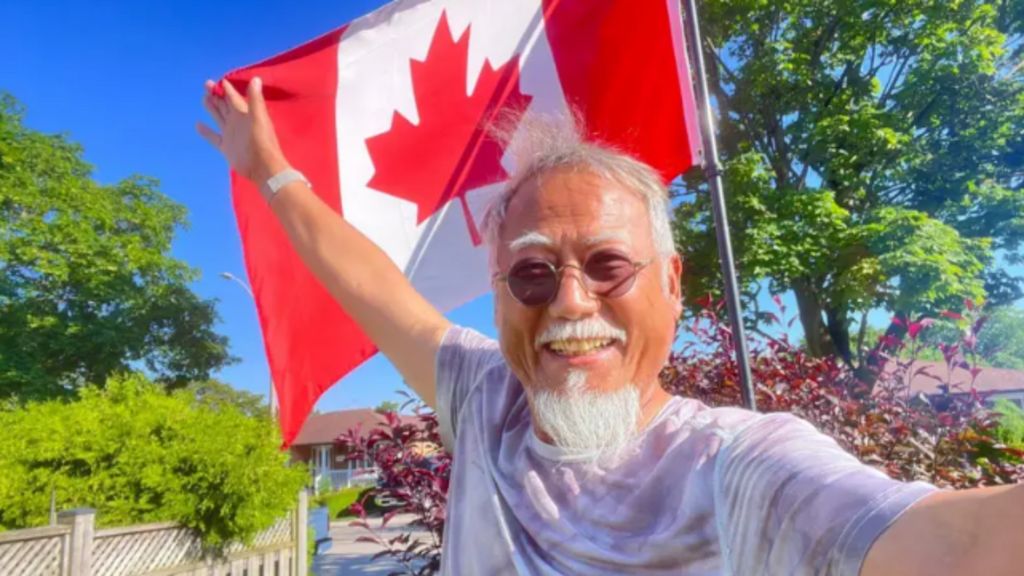
After years of repeated detention and four foiled escape attempts that sent him back to Chinese custody each time, 68-year-old former police officer turned activist Dong Guangping has finally reached safety, completing a harrowing 40-hour open-sea journey from eastern China to resettle in Canada with his long-relocated family.
Dong’s decades-long clash with Chinese authorities began in 1999, when he was dismissed from his 13-year career with the Chinese police force after adding his signature to a public petition marking the 10th anniversary of the 1989 Tiananmen Square pro-democracy protests. That first professional penalty was followed by multiple prison sentences: a three-year term starting in 2001 on charges of “inciting subversion of state power”, and another jail stint in 2014 for taking part in another commemoration of the 1989 events, according to human rights organization Amnesty International.
Over the past eight years alone, Dong tried and failed to leave China four times. In 2015, he and his family reached Bangkok, where the United Nations granted them refugee status and approved their resettlement to Canada. But just days before their scheduled departure, Thai authorities deported Dong back to China, where he received a three-and-a-half-year prison sentence for “inciting subversion” and “illegal border crossing”. After his 2019 release, he tried to swim to the Taiwan-held island of Kinmen, only to be picked up by Chinese fishermen who returned him to authorities, who then imposed an exit ban on him. In 2020, he slipped into Vietnam and hid in Hanoi for two years before being deported back to China, where he served another year-long prison term, and was released again in 2023.
Each failed attempt only hardened Dong’s resolve to reach the free world. For his fifth attempt, he planned a risky open-sea crossing: a 300-kilometer journey across the Yellow Sea, originally intended for Japan before poor weather forced a last-minute route change toward closer South Korean waters. With just a few hours of basic sailing practice under his belt, the 68-year-old set off from Weihai, Shandong province, in mid-May of this year aboard a 3.3-meter motorized rubber dinghy.
What followed was an ordeal that tested every ounce of his endurance. Over two full days without sleep, Dong battled choppy, rocketing waves that left him dizzy and exhausted. Severe sunburn burned his exposed skin, his phone battery drained rapidly, and his portable charger died completely, leaving him dependent on his phone’s digital compass to avoid drifting back into Chinese territorial waters. At one point, he dozed off from exhaustion, waking just in time to avoid a catastrophic collision with a large cargo ship — a close call he later said would have ended his life if he had slept just 20 seconds longer.
After 40 hours adrift, Dong spotted a South Korean fishing vessel close to 8:30 p.m. local time on May 27. He shouted for help, and the fishermen alerted authorities, who rescued him and brought him ashore in Taean County. He was held briefly for immigration processing before being transferred to a refugee center in Incheon, where he completed the political asylum application process for Canada.
Speaking to BBC Chinese in a recent video interview from his new home in Toronto, Dong said escape was not just a matter of safety: “I can never survive in China. If I didn’t leave, I would never have peace for the rest of my life. I had to show the Chinese Communist Party I was capable of leaving. They cannot stop me, they cannot control me.”
When the BBC requested comment on Dong’s case, a Chinese Foreign Ministry spokesperson stated that the Chinese government manages citizen entry and exit in accordance with national law, and requires all Chinese citizens to abide by the country’s Constitution and legal framework.
Dong is not the first Chinese dissident to make a sea escape to South Korea: In 2023, fellow activist Kwon Pyong fled to the country on a jet ski, and after a period of detention on immigration charges, he resettled in the United States.
Reflecting on the moment he received confirmation of his flight to Canada, Dong said he was overcome with emotion holding his airline ticket. Still, his new freedom carries a heavy regret: just days before he launched his risky escape, he celebrated his mother’s 95th birthday in China, but never told her of his plan to leave. “Not being able to fulfil my filial duties towards my mother will remain my greatest, greatest regret,” he said.