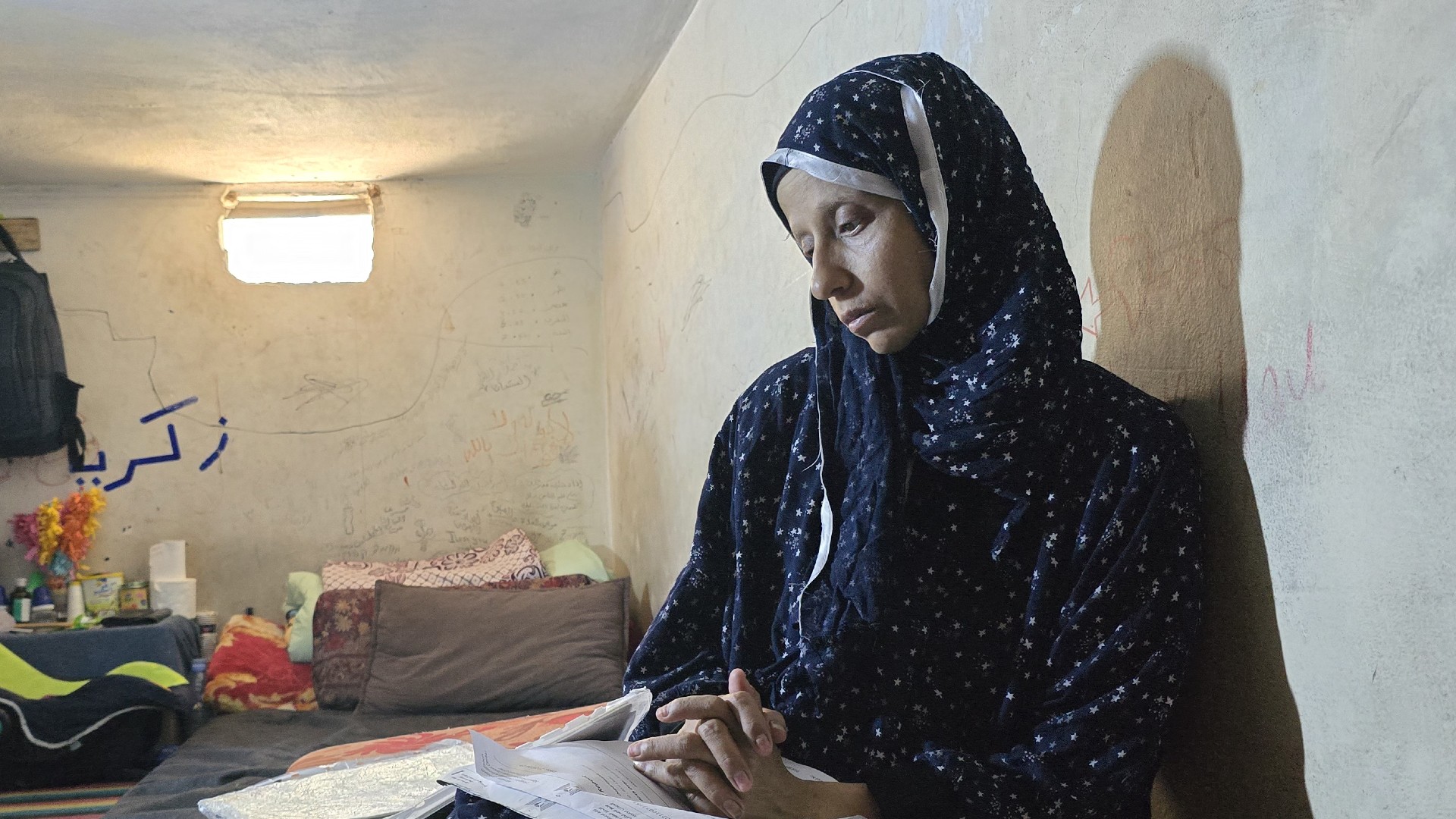
Deep in the cramped, overcrowded space beneath a school staircase in Khan Younis, southern Gaza, 33-year-old Palestinian university professor Kholoud Abu Sahmoud waits helplessly as her late-stage liver cancer progresses out of control. Nine months after her diagnosis, what should have been a treatable condition has become a death sentence, cut short by a catastrophic shortage of life-saving medicine and a months-long bureaucratic blockade that has kept her trapped in the war-ravaged enclave.
Abu Sahmoud received her devastating diagnosis just days after giving birth to her second child nine months ago. She completed 15 rounds of chemotherapy using the limited drugs available inside Gaza, but her condition has only continued to worsen. Unlike the targeted therapies she needs, the available medications have failed to shrink her tumor, only leaving her grappling with brutal side effects. “The chemotherapy never treated my cancer. It only caused my hair and nails to fall out,” she told reporters from Middle East Eye. “Almost every day, parts of my nails come off.”
Nearly 10 months after a ceasefire halted large-scale active fighting in October 2025, Israeli authorities continue to enforce tight restrictions on the entry of all essential medical supplies into Gaza, including specialized oncology drugs, chemotherapy agents, antibiotics, anesthetics, diagnostic tools and surgical equipment. UN data from earlier this year shows that by March, 46 percent of all essential medications and 66 percent of critical medical consumables across the enclave were completely out of stock.
This month, Gaza’s Palestinian Ministry of Health announced that most chemotherapy programs for common high-mortality cancers—including breast, colorectal, gastrointestinal, head and neck tumors, and sarcomas—have already been forced to stop entirely, as stockpiles of specialized cancer drugs dropped to critically low levels. Out of Gaza’s nearly 11,000 registered cancer patients, at least 4,000 have received formal medical referrals for urgent treatment outside the enclave, but remain stuck waiting for exit approval from Israeli or Egyptian authorities.
Dr. Muhammed Abu Nada, director of the Gaza Centre for Cancer, told Middle East Eye that the current shortage is the most severe Gaza has seen in decades. “We have been forced to use some medicines that had already expired because of the severe shortages. Now even those have run out,” he said. “This is clearly increasing the mortality rate.” For existing patients, remaining stockpiles barely cover ongoing care, leaving no options for newly diagnosed cases. Facing empty drug cabinets, doctors have been forced to abandon evidence-based combination treatment protocols in favor of less effective single-drug regimens. “This obviously reduces the effectiveness of treatment, worsens outcomes and can lead to further complications,” Abu Nada explained. “We are also facing shortages of immunotherapy drugs, which further increases the risks for our patients.”
Abu Sahmoud’s case is far from unique. Her medical referral for treatment abroad was approved just after her diagnosis, as clinicians confirmed the therapy she needs is not available anywhere inside Gaza. Doctors recommended she travel to Jordan or Turkey for targeted care, but nine months later, she remains trapped in Gaza, her health declining with each passing day. “Doctors told me the treatment I need is available in Jordan or Turkey, and there was no way to improve my condition here,” she said. “I’ve been waiting for urgent medical evacuation for nine months. My health deteriorates every day with this endless waiting.”
Under longstanding regional medical protocols, Gazan patients who require specialized care unavailable locally receive referrals funded by the Palestinian Authority’s Ministry of Health, but final permission to exit through border crossings controlled by Israel or Egypt remains a mandatory prerequisite. Since the start of large-scale military operations in Gaza in October 2023, Israel has drastically limited the number of medical evacuations allowed out of the territory, leaving thousands of critically ill patients stranded without access to care that could save their lives.
Four months after the October 2025 ceasefire, Israel partially reopened the Rafah crossing with Egypt for medical evacuations under a strict, tightly controlled system that caps the number of patients allowed to exit at just 50 per day, all subject to Israeli approval. As of June 30, only 1,655 patients have been evacuated since Rafah reopened in February, while more than 20,000 people—including 4,000 children—remain on the waiting list for urgent exit. Since October 2023, more than 1,570 critically ill patients have died while waiting for permission to leave Gaza for treatment.
For Abu Sahmoud, the waiting game has already left her bedridden, unable to carry out even the most basic daily activities or care for her two young children, a five-year-old son and her nine-month-old daughter. She has lost 20 kilograms as fluid buildup in her abdomen leaves her unable to eat for days at a time, and she has not been able to hold her newborn daughter since she gave birth. “I cannot fulfil any of my responsibilities towards my children. Because of my illness, I have become bedridden,” she said. “I am dying slowly.”
Like most Gazans, Abu Sahmoud has been forcibly displaced dozens of times since the war began, after her home was destroyed in Israeli attacks. She most recently lived in a makeshift tent in Mawasi al-Qarara, but the unsanitary, harsh conditions caused her health to decline even faster. She moved in with her displaced sister, who already occupies the cramped space under the staircase at Ahmed bin Abdul Aziz School, bringing the total number of people sharing the tiny space to 10. “The environment is completely unsuitable for someone in my condition. Even a healthy person would struggle to live here, let alone a cancer patient,” she said.
Next to the thin mattress where Abu Sahmoud spends her days sits a small box of medication, carefully positioned out of reach of the rats that frequent the shelter. Beside it rests a cloth bag holding nearly 50 academic certificates, testaments to a career and academic journey cut short by war and illness. A self-described lifelong bookworm, Abu Sahmoud made history at the Islamic University of Gaza as the first student to complete a two-year master’s degree program in just 16 months, before going on to pursue a PhD and take a position as an assistant professor specializing in curriculum and instruction. “I love learning. My whole life has been devoted to education,” she said. “My dream was to become a professor and continue my academic journey beyond my PhD. I never wanted to stop learning. But the illness has taken all of that away from me. The hardest part is waiting for treatment, with no end in sight.”