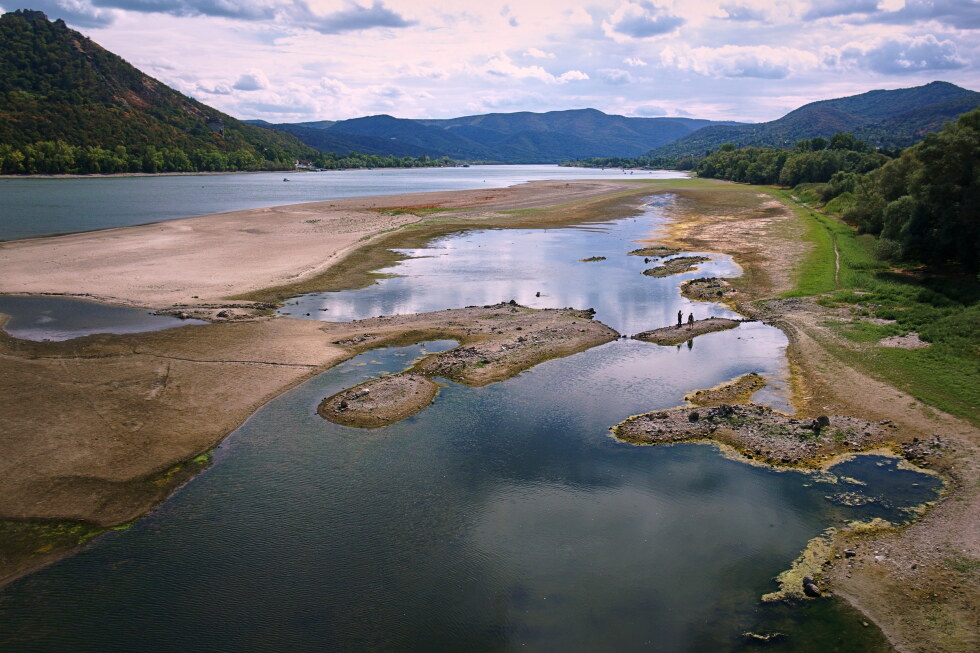
GÁRDONY, Hungary — Last week, 58-year-old fisherman Árpád Selmeci pulled his small vessel onto the shore of Lake Velence, Hungary’s third-largest lake, navigating a dock ramp that has grown dangerously steep as water levels recede to historic lows. Today, the lake sits at roughly 20 centimeters (8 inches) deep — a stark drop from the 150-centimeter (5-foot) depth that is typical for August. Once-popular tourist swimming beaches along the lake’s shoreline have already been forced to close, and even launching a small fishing craft has become a major challenge.
“I’ve lived alongside Lake Velence since I was a child, and I have never seen the water this low,” Selmeci told reporters. “It’s devastating. My heart hurts every time I look at it.”
Selmeci’s experience is just one visible symptom of a cascading national water crisis that has been amplified by human-caused climate change, amplified by centuries of harmful water management policies that have left Hungary extraordinarily vulnerable to worsening droughts. Across Europe, this summer has brought record-breaking heatwaves and destructive wildfires that have scorched landscapes from the United Kingdom to Greece. In Hungary, the ongoing drought has slashed crop yields, triggered regional drinking water shortages, and even put the country’s only nuclear power plant at risk of a forced shutdown.
While record-low rainfall driven by climate change is a core driver of the crisis, experts emphasize that long-standing human practices have turned a regional dry spell into an emergency. Hungary’s national meteorological service currently reports that 99% of the country’s total land area is experiencing severe or extreme drought, and desertification — the process where high heat and low rainfall kill off native vegetation — threatens large swathes of the ecologically and economically important Great Hungarian Plain.
Historically, more than a quarter of Hungary’s low-lying terrain naturally trapped rainwater, and an extensive network of rivers and streams left the country rich in freshwater reserves. But a 2023 study published in the journal *Nature* estimates that Hungary has lost more than 80% of its original natural wetlands over the past two centuries. The largest driver of this loss is a massive network of drainage canals spanning more than 40,000 kilometers (25,000 miles) — longer than the Earth’s circumference — built to drain precipitation from wetlands and low-lying fields to clear space for agricultural development.
Zsuzsanna Ujj, a biodiversity policy specialist and project coordinator for Friends of the Earth Hungary, says the country has failed to properly steward its water resources over the past 200 years. This persistent focus on draining water rather than letting natural flood cycles replenish groundwater reserves has caused a steady drop in the regional water table, drying out wetlands and topsoil across the country. As less water is available to evaporate into the atmosphere, local air grows drier, reducing the likelihood of localized summer rain — creating a dangerous feedback loop that worsens drought conditions.
The OECD ranks Hungary as the 16th most drought-exposed country in the world, and one of the most vulnerable in Europe. Ujj argues that the country must fundamentally shift its approach to water governance. “We need to realign our water management practices, moving away from a drainage-first model to one centered on retaining water in the landscape,” she explained.
The crisis is not limited to Lake Velence. Lake Garancsi, a small recreational body of water located just 20 kilometers (12 miles) northwest of Budapest, has existed since the Middle Ages and was even the filming location for the beloved 2001 Hungarian cult comedy *Glass Tiger*. For generations, it was a popular spot for local residents to fish, swim, and ice skate in the winter. But in recent years, the lake has shrunk so dramatically that all recreational activities have been banned, and most of its former bed is now exposed, cracked, dry earth. What little water remains is shallow and overwarm, killing off all native fish and most local wildlife. Local authorities predict the lake will dry up completely by the end of summer.
Zoltán Mettner, who operates the Glass Tiger bar on the lake’s former shore, says conditions have worsened steadily year after year. “Looking at it now is terrible — there’s no other way to say it,” Mettner said. “It’s devastating that we let things get this far, that we didn’t take gradual action to stop this lake from being completely destroyed.”
Hungary’s new government has now promised to course-correct. In late June, on the same day the country hit an all-time high temperature record of 42°C (107.6°F), Prime Minister Péter Magyar told lawmakers his administration would place water management on a “new footing” and launch a sweeping national water conservation program to mitigate the impacts of ongoing drought.
“Year after year, many experts have warned that water scarcity would become one of Hungary’s most pressing challenges, one of our most critical strategic issues to solve,” Magyar said. “They were right.”
In addition to fixing the country’s long-standing failure to retain water, Magyar noted that aging drinking water infrastructure leads to 20% to 25% of the country’s clean drinking water leaking out through cracked, outdated pipes — costing an estimated 17 billion forints ($54.4 million USD) in lost water every year. “For years, the very existence of this problem was denied and downplayed,” Magyar said. “Going forward, water retention will be the core principle of Hungarian water management.”
But implementing these sweeping changes will take years and massive investment, while the current crisis is already threatening the country’s energy security. The Danube River, the longest river in the European Union that runs from Germany to the Black Sea, has hit successive record-low water levels this summer. That has put the Paks Nuclear Power Plant, Hungary’s only nuclear facility which relies on Danube water to cool its reactors, at risk of a forced shutdown for the first time in its 44-year history.
The government has already launched emergency interventions to raise water levels at the plant, including sinking two 80-meter (262-foot) barges upriver and installing a temporary riverbed sill to redirect more water to the plant’s intake pumps.
Ujj notes that intact wetlands along the Danube would normally act as a natural reservoir, releasing stored water during dry periods to maintain river levels. She explained that both the record-low Danube levels and the increasing frequency of extreme floods are consequences of human-caused climate change, impacts that could be partially offset through restoring wetlands and natural water retention habitats.
“We absolutely should expect more extreme water level fluctuations, and more extreme precipitation patterns with drier summers in the future,” Ujj said. “But restoring wetlands and increasing evaporation in targeted regions could help boost local precipitation during the summer months, softening the worst impacts of drought.”