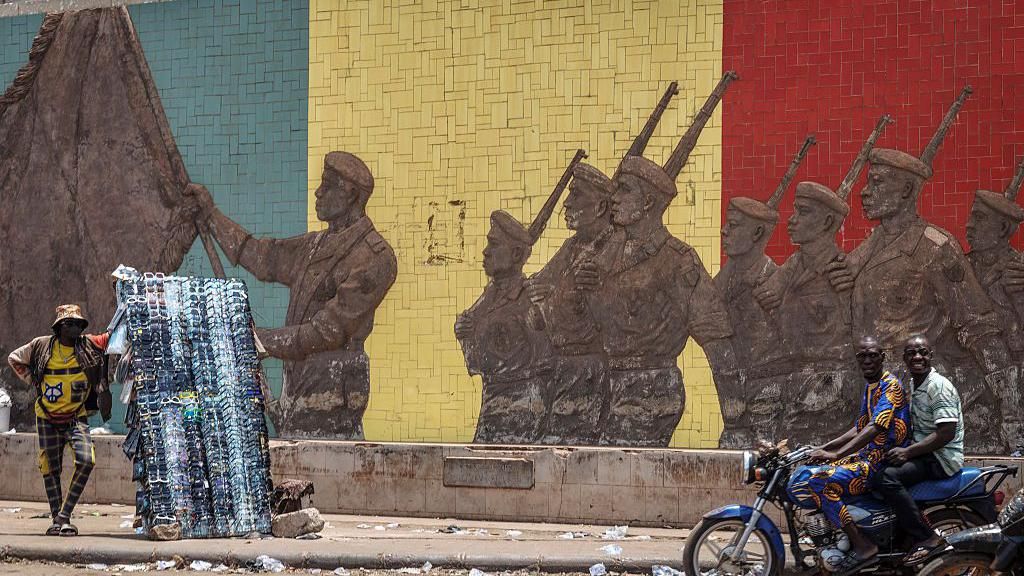
For over a decade, Mali’s national military has waged a persistent, bloody conflict against Islamist insurgent groups across the West African nation. Now, that conflict has tightened its grip on the heart of the country: Bamako, the bustling capital and key regional hub home to more than 3 million residents, is currently under a rolling partial blockade by Jama’at Nusrat al-Islam wal-Muslimin (JNIM), one of the country’s most active Islamist militant factions. The blockade comes just days after a high-profile assassination of Mali’s defense minister within the city’s borders, deepening the sense of crisis gripping the nation.
Stranded motorists and travelers on the Bamako-Kéniéba highway, one of the capital’s primary arterial routes, have described days of uncertainty and fear. One mother of two, who traveled outside the city to visit aging parents, told the BBC she has been barred from re-entering Bamako for nearly 24 hours. “Our army isn’t capable of protecting us, how are we going to get back home?” she asked, echoing the anxiety shared by hundreds of other stranded people along major inbound routes. JNIM fighters issued an explicit public warning Wednesday that “no-one will be allowed in any more” to the capital, a sharp escalation of tactics the group has used to pressure the ruling military junta.
This tightening blockade marks a significant escalation from the group’s 2025 fuel blockade, which crippled supply chains, caused widespread fuel shortages, and sent prices for essential goods soaring across Bamako. Today, eyewitnesses confirm that at least three of the six main access roads leading into the capital are closed for hours at a time, as militants rotate positions across different routes to avoid counterattacks. During gaps between militant presence, small numbers of civilian vehicles are able to sneak through, but movement remains severely restricted and unpredictable.
The current crisis follows a coordinated nationwide offensive launched last weekend by a newly formed alliance of jihadist fighters and separatist rebels from the Azawad Liberation Front (FLA), whose stated goal is to overthrow the military regime led by General Assimi Goïta. Goïta seized control of Mali in a 2020 coup and has since shifted the country’s foreign security alliances dramatically, expelling French counterterrorism forces that had supported the government for nearly a decade and turning instead to the Russia-aligned Africa Corps, a paramilitary force that emerged from the remnants of the Wagner Group following the death of its founder Yevgeny Prigozhin.
Despite this new partnership, the insurgent offensive has already scored major gains. The FLA alliance forced African Corps and Malian government troops to withdraw from the key northern city of Kidal, which is now fully under separatist control. Following the capture of Kidal, FLA leaders have announced plans to advance on other northern population centers and issued an ultimatum demanding the full withdrawal of all Africa Corps forces from Malian territory.
The Kremlin has repeatedly reaffirmed its commitment to maintaining a presence in the country. “Russian forces will remain in Mali to combat extremism, terrorism and other harmful phenomena and will continue to provide assistance to the current government,” a Kremlin spokesperson stated Thursday, pushing back against claims that the withdrawal from Kidal signals weakening Russian commitment to the junta.
For ordinary civilians caught in the crossfire, the situation has grown increasingly desperate. A long-haul lorry driver who has worked Malian trade routes for decades told the BBC he had never experienced a crisis of this scale. “I’m stuck here and it sounds dangerous. I would rather run away to save my life than fight for the goods I have to deliver. I’ve never thought like this before,” he said. Just 50 miles from Bamako, the regional town of Ségou is already under a full insurgent blockade, where hundreds of commercial trucks, passenger buses, and private cars have been trapped for days. A local reporter confirmed that stranded passengers, including whole families and small-scale traders, are already facing critical shortages of clean drinking water and food.
Mali’s junta leadership has responded with vows of harsh retribution. Following an emergency meeting of the country’s security council Wednesday, state media quoted Goïta saying that Malian armed and security forces have already inflicted “heavy losses” on insurgent forces and would continue to ramp up counteroffensives to restore order.
Independent security analysts warn that the current offensive exposes deep vulnerabilities in the junta’s grip on power. “Those moves show that the regime is weak and can’t restore security,” explained Alain Antil, director of the Sub-Saharan Africa Centre at Ifri, a leading French foreign affairs think tank. Antil noted that the current trajectory echoes 2013, when a similar alliance of jihadists and Tuareg separatists advanced on Bamako, prompting a large-scale French military intervention that pushed insurgents back but failed to fully resolve the country’s instability. Despite Goïta’s decision to oust French forces and align with Russia, the security situation has continued to deteriorate, culminating in last weekend’s coordinated offensive.
International governments have already begun issuing warnings to their citizens. France, Canada, and the United Kingdom have all issued formal advisories urging their nationals to leave Mali immediately, while the United States recommends that all U.S. citizens in the country stay in secure locations and avoid non-essential travel. Even amid the warnings, some long-term foreign residents have refused to flee, pointing to deep personal ties to the country. “I won’t leave,” one Frenchwoman who has lived in Mali since 2002 told the BBC. “I love Mali. It has become a part of me since I came here in 2002. We’ll stay with my family. We know things will be OK.”