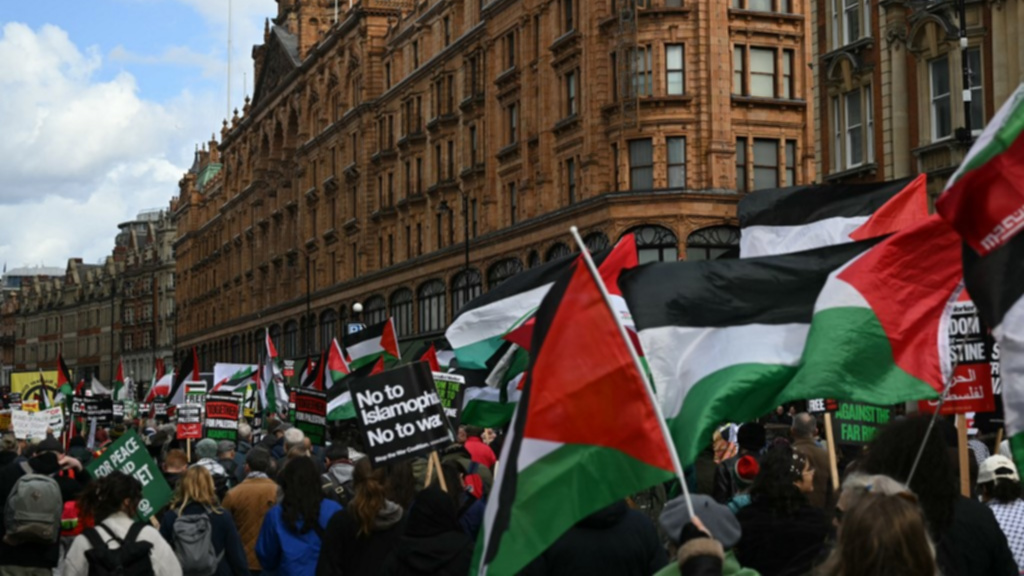
A shocking antisemitic stabbing attack in a heavily Jewish London neighborhood has ignited a fierce national debate over the future of pro-Palestine protests in the United Kingdom, after the country’s top independent reviewer of terrorism legislation called for an immediate halt to such demonstrations.
The incident unfolded Wednesday afternoon in Golders Green, north London, where two Jewish men — aged 34 and 76 — were stabbed by a suspect wielding a large blade. A 45-year-old Somali-born British national was taken into custody shortly after the attack, and both victims are projected to make a full recovery. The Metropolitan Police confirmed the suspect has an established record of serious violence and documented mental health conditions, and was first referred to the UK’s Prevent counter-extremism program back in 2020. Investigators also noted the attack appears to be linked to a separate altercation that took place in southeast London several hours earlier.
In the wake of the violence, Jonathan Hall, the independent reviewer of UK terrorism legislation, publicly called for a moratorium on all ongoing pro-Palestine marches during an interview with Times Radio. Hall argued that the current climate has created conditions where these demonstrations inevitably foster antisemitic rhetoric and demonization of Jewish communities. He pushed back against what he described as insufficient government action, saying that offering only statements of solidarity and supporting police investigations is no longer adequate.
“It pains me to say this, but I think we may have reached a point where we need to have a moratorium on the sorts of marches that have been happening,” Hall said, adding that the government must be willing to take bolder action to address rising antisemitism across the country.
Hall’s remarks drew immediate and sharp pushback from the Stop the War coalition, a prominent group that has supported ongoing pro-Palestine demonstrations. The organization condemned the Golders Green attack and all forms of antisemitism and racism unequivocally, but rejected attempts to tie the violence to peaceful pro-Palestine protests. The coalition noted that many Jewish people have participated in the marches themselves, framing the demonstrations as legitimate displays of solidarity with Palestinian civilians caught in the Israel-Hamas conflict, not the “hate marches” labeled by right-wing political figures.
Attempts to criminalize the protests, which reflect majority public opinion on the conflict in the UK, or falsely link them to racist attacks targeting Jewish communities, are scurrilous and must be rejected, the group added.
Prime Minister Keir Starmer called the Golders Green attack “utterly appalling”, and the UK government announced Thursday it would allocate an additional £25 million to boost security for Jewish communities across the country. This announcement comes amid a documented surge in antisemitic incidents across the UK in recent months: Metropolitan Police has recorded dozens of antisemitic hate crimes, including multiple arson attacks, over the past 30 days alone.
Hall’s call for a moratorium also comes amid ongoing controversy over the government’s sweeping crackdown on pro-Palestine activism. In December, both the Metropolitan Police and Greater Manchester Police announced they would arrest demonstrators for chanting the phrase “globalise the intifada” or displaying it on protest placards; three protesters were formally charged on related offences in January. Pro-Palestine activists have repeatedly denied that the term, which translates from Arabic to “uprising”, is inherently antisemitic or a call for violence, and many British Jews have been visible, prominent participants in pro-Palestine marches across the country.
The debate also overlaps with a separate ongoing legal battle over the government’s designation of direct action group Palestine Action as an illegal terrorist organization. The High Court recently ruled the government’s ban unlawful, and the administration is now appealing that ruling. In his newly released annual report, Hall himself raised significant red flags about the ban, noting it exposed “real uncertainty” over whether non-violent property damage alone should be classified as a terrorist offence.
Hall warned that the broad wording of current UK terrorism law, without clearer legal guardrails, risks drawing legitimate protest activity into terrorism policing — even in cases where there is no intent to harm human life. “There is no legal authority on what ‘serious damage to property’ means,” Hall wrote, noting the vague definition could stretch to encompass minor cases of criminal damage depending on how courts interpret the legal threshold. While Hall argued it would be unthinkable to remove property damage from the terrorism statute entirely, he recommended that lawmakers narrow the legal test, for example by requiring proof of risk to life, a proven connection to national security threats, or explicit exemptions for non-violent protest activity.