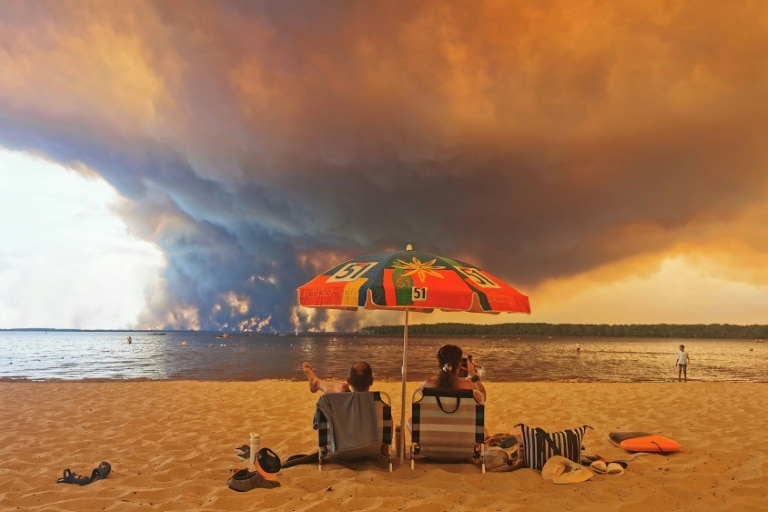
It started as an impromptu smartphone snapshot taken during a family holiday, but one image captured amid southwest France’s devastating 2022 summer wildfires quickly spread across the globe to become one of the most iconic representations of modern climate complacency.
Maximilien Lamy, a veteran photo editor with Agence France-Presse (AFP) with more than 20 years of industry experience, was on vacation with his partner and young daughter in the resort town of Lacanau when the moment unfolded. Walking from his parked car to a local restaurant along the shore of a lakeside beach, Lamy’s photographer’s instinct kicked in as he spotted the scene before him. Hurrying because his hungry daughter kept urging him to stop shooting and move on, he pulled out his phone and captured the frame in seconds, never expecting it to gain international traction within hours. When reached for comment by AFP, Lamy said he was completely overwhelmed by the response, adding: “I didn’t think it was going to be that big.”
The image itself strikes a jarring contrast between leisurely comfort and impending catastrophe. In the foreground, a couple on vacation slump in striped deck chairs under a bright, colorful parasol, their beach gear scattered casually around them. The man sits with his legs crossed in a relaxed slouch, while the woman holds up her mobile phone. Behind them, a massive, churning column of wildfire smoke billows into the sky, casting an eerie orange glow over the entire horizon. Lamy himself described the snapshot as immediately feeling apocalyptic and profoundly symbolic of the current era.
In the days after the photo was published, political analysts, media outlets and social media users widely embraced it as more than just a record of the French wildfire season. Many framed it as a searing political and social commentary on decades of global climate inaction. Social media users quickly drew comparisons to the 2021 satirical climate film *Don’t Look Up*, which parodies widespread societal apathy toward an impending extinction-level event, and shared the image with captions highlighting its parallel to global indifference to the climate crisis. Ian Bremmer, president of global political risk consultancy Eurasia Group, summed up the common interpretation on social media: “France wildfires… and the world around us.”
Leading French daily newspaper *Le Figaro* called the unplanned shot an accidental allegory that paints an uncomfortable portrait of 21st-century generations. “The catastrophe occupies almost the entire image and yet somehow appears relegated to the background,” the outlet wrote, noting that the man’s relaxed posture has been read as a sign of indifference, the woman’s phone as a symbol of modern distraction, and the parasol as the fragile comfort people cling to even as crisis unfolds around them.
Lamy says he understands why the image resonated so deeply with global audiences, agreeing that it perfectly symbolizes the collective experience of the current climate era. He compared the couple’s perspective to watching a disaster unfold from the comfort of one’s own living room: “This is the end of the world and they feel fine,” he observed. But the veteran photo editor has pushed back against widespread calls to judge the couple in the photo, urging commentators not to rush to conclusions about their mindset. “I don’t want to blame them,” he said. “Nobody knows what they actually thought.” Lamy suggested the couple may simply have felt powerless to stop the fire, or may have stayed put because their children were playing nearby in the water.
The image’s stark composition was so striking that some online observers speculated it had been created using artificial intelligence or digitally altered. Lamy has firmly debunked those claims, confirming that the original photo went through only a minor side crop for publication, with no other modifications made. A lifelong street photography enthusiast who shoots for fun in his free time, Lamy joked that on that particular summer day, he simply ended up being a beach photographer by chance — and that chance produced one of the most memorable images of Europe’s devastating wildfire summer.