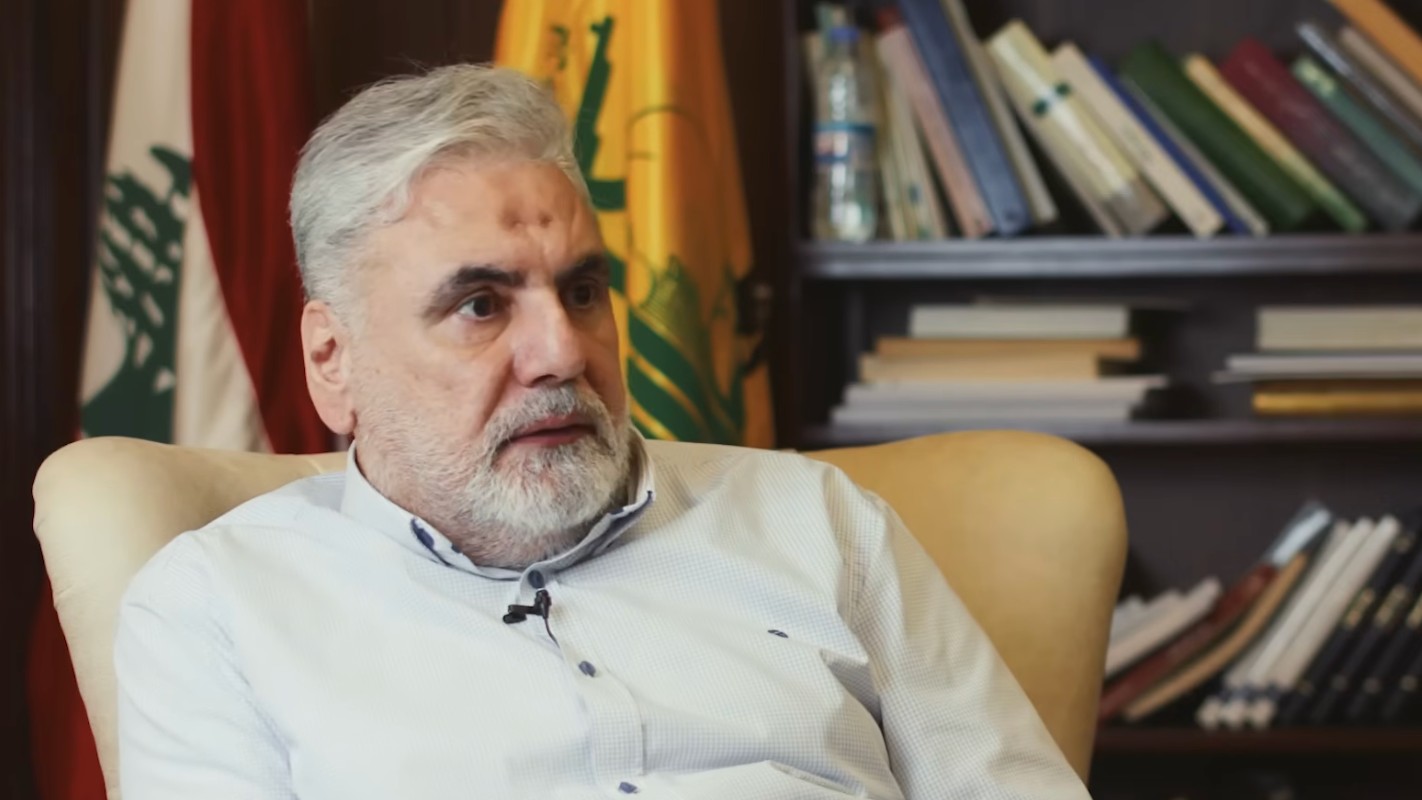
In a wide-ranging exclusive interview with Middle East Eye held at his Beirut office, senior Hezbollah official Nawaf Moussawi — who currently leads the group’s border and resources department and previously headed its foreign relations division and served as a Lebanese member of parliament — has laid out the movement’s uncompromising stance: military force remains the only viable path to liberate occupied South Lebanon, as negotiations alone will never compel Israel to withdraw its forces.
Moussawi argued that ongoing negotiations led by Lebanese President Joseph Aoun are doomed to fail from the start, citing two critical flaws: the talks lack consensus across Lebanon’s fragmented political landscape, and Aoun enters the negotiating table without any meaningful leverage to pressure Israel. He stressed that the armed resistance movement will not abandon its campaign until all Israeli troops fully withdraw from Lebanese territory.
“There is no international pressure strong enough to force Israel out of our land, just as there has been no such pressure in Palestine,” Moussawi stated. “That leaves us with no option but to continue fighting the Israeli occupation until withdrawal is complete.”
The current cycle of cross-border conflict traces back to October 8, 2023, when Hezbollah launched cross-border strikes against Israel one day after the Hamas-led October 7 attacks, opening what the group calls a “support front” to divert Israeli military resources away from its offensive in Gaza. The conflict has since escalated into two major waves of war: the first decimated much of Hezbollah’s traditional military infrastructure and killed most of its senior leadership, including long-time secretary-general Hassan Nasrallah. The second outbreak of hostilities began in March 2024, triggered by the US-Israeli war on Iran and the killing of Ayatollah Ali Khamenei, a key spiritual and political figure for Hezbollah. Both Hezbollah and Israeli media have confirmed this second round of fighting also pre-empted a planned large-scale Israeli offensive into Lebanon, after 15 months of repeated Israeli ceasefire violations and the consolidation of Israeli occupation in border areas of South Lebanon.
The escalation has drawn sharp criticism and anger from many Lebanese citizens and international observers, with more than 4,300 people killed in Lebanon since March and additional territory falling under Israeli occupation. But Moussawi rejected blame placed on Hezbollah for the current crisis, shifting culpability entirely to Israel as the occupying power.
“Israeli propaganda once claimed Fatah was the problem, then it became Hamas, and in the future it will be any Palestinian organization that fights to liberate its land,” Moussawi said. “The real problem is always the occupation, not the organizations that resist it. Today they claim Hezbollah is the problem, but Israel would oppose any group that defends the Lebanese people’s right to free their land — even if that group called itself the Democratic Party of America.”
He argued that the US-backed Israeli campaign across Palestine and Lebanon since October 2023 is intentionally designed to inflict widespread destruction to break the will of occupied populations, convincing them that resistance is too costly to pursue. He pointed to the decades-long negotiation track pursued by the Palestine Liberation Organization as proof that talks cannot deliver sovereign statehood, noting that even full surrender would not satisfy Israeli demands. “What the Israelis ultimately want is the extermination of the Palestinian people,” he added.
Since April 2024, the Lebanese presidency and Washington embassy have held direct negotiations with Israel aimed at securing a permanent ceasefire, full Israeli withdrawal, and separating Lebanon from the regional war against Iran. The talks have produced a US-backed framework for ending hostilities between Israel and Hezbollah, but the deal has sparked massive opposition across Lebanon, with critics raising alarms over threats to national sovereignty, weak accountability mechanisms, and provisions that prioritize Lebanese obligations over Israeli commitments to withdraw. Hezbollah has publicly condemned the framework for failing to guarantee Israel’s full withdrawal from the 6 percent of Lebanese territory it still occupies and secure the return of hundreds of thousands of displaced Lebanese residents to their southern homes.
With decades of experience negotiating with Israel, including during the 2006 war and talks over the Lebanon-Israel maritime border, Moussawi said the current round of state-led talks has produced zero tangible results. As an example of the framework’s failures, he noted that Israeli forces have only allowed the Lebanese military to deploy in one southern Lebanese village — a village that Israel never occupied in the first place. Talks to deploy Lebanese forces to other currently occupied villages have stalled entirely, while cross-border shelling and skirmishes grow more frequent by the week.
Moussawi argued that the core failure of Aoun’s negotiation strategy is that it proceeded without broad national unity. “Steps like this require consensus from all Lebanese political forces, and this effort does not have that backing,” he said. Beyond lack of consensus, Moussawi emphasized that successful negotiations with Israel require leverage, and Aoun chose to distance his government from Hezbollah’s armed resistance — the most significant source of pressure on Israel. “The resistance is a source of national strength, but he chose to confront it instead of working with it,” Moussawi said. “How can you achieve liberation when you are at odds with your own people? That is the president’s fundamental problem.”
More than 500,000 Lebanese, most from the Shia community that Hezbollah claims to represent, have been displaced by the latest war. Hezbollah has adopted a new asymmetric tactic of ceding territory to draw Israeli troops in, then targeting deployed forces with ambushes and attacks. While the tactic has proven tactically effective, it has also allowed more of South Lebanon to fall under Israeli control, and Israel has razed dozens of southern villages and towns to the ground. But Moussawi insisted armed resistance remains the only path to bring displaced people home to their land.
“Our way of returning our people to the south is to liberate their land. Liberating the land requires fighting the Israeli occupier and driving it back,” he said. “That is what we did in 2000, and this is our path today. If Aoun had secured an Israeli withdrawal, he would be a national hero. Instead, he has not even been able to stop the destruction of occupied villages. Despite all the concessions he has made, Israel has given him nothing in return. Therefore, we have no choice but to resist.”
The question of Hezbollah’s disarmament has also become a flashpoint between the movement and the Lebanese state, with external pressure from Israel and the United States pushing for the Lebanese military to take a confrontational stance toward the group. Days after Hezbollah launched rocket strikes against Israel on March 2 in response to Khamenei’s killing, Lebanese Prime Minister Nawaf Salam outlawed Hezbollah’s military activities, asserting that the state must hold a monopoly on the use of force. Moussawi claimed the US-backed negotiation framework was intentionally designed to trigger internal Lebanese conflict, shifting the focus from opposing Israeli occupation to fighting Hezbollah.
“The goal is to make Lebanese fight each other instead of fighting the Israeli occupier,” he said. “I do not believe anyone in Lebanon would take up arms against the resistance to occupation, because that would lead to their own destruction before it leads to anyone else’s. Even if the president wanted to fight the resistance, he could not do it. The Lebanese army and security services belong to the Lebanese people, and the people will not turn on each other.”
Moussawi also dismissed another external proposal pushed by US President Donald Trump, which would have Syrian President Ahmed al-Sharaa — who fought Hezbollah for a decade during the Syrian civil war — deploy Syrian forces to confront the group. He called the plan “wishful thinking that cannot become reality,” noting that al-Sharaa’s government is closely allied with Turkey, whose President Recep Tayyip Erdogan recently stated that Turkish security begins in Beirut, in the context of opposing Israeli expansion. “How could a Syrian government allied with Turkey become a tool to advance Netanyahu’s interests and expand Israeli power in the region?” Moussawi asked.
Notably, Moussawi revealed that Hezbollah has opened a new channel of dialogue with the Syrian government via Turkish mediation. “We are engaged in genuine and effective dialogue with Turkey, through which new avenues can be opened with the emerging actors in the region,” he said.
After the 2024 war, many outside analysts assessed that Hezbollah’s military wing had been permanently degraded, with most of its senior commanders and their deputies killed and the group unable to match Israeli military strength in the near future. But an investigation published by Middle East Eye earlier this month confirmed that Hezbollah has since restructured its military command and expanded its drone program, recruiting experienced video gamers to operate the unmanned platforms. Moussawi confirmed that while Israeli intelligence successfully penetrated Hezbollah’s old command structure, the group has now shifted to a new generation of commanders who were never on Israeli targeting lists.
“Hezbollah is now fighting with a generation Israel does not know,” Moussawi said. “This fourth generation of commanders was not included on any Israeli intelligence or operational targeting lists, so our brothers today can operate with far greater ease than the martyred commanders who came before them.”