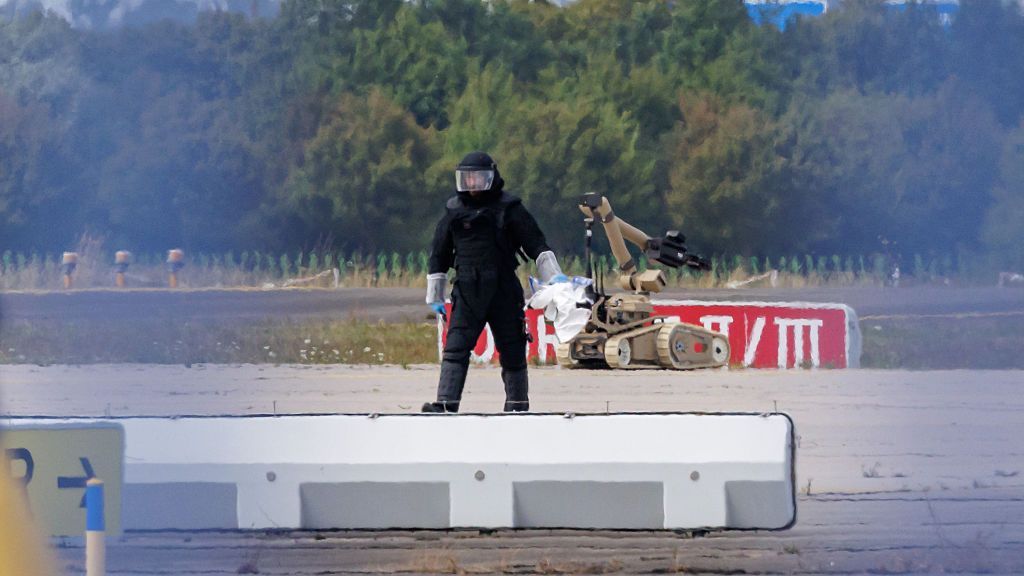
In a landmark public announcement that escalates tensions between Berlin and Moscow, German officials have formally named Russia as the perpetrator of an explosive drone attack last month at Leipzig/Halle Airport, a critical logistics hub supporting military shipments to Ukraine.
The incident, which unfolded on August 4, saw an explosive-laden drone discovered near Ukrainian cargo aircraft parked at the eastern German airport. The device never detonated, investigators confirmed, after its detonator malfunctioned. Separately, probes suggest a second drone collided with a nearby cargo plane, while a third unmanned device was located in the area surrounding the airport 10 days after the initial discovery.
Speaking at a Berlin press conference alongside German Foreign Minister Johann Wadephul, Interior Minister Alexander Dobrindt framed the attempted attack as fitting the long-documented blueprint of Russian hybrid operations targeting European states. He added that German authorities operate under the working assumption that further attacks on German soil are likely.
Leipzig/Halle Airport holds unique strategic significance: it is used by the German military and NATO allies to transfer military supplies, and it also acts as a operational base for Ukraine’s Antonov Airlines, the carrier that moves the vast majority of Ukraine’s airborne cargo. That strategic role makes it a logical target for Moscow, analysts note, at a time when Germany remains one of Kyiv’s most prominent backers in its war against Russian invasion.
In response to the confirmed Russian involvement, Wadephul announced sweeping diplomatic measures: he has ordered the closure of Russia’s consulate in Bonn, and the government will terminate the operating contract for the Russian House in Berlin, a facility long suspected by security observers of being used for Russian espionage and disinformation campaigns.
The formal accusation and retaliatory measures have drawn immediate reaction from across the Western alliance. NATO Secretary General Mark Rutte released a statement on X confirming the alliance’s full solidarity with Germany, noting that “the evidence is clear” and that he supports the actions Berlin has taken in response. The incident is scheduled to be a top topic of discussion during a meeting of European Union foreign ministers taking place in Ireland on the same Tuesday the announcement was made.
Moscow has repeatedly denied any involvement in attacks on European soil, and in response to the new measures, Russian Foreign Ministry spokesperson said Russia would retaliate for what it calls “anti-Russian decisions”, according to Russian state news agency Interfax.
This formal attribution marks a shift from Berlin’s previous cautious stance, which only referenced potential involvement by “foreign powers” without naming a specific actor. US media had already reported that American intelligence agencies linked the attack to Russian actors, confirming the assessment that German intelligence had privately reached.
German officials have long warned that the country faces daily hybrid threats from hostile powers. Last week, Chancellor Friedrich Merz, who has taken a hardline stance in support of Ukraine, reiterated that any actor that carries out hostile acts against German interests will “pay a price”. The German government is currently moving forward with plans to expand the legal powers of the country’s intelligence agencies, which have long been criticized for having limited authority to counter hybrid and asymmetric threats.
The announcement comes at a sensitive domestic political moment for the Merz administration. A key regional election in the eastern state of Saxony-Anhalt, where the airport is located, is approaching, and polls suggest the far-right Alternative for Germany (AfD) could win enough support to take control of the state government for the first time in the party’s history. The AfD, Germany’s largest national opposition party, has campaigned on ending all military and political support for Ukraine and restoring normal diplomatic and economic ties with Russia.
In a separate development that adds to growing concerns over security on German soil, German police confirmed Tuesday they are launching an investigation into the discovery of improvised explosive and incendiary devices at a power substation in the eastern state of Brandenburg. The devices damaged a power line, causing a temporary power outage in the area. No group or actor has yet been linked to the sabotage attempt, and investigations into what happened remain ongoing.
Over the past 12 months, multiple NATO member states, Germany included, have recorded a surge in drone sightings near critical infrastructure, military bases, and industrial facilities, raising alarms across the alliance over the growing scope of Russian hybrid activity targeting Western countries.