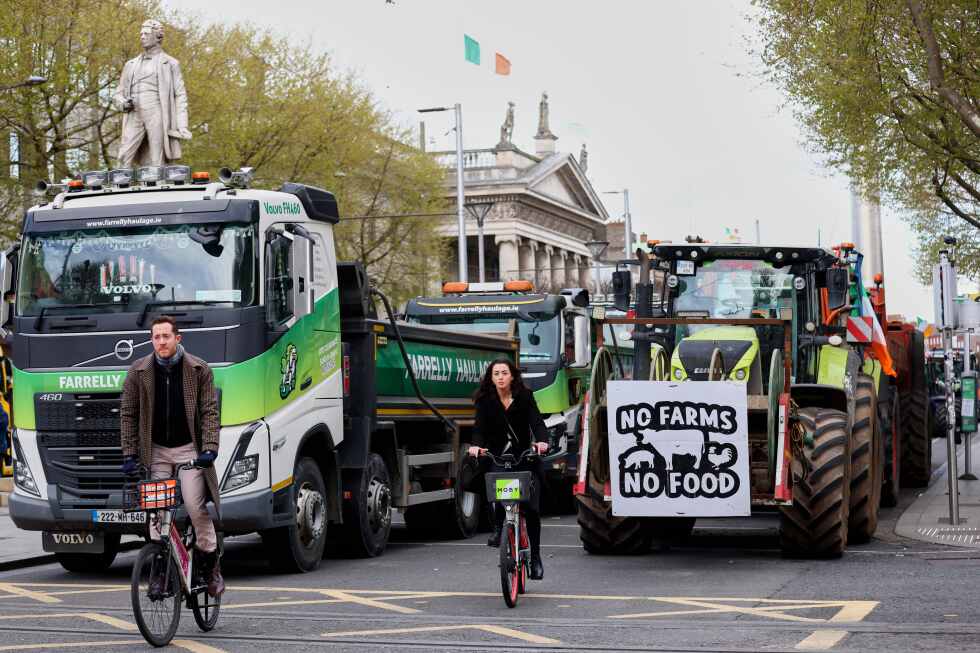
DUBLIN, Ireland – A week of widespread fuel protests that paralyzed critical national infrastructure has pushed Ireland’s ruling coalition government to the brink, with a scheduled no-confidence vote in parliament set to unfold Tuesday. The unrest, rooted in skyrocketing fuel prices triggered by conflict-related disruption to global oil supplies through the Strait of Hormuz, has exposed deep divisions over the government’s crisis response and brought Irish politics to a moment of high stakes.
The wave of demonstrations began on April 7, when slow-moving convoys of frustrated industry operators first clogged major roadways. Organized largely through social media, the movement quickly swelled, drawing truckers, farmers, taxi drivers, and bus operators who blockaded key transport links, oil infrastructure, and central thoroughfares in Dublin, the nation’s capital. Protesters cut off access to Ireland’s only oil refinery in Whitegate, County Cork, and blockaded the country’s major ports, leading to widespread fuel shortages that left more than a third of the nation’s gas pumps dry and created massive gridlock across the country. Demonstrators’ core demands were straightforward: urgent government intervention, either through permanent price caps or immediate tax cuts, to offset soaring fuel costs that they warned threatened to put thousands of small operators out of business.
The supply shock that sparked the protests traces back to escalating conflict between the U.S.-Israel bloc and Iran, which disrupted shipping through the Strait of Hormuz—one of the world’s most critical chokepoints for global crude oil exports. The sudden spike in international oil prices filtered directly to Irish fuel pumps, pushing costs to unaffordable levels for transport and agricultural industries that depend heavily on diesel and gasoline.
After days of allowing demonstrations to proceed largely unimpeded, Irish authorities moved to clear blockades over the weekend. Police used pepper spray to clash with protesters in some locations, while an army vehicle removed a large log barricade at Galway Port. Outlining the government’s decision to clear infrastructure, Prime Minister Micheál Martin emphasized that the country’s ports and refineries are non-negotiable economic lifelines for Ireland, which exports roughly 90% of its domestically produced goods. “If the ports were blockaded for any length of time, people would have lost jobs, production would have ceased, and it would have been very, very serious,” Martin said, while also defending the overall response from police and military forces. He acknowledged that the government could draw lessons from the unrest.
To de-escalate the crisis, Martin recently announced a new €505 million ($595 million) fuel support package designed to ease cost-of-living pressures and address protester demands. The package includes targeted direct payments to truckers and school bus operators, alongside fuel subsidies for the agricultural and fishing sectors. This new relief comes on the heels of a €250 million tax break approved just three weeks earlier, and the Irish parliament is scheduled to vote on the new package the same day as the no-confidence motion.
Despite the government’s last-minute concessions, opposition parties have rejected the response as too little, too late. Sinn Féin, the country’s largest opposition party, formally called for the no-confidence vote scheduled for Tuesday evening. Six other opposition parties—The Social Democrats, Labour, People Before Profit, Aontú, the Green Party, and Independent Ireland—have all committed to supporting the motion. Sinn Féin has also criticized the ruling Fianna Fáil-Fine Gael coalition for failing to recall parliament during a recent holiday break to address the crisis and for offering what it calls ineffective half-measures to protect households and businesses from the fuel price spike.
In a tactical move to pre-empt the opposition’s motion, Martin’s coalition has scheduled an earlier parliamentary vote on its own motion of confidence. If the government secures enough support to pass its confidence motion, the opposition’s no-confidence motion will become moot before it even goes to a vote. If the no-confidence motion were to pass, the current government would be forced to resign, triggering either a parliamentary process to select a new prime minister and form a replacement government or a snap general election for the entire Irish parliament. Many protesters have already claimed a partial victory, noting that their demonstration forced the sitting government to make major policy concessions it would not have otherwise considered.