Denver, Colorado – More than 2,000 Democratic activists, elected officials, and campaign operatives gathered at a two-day “What’s Next?” political summit last week, just days after a historic midterm election cycle that delivered the party sweeping control of both chambers of the U.S. Congress, flipping 80+ House seats and securing a 9-seat gain in the Senate to break years of divided federal government. Hosted by the Majority Democrats PAC, launched last year to mediate long-simmering rifts between the party’s progressive left and centrist establishment wings, the event opened on a wave of post-victory euphoria that quickly gave way to raw, unfiltered debate over the party’s path forward for the next two years of Donald Trump’s upcoming presidential term.
The most electric and divisive moment of the opening day came when 37-year-old James Talarico, the first Texas Democrat elected to the U.S. Senate since 1988, took the stage to a roaring standing ovation from the crowd. That enthusiasm curdled sharply when the incoming youngest Senate member laid out a provocative vision of cross-party collaboration with the incoming Trump administration. “We should turn the final two years of his presidency into the most productive four-year stretch in modern U.S. history,” Talarico told the restless audience. “This moment matters far more than partisan loyalty to the red team or the blue team.” His proposal to align with Republicans on shared economic priorities including expanded health insurance access and targeted inflation reduction drew scattered boos alongside scattered nods of approval, setting the tone for the entire summit’s unresolvable core tension.
The conference laid bare no unified, agreed-upon roadmap for the party’s future, as competing factions pushed wildly divergent strategies for leveraging their new congressional majority. Alabama Congressman Shomari Figures, who pulled off a surprise re-election victory even after state Republicans redrew his district to tilt heavily in their favor, echoed Talarico’s pragmatic stance, noting that the party’s two prior failed efforts to impeach Trump ended in GOP-led Senate acquittals and wasted critical legislative bandwidth. “We wasted time on impeachment twice, and voters sent him right back to the White House with a Republican majority last cycle,” Figures warned. “Voters are worried about putting food on their tables and paying their rent, not endless partisan vendettas.”
That position faced fierce pushback from other elected leaders, including Maryland Congresswoman Angela Alsobrooks, who argued that voters had explicitly demanded full accountability for alleged misconduct during Trump’s first term. “Voters saw the smash-and-grab corruption that happened during his last administration, and they are not going to accept us sweeping that under the rug,” Alsobrooks insisted, calling for sweeping, public congressional investigations into prior Trump administration actions.
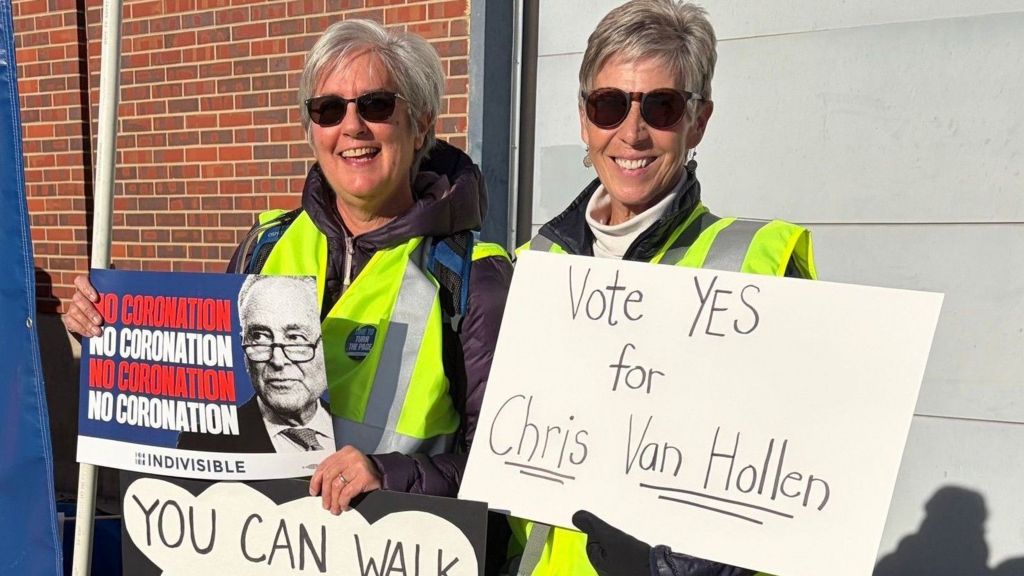
Deep, unaddressed internal rifts bubbled to the surface across every hour of the event. High-profile progressive leaders including Congresswoman Alexandria Ocasio-Cortez and Senator-elect Abdul El Sayed skipped the summit entirely, citing long-running frustrations with the party’s centrist leadership. Outside the main conference hall, demonstrators waving Palestinian flags chanted demands for an immediate end to U.S. unconditional military aid to Israel, a policy fault line that has split the party’s base for months and drawn fierce criticism of centrist leaders including Senate Minority Leader (and presumptive incoming Majority Leader) Chuck Schumer, who faces an unprecedented leadership challenge from Maryland left-wing populist Senator Chris Van Hollen.
Protesters Vicki Saxe and Tami Butters, both local Democratic activists, held signs denouncing Schumer’s leadership and voicing support for Van Hollen’s bid to oust him. “Our party leadership has been far too soft on Trump’s abuses from the very start, and that’s exactly why voters are screaming for new, more urgent representation,” Saxe told reporters. Butters echoed that frustration, pointing to the recent absence of 11 Democratic lawmakers during a House vote to consider impeaching Defense Secretary Pete Hegseth as evidence of the party leadership’s lack of urgency to hold the Trump administration accountable. Even presumptive incoming House Speaker Hakeem Jeffries, the centrist New York Democrat poised to become the first Black Speaker in U.S. history, faced loud heckling from protesters mid-speech over his continued support for unconditioned military aid to Israel.
Many attendees who said they had nearly left the party entirely over disagreements on the Gaza conflict and proposed military escalation with Iran noted that the influx of young, newly elected diverse officials had restored their cautious optimism. “The biggest mistake our party made for decades was refusing to listen to the actual people who voted for us,” noted Shiva Saram, non-profit founder and chair of the Iranian American Legal Defense Fund, who traveled to Denver from Connecticut to attend the summit. Multiple veteran and incoming elected officials emphasized that the party’s historic midterm wins came not from performative partisan rhetoric, but from laser-focused policy platforms that directly addressed voters’ day-to-day financial struggles. Delaware Senator Chris Coons told reporters he had advised all newly elected Democratic lawmakers to “under-promise and over-deliver” for their constituents. “Voters hired us to make their lives easier, to cut their household costs, to end corruption and restore their hope for the future,” Coons said. “None of that will be easy, and it will require tough compromise across party lines.”
Other attendees framed the party’s deep internal diversity not as a weakness, but as its greatest strategic asset. 28-year-old Tahra Hoops, senior director of economic analysis at left-of-center tech think tank the Chamber of Progress, argued that ideological flexibility was critical for a geographically and demographically diverse nation. “A far-left progressive platform works in New York City, but a moderate, pragmatic message like Talarico’s is the only way Democrats can win statewide office in Texas,” Hoops explained. “The U.S. is an incredibly diverse country, and our party’s representatives should reflect that diversity instead of forcing every single candidate to fit a one-size-fits-all ideological box.” 25-year-old Texas campaign consultant Carlos Repetto-Ayala, who traveled to Denver with two fellow Texan activists wearing a cowboy hat and a Lone Star State lapel pin, agreed. “We are a big tent party, and that’s not a flaw,” he said. “As long as every single one of us stays focused on solving the actual problems voters care about, the Democratic Party will keep winning for decades to come.” By the close of the two-day summit, no formal unified strategic roadmap had been adopted, but attendees broadly agreed that the party’s biggest test ahead would be balancing internal ideological demands with the pragmatic governance that delivered their historic midterm victories.