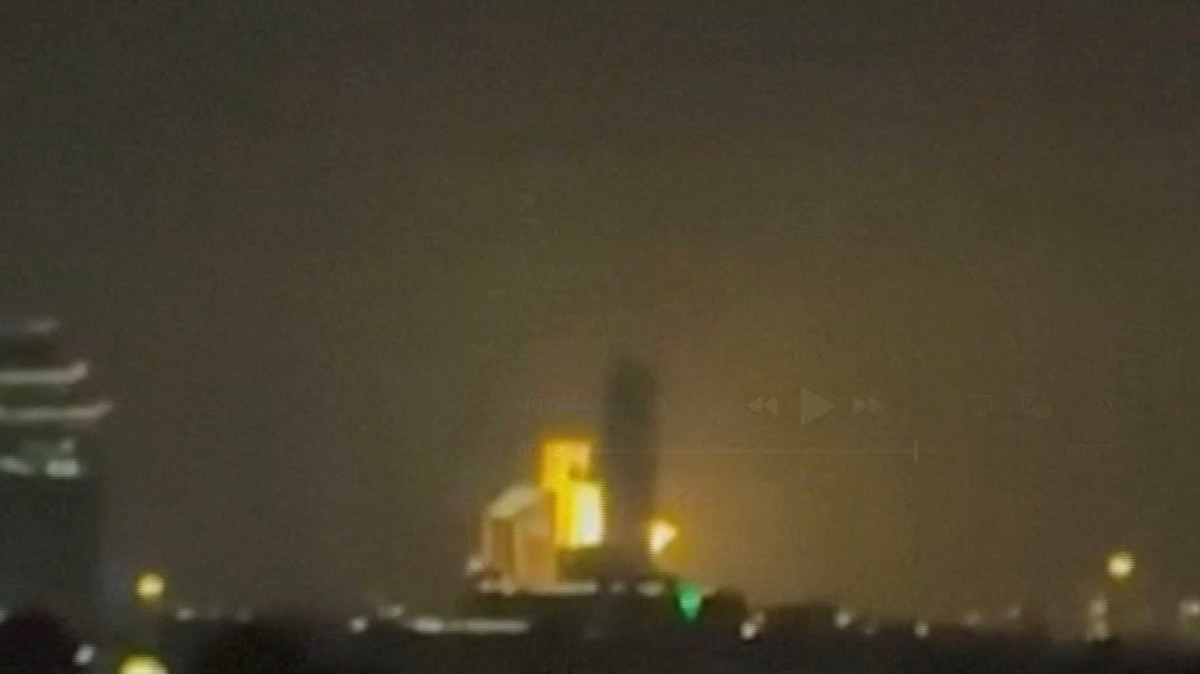
Saudi Arabian officials formally confirmed on Thursday that the Riyadh skyscraper housing the headquarters of the kingdom’s $1 trillion Public Investment Fund (PIF) sustained damage in an attack claimed to be carried out by Houthi forces, marking the second high-profile strike on core Saudi commercial infrastructure in the capital within a single month. The 80-story tower, recognized as Riyadh’s tallest skyscraper, suffered shattered windows across seven to eight floors and visible deformation to sections of its metal exterior, according to on-site observations from a Reuters correspondent, with early footage from the capital showing maintenance crews already dispatched to begin replacing damaged glass panes shortly after the incident. Saudi official statements characterized the incident as a “terrorist attack by the Houthi militia,” noting that no civilian or staff injuries were reported, only localized material damage. While circulating social media footage appeared to capture a missile directly impacting the high-rise, independent verification of the clip by news outlet Middle East Eye (MEE) could not be completed. Three anonymous Reuters sources confirmed the building was hit by a missile, though Saudi authorities offered a competing account stating their air defense systems had neutralized the incoming aerial threat, and the damage was caused by falling missile debris. Local residents in Riyadh reported being jolted awake by a deafening explosion at approximately 5 a.m. local time on the day of the strike. This direct assault on the PIF headquarters carries outsized symbolic and economic weight, as the sovereign wealth fund serves as the central operational pillar of Crown Prince Mohammed bin Salman’s ambitious national strategy to diversify Saudi Arabia’s oil-dependent economy and position the kingdom as a top-tier global destination for foreign direct investment. The attack is the latest entry in a sustained Houthi aerial campaign that has targeted a wide swath of Saudi civilian and critical infrastructure, including international airports, commercial high-rises, and energy production facilities. The spike in cross-border strikes coincides with rapid territorial advances by Houthi forces in Yemen, where the Saudi-backed internationally recognized Yemeni government is struggling to fend off offensives that now threaten the provisional seat of power in Aden, the country’s temporary capital. The rising security crisis has pushed Saudi Arabia to ramp up diplomatic and military outreach for international support to counter Houthi operations: on the same day as the PIF tower strike, U.S. Central Command (CENTCOM) chief Admiral Brad Cooper held closed-door talks with Crown Prince Mohammed bin Salman in Riyadh, a high-level visit first reported exclusively by MEE that also included the deployment of dozens of senior U.S. military advisors to assist Saudi forces in upgrading and operating their national air defense systems. Official readouts of the meeting noted the two leaders reviewed bilateral military cooperation frameworks and exchanged assessments on fast-moving regional security developments. Multiple regional diplomats and western officials with direct knowledge of closed-door deliberations confirmed that Saudi Arabia is currently not pursuing diplomatic negotiations with Houthi representatives, and is instead actively preparing for a prolonged, extended phase of conflict. Earlier in the same week, Saudi hosts convened a gathering of key western partner representatives in Riyadh to request accelerated arms shipments to bolster the kingdom’s deterrence capabilities against further cross-border Houthi assaults, with one western official noting “Saudi Arabia is in the market” for expanded military supplies to support a drawn-out conflict posture. The latest round of hostilities follows the collapse of a two-year lull in Yemen’s long-running civil war, which had been largely held in place by a 2022 UN-brokered ceasefire. Since the ceasefire collapsed and fighting reignited in recent months, Houthi forces have seized large swathes of new territory and advanced to the outskirts of Aden, with UN humanitarian records documenting more than 1,600 fatalities and over 300,000 people displaced across Yemen in the current wave of violence.