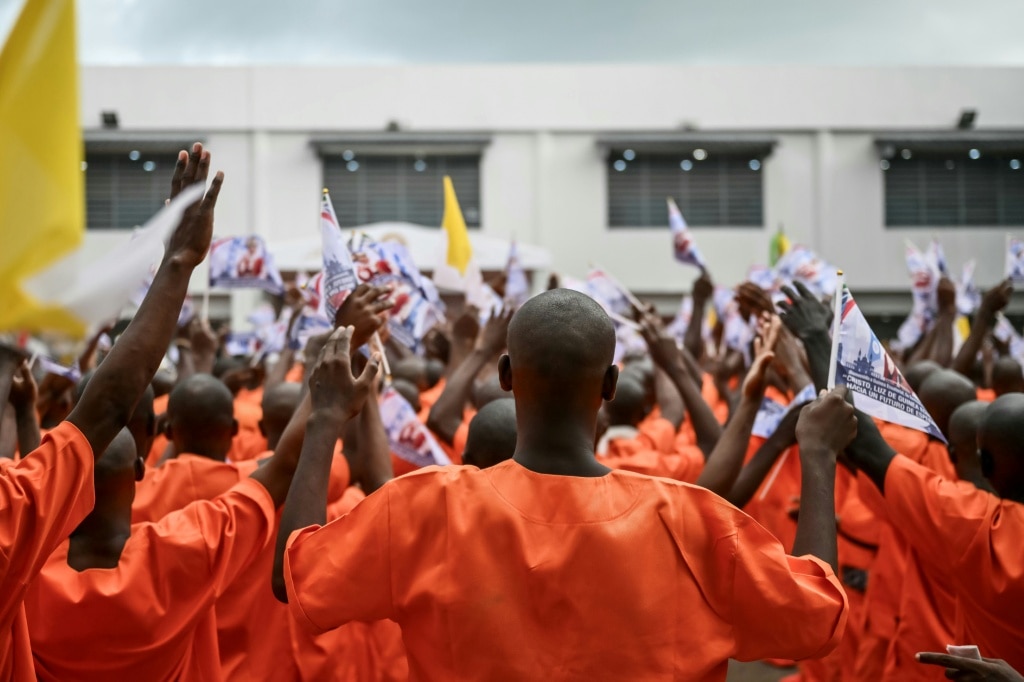
The air was thick with the unmissable stench of sweat and urine inside Bata Prison, despite fresh coats of salmon-pink paint covering the facility’s outer walls to spruce it up for Pope Leo XIV’s high-profile visit on Wednesday. This notorious correctional facility in Equatorial Guinea played host to the leader of the global Catholic Church, who is in the middle of a 10-nation African tour, and the day was defined by a sharp contrast between carefully stage-managed hospitality and longstanding international criticism of the country’s prison system.
Hundreds of incarcerated people gathered in the prison’s open courtyard, greeting the pontiff with chants of “freedom” as heavy tropical rain poured down across the complex. Around 600 inmates, 30 of whom were women, lined up in neat rows for the visit, all with shaved heads, wearing standard-issue bright orange or khaki-green uniforms, cheap plastic sandals, and in some cases, cloth face masks. Their coordinated jumps and chants were part of a carefully choreographed welcome planned ahead of the papal arrival, a public relations push for a prison system that has faced decades of global condemnation.
Equatorial Guinea, a Spanish-speaking Central African nation of roughly 2 million people, has been under the authoritarian rule of President Teodoro Obiang Nguema Mbasogo since 1979. The regime has been repeatedly accused by international human rights organizations of systematic violations across all sectors of public life, including its detention network. For Obiang’s government, Pope Leo’s visit represented a rare chance to reframe the global image of its widely criticized prison operations.
This polished, red-carpet welcome stood in stark opposition to multiple independent reports documenting brutal conditions inside the country’s prisons. A 2023 U.S. State Department human rights report detailed widespread accounts of torture, severe overcrowding that leaves cells crammed beyond capacity, and unsanitary conditions that pose constant health risks to detainees. A 2021 report from Amnesty International echoed these findings, noting that official population data for Equatorial Guinea’s prisons is rarely made public and almost always outdated. The organization added that hundreds of incarcerated people are held for years without access to visits from legal counsel or family members, leaving relatives with no information about whether their loved ones are even alive. For Pope Leo’s visit, reporters were barred from conducting independent interviews with inmates, and only government-approved statements were permitted. Justice Minister Reginaldo Biyogo Mba spoke to reporters at the prison entrance, framed by a guard tower patrolled by two armed officers, and praised what he claimed were safe, humane conditions at the facility.
When the pope arrived, upbeat rhythmic music blared over prison loudspeakers as inmates performed a coordinated song and dance routine under the watchful eye of uniformed prison guards. Without warning, a heavy tropical deluge broke out, drenching the entire crowd. Rather than brush off the downpour, Pope Leo framed it as a meaningful symbol in remarks delivered to the assembled detainees. “Rain is a sign of God’s blessing,” the 70-year-old U.S.-born pontiff declared in Spanish, drawing loud cheers and applause from the crowd.
In his address to incarcerated people, Pope Leo struck a carefully balanced but pointed tone. “The administration of justice aims to protect society,” he told the gathering. “To be effective, however, it must always promote the dignity of every person.” He added a message of solidarity, telling detainees “you are not alone” in their experiences of incarceration. Analysts note that these comments, while delivered with diplomatic restraint, represent an unprecedented public critique of government policy in a country where freedom of expression is heavily suppressed.
The Bata Prison stop came on the 10th day of Pope Leo’s African tour. Earlier the same day, he led a large open-air mass in Mongomo, a city near Equatorial Guinea’s border with Gabon, with President Obiang in attendance. During that service, the Catholic leader also called explicitly for “greater room for freedom” and the universal protection of human dignity for all people in the country.