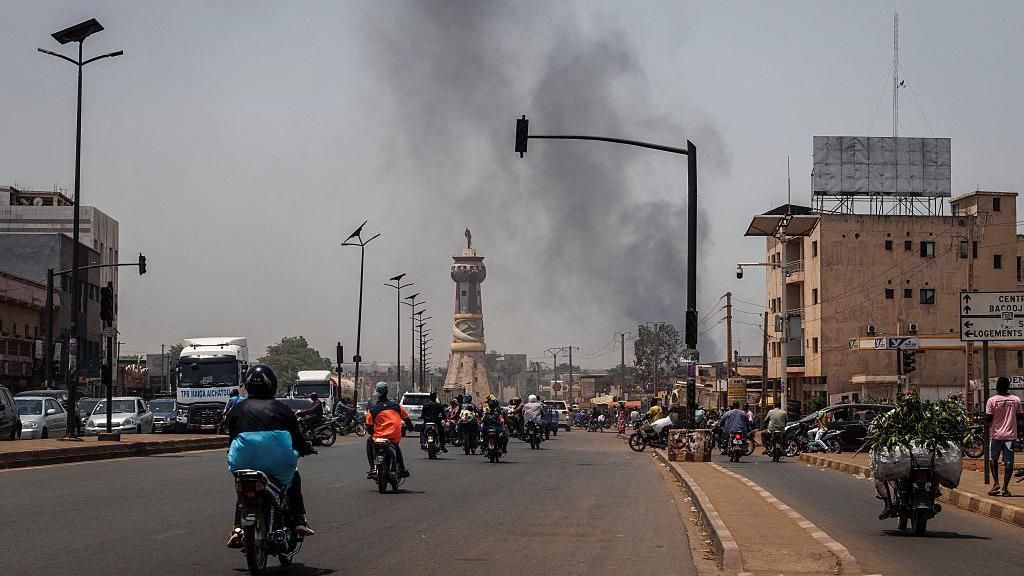
Over the weekend of late April 2026, Mali was thrown into a fresh state of crisis after a wave of coordinated large-scale attacks launched by separate separatist and jihadist militant groups rocked multiple regions across the West African nation, prompting former colonial ruler France and the United Kingdom to issue urgent evacuation orders for all their citizens still present in the country.
Witnesses reported loud explosions echoing across neighborhoods and sustained bursts of automatic gunfire in multiple locations starting Saturday. The violence stretched from the capital city of Bamako to northern frontier regions and central population hubs, marking one of the most broad coordinated assaults on Malian state positions in recent years. Among the most high-profile casualties was Malian Defence Leader Sadio Camara, who was killed in a targeted suicide bombing in the garrison town of Kati, which hosts a major military base just outside Bamako. In the far north, separatist fighters from the Azawad Liberation Front (FLA), an ethnic Tuareg group pushing for an independent breakaway state, successfully seized full control of the strategic city of Kidal, with clashes continuing into Sunday even after the initial assault.
Official accounts confirm the attacks were coordinated between two distinct factions: FLA separatists focused on capturing northern territory aligned with their decades-long independence campaign, while Jama’at Nusrat al-Islam wal-Muslimin (JNIM), an al-Qaeda-linked jihadist network, carried out simultaneous bombings and raids on military and government targets across the country. The coordinated nature of the assault exposed critical gaps in the military junta’s security promises, after it seized power in a 2020 coup under the leadership of Gen Assimi Goïta.
In his first public address since the attacks delivered Tuesday evening, Goïta sought to reassure the public, claiming that Malian armed forces had inflicted a “violent blow” to the attackers and that overall security across the country had been brought back under government control. His claims have not been independently verified, and ongoing tensions in Kidal and other northern areas cast doubt on the junta’s assertion.
On Wednesday, France’s foreign ministry issued an updated advisory leveling its strongest warning yet for French citizens in Mali. “French nationals are advised to make arrangements to leave Mali temporarily as soon as possible on the commercial flights that are still available,” the statement read, adding that all travel to Mali, regardless of purpose, is strongly discouraged. For citizens who cannot immediately depart, the advisory orders them to shelter in place, restrict all non-essential movement, and stay in constant contact with their families and local authorities.
The United Kingdom echoed France’s warning, maintaining evacuation guidelines that were first implemented over the weekend. The UK Foreign Office advises against all travel to Mali due to the highly unpredictable security landscape, and urges all British citizens already in the country to depart immediately via remaining commercial routes, if they assess it is safe to do so. The advisory explicitly warns against overland travel to neighboring countries, calling the route “too dangerous” due to consistent threats of terrorist attacks along major national highways. “If you choose to remain in Mali, you do so at your own risk,” the UK statement adds, noting that British citizens cannot rely on UK government support for emergency evacuation in the region.
Mali’s current political landscape has been shaped by nearly a decade of overlapping insurgency and political upheaval. The Tuareg rebellion that first broke out in northern Mali in 2012 was quickly hijacked by Islamist militant groups, sparking a long-running security crisis that has destabilized large swathes of the country. Goïta’s military junta seized power in 2020 on a platform of restoring national security and pushing back armed insurgents, earning broad popular support at the time for its pledges to end the chronic instability. After the junta took control, UN peacekeeping forces and French counter-insurgency troops that had been deployed to the region withdrew from the country, and the military government turned to Russian mercenary groups to assist with counter-insurgency operations. Despite this partnership, jihadist insurgency has continued to spread, and large portions of northern and eastern Mali remain outside the control of the central government in Bamako.