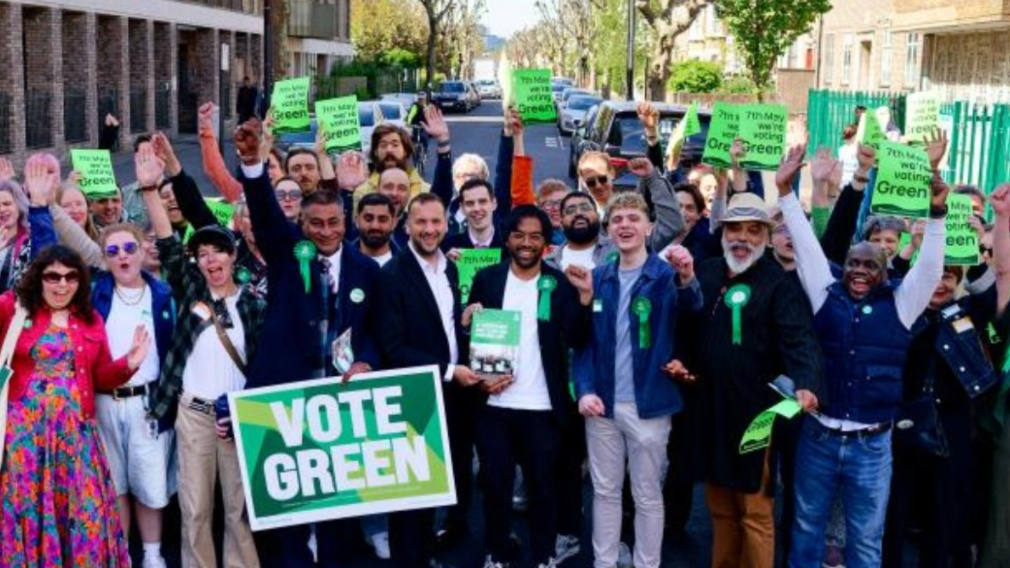
For nearly 60 years, one political reality has remained unshaken in Newham, east London: since the borough’s founding in 1965, the London Borough of Newham has been continuously governed by the Labour Party, a rock-solid stronghold for the centre-left party in the capital. But as voters head to the polls for local elections on May 7, that long-standing status quo is at greater risk than ever before, as the Green Party surges to challenge Labour’s grip on power across multiple east London boroughs.
While small independent left-leaning groups such as Redbridge Independents have chipped away at Labour’s support in the region, political analysts and campaigners are increasingly pointing to a growing “Green wave” that could flip multiple councils away from Labour control. Green Party leader Zack Polanski has set ambitious targets for significant gains nationwide, and polling indicates the party is on track to seize outright majorities in two other east London boroughs, Hackney and Lewisham. Newham, however, has flown under the radar of most national political coverage – despite emerging polling that puts the Green Party within striking distance of a historic upset here.
Recent polling offers competing snapshots of the tight race in Newham: a YouGov survey released last week placed the Greens five percentage points behind Labour, with the local Newham Independents grouping a further four points behind the Greens. But a new study commissioned by the London School of Economics and published this Monday puts Green support at 34%, a single percentage point ahead of Labour.
Areeq Chowdhury, the 33-year-old Green Party candidate for Newham mayor, who spoke to Middle East Eye during a campaign stop in Plaistow Park on Monday, is clear about his chances: he is confident he can win. For Chowdhury, this election is rooted in widespread voter discontent, both with local Labour governance and the national party under Keir Starmer. “There’s a huge amount of discontent with the Labour Party locally,” he explained. “We’re at the highest level of homelessness. One in 18 people are homeless. We’ve got the title of litter capital of England.”
Chowdhury is no stranger to the Labour Party: he was a member from his student years, and even won election as a Labour local councillor in 2022. His defection to the Greens in 2023 was driven by two core frustrations: Starmer’s Labour refusal to take a strong stance against the Israeli military campaign in Gaza and call for an immediate ceasefire, and the party’s repeated high-profile U-turns on key progressive campaign pledges, including cuts to welfare benefits for disabled people. “A big part of why I joined Labour was things like human rights and standing up for workers,” he said. “The more I got to know about the Green Party, the more I understood that actually they were focused on the correct issues facing society, around the environment and human rights.” For many Newham voters, he added, Labour’s weak position on Gaza was the “trigger for people to look elsewhere”.
The Green momentum stretches beyond Newham, across east London’s boroughs. In Waltham Forest, recent YouGov polling puts both Labour and the Greens at 30%, setting up a knife-edge contest for council control. Green candidates on the ground say voters are linking national political failures directly to local quality-of-life issues. Eva Tabassam, 35, a first-time Green candidate for Cann Hall ward who joined the party last summer, says voters consistently raise both international conflicts and local struggles on the campaign trail. “They go hand in hand,” she explained. “We get a mixture of big things, like the illegal war on Iran. We also get told about what’s happened in Palestine and the government’s complicity in that.” Tabassam added that it is often non-Muslim voters who first bring up Gaza, alongside criticism of Starmer’s repeated policy U-turns, the ongoing cost of living crisis, sky-high local rents, and the two-child benefit cap – all issues that directly impact daily life for east London residents.
Peter Ibrahim Kanyike, 26, the Green candidate for Waltham Forest’s William Morris ward, says his local campaign focuses on bread-and-butter issues: cleaner public streets, improved safer parking for local businesses, and better accessibility for residents. But he echoes the sentiment that national political discontent is driving Green gains. “I think there’s a load of concern with the direction that society is going in and how the current government, Labour specifically, have directed society in that way,” he said. “The Greens want to create a council and a borough that works with our neighbours. That feeds into policy, and I think that’s one of the overarching concerns – society-building, working with each other.”
On the streets of Newham’s Stratford district, public opinion remains mixed: many voters are still undecided, and some are unaware that an election is just days away. While one voter told MEE she planned to vote for Reform UK over its anti-immigration platform, another middle-aged woman said she was voting Green out of concern for future generations. “My grandchildren are not here yet, and I want them to enjoy the planet,” she said. “It’s green all the way, darling. We need the oxygen. We need the plants, which are part of our biodiversity for the planet.” For long-time Labour voters, the shift is already palpable within families: an elderly Moroccan long-time Labour voter told MEE his daughters are pushing him to switch to the Greens over the party’s position on Gaza, and he is still considering changing his vote on election day.
The Green’s gains, particularly around their stance on Gaza, have drawn criticism from right-wing party Reform UK, whose leader Nigel Farage has accused the Greens of engaging in “sectarian politics” over the issue. Chowdhury calls the accusation “completely racist”, noting that the Greens are a broad coalition of progressive voices that welcomes diverse communities. “The Green Party is at the same time an Islamist party and a super LGBT party? Right. The reality is that we’re a coalition of progressive voices [that] wants to build a better society. So we have a lot of diversity in our party, and we have a lot of Muslims joining the party. We do have a lot of LGBT people join the party, people from every different community.” Chowdhury added that he has faced constant racist abuse during the campaign, including repeated calls for his deportation.
Tabassum pushes back against the common misconception that Muslim voters and climate action are disconnected issues. “There seems to be this weird perception that these two things are so artificially distinct,” she said. “As Muslims ourselves, we’ve always been taught to protect the world and nature and environment and living things around us. So I don’t know why there seems to be this artificial separation of the two.” Kanyike added that the Green’s welcome for Muslim voters is not sectarianism, but a commitment to inclusion: “I think critics are just afraid because Muslims are finding a party that actually wants to support them. We actually focus on unity rather than division. Just because we’re welcoming different groups doesn’t mean that we’re being sectarian. Our focus is to be open for all groups.”
Labour still retains solid support in the region. Phil, a Labour voter shopping at Westfield Stratford, told MEE he remains resolute in his support for the party, calling it the only “sensible” option in UK politics. “They’re less extreme, they look after the individual people,” he said. “And yes they’ve made mistakes in the past two years but I still think they’re the people for me.” He dismissed the Greens as well-meaning but unfit to govern, and called Reform UK “a complete load of loonies. It’s sensational stuff, and it’s actually nasty and evil in many ways.”
Green Party officials frame the 2024 local elections as a turning point for the party. Faaiz Hasan, the Green Party’s national elections coordinator, said the vote “comes at a critical time” for UK politics. “This is the moment that we can actually start putting forward an alternative vision for the country that is not based on blaming migrants, is not based on blaming people of colour or others, but identifies that the real issue is not race, it’s class, and the concentration of wealth and power in a very tiny group of people,” he said.
Nationally, polling suggests the Greens could win control of nine councils across the UK, including the east London seats of Lewisham and Hackney. Even if the party falls short of capturing an outright majority in Newham, political observers broadly agree that these elections will cement the Green Party’s status as a major national political force, with a permanent foothold in local government across the country. For Labour, which has dominated east London politics for generations, the Green surge is already a major cause for concern.