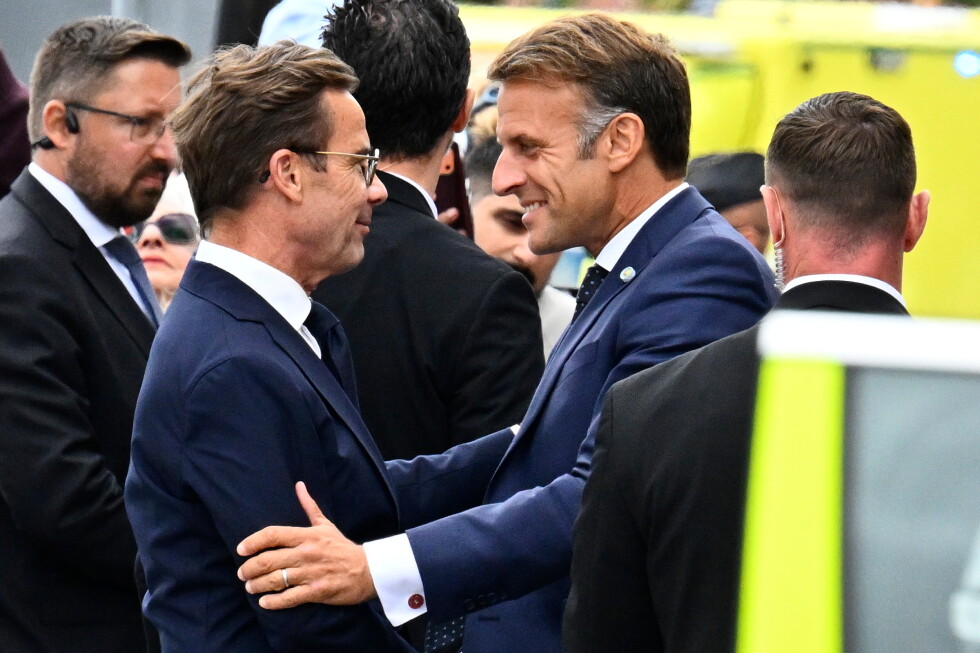
During an official state visit to Stockholm on Monday, French President Emmanuel Macron formalized a landmark 4.3-billion-euro ($5-billion) defense agreement to deliver four advanced Amiral Ronarc’h-class frigates to Sweden, boosting the defensive capabilities of NATO’s 32nd and newest member in the strategically critical Baltic Sea region, where Russia maintains key maritime and air transit routes. The signing ceremony took place aboard the French Navy’s newly commissioned lead frigate of the class, launched in 2022 and delivered to French service in October 2025, shortly after Macron held bilateral defense talks with Swedish Prime Minister Ulf Kristersson ahead of a scheduled working dinner.
The deal marks a major step forward for Macron’s ongoing push to deepen European military autonomy, a policy goal designed to reduce the continent’s long-standing defense reliance on the United States. This push comes as the U.S. has increasingly shifted its strategic focus to Indo-Pacific security challenges, and just last week, the Biden administration publicly urged NATO European allies to ramp up their own defense investment and capabilities as Washington reorients its global security priorities.
Swedish Prime Minister Kristersson emphasized that the new frigates will deliver transformative long-range maritime operational capabilities and critical ballistic missile defense protection — a capability that has grown urgent in the wake of Russia’s full-scale invasion of Ukraine. “The war in Ukraine has shown us the importance of being able to defend against this type of missile,” Kristersson noted during the ceremony. Under the terms of the contract, French state-linked shipbuilder Naval Group will provide not just the four warships, but also a full suite of integrated weapons systems including ballistic missile-capable air defense interceptors, torpedoes, and long-range cruise missiles, alongside specialized training for Swedish naval personnel. The first frigate is scheduled for delivery to the Swedish Navy in 2030, according to anonymous French presidential officials who spoke on background in line with the Elysee Palace’s standard media protocols.
Macron framed the agreement as a cornerstone of deepened strategic partnership between the two nations, highlighting that it will also strengthen Europe’s domestic defense industrial and technological base. Talks between the two leaders also covered Sweden’s potential participation in France’s unprecedented European nuclear deterrence coordination initiative, a program that has already drawn interest from eight other European nations: Britain, Germany, the Netherlands, Belgium, Greece, Poland, Denmark and Norway. The initiative allows France to temporarily deploy nuclear-capable aircraft to allied territories, invites partner nations to join French deterrence exercises, and enables non-nuclear allied forces to support French nuclear deterrence operations.
The defense partnership runs both ways: in December last year, France placed an order for two GlobalEye airborne surveillance aircraft built by Swedish defense giant Saab, deepening cross-border industrial cooperation between the two countries. Sweden’s accession to NATO in 2024 ended nearly 80 years of post-World War II military neutrality and centuries of broader non-alignment with European great power blocs, a shift driven by sharply heightened security concerns across Northern Europe following Russia’s 2022 full-scale invasion of Ukraine. Regional security experts have widely noted that adding Sweden to NATO has dramatically strengthened the alliance’s posture in the Baltic Sea, a region that remains a flashpoint for tensions between the Western alliance and Russia.