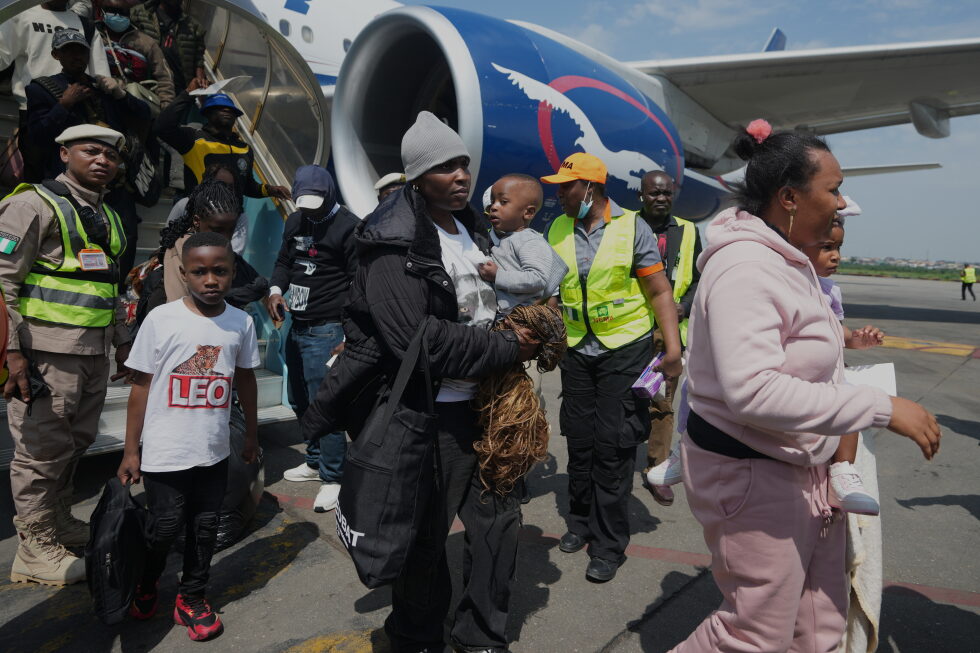
JOHANNESBURG and LAGOS — In a move that underscores deepening tensions over immigration and xenophobic violence across Southern Africa, the first planeload of Nigerian citizens touched down in Lagos on Thursday, the start of a government-ordered repatriation effort for people fleeing deadly anti-foreign unrest in South Africa.
Nigeria’s Ministry of Foreign Affairs confirmed the incoming flight carried 262 returning passengers plus three government officials. Prior to the arrival, authorities had announced that more than 1,000 Nigerians residing in South Africa had already registered to take advantage of the voluntary repatriation program, which was launched after a wave of violent anti-immigration demonstrations swept across parts of South Africa starting in April.
The repatriation effort has already sparked a public disagreement between the two African nations. South African officials assert that all the Nigerians processed for return were staying in the country without valid immigration documentation, a direct contradiction of Nigerian officials’ framing that the evacuees are escaping life-threatening xenophobic attacks. As of Thursday, Nigerian officials had not issued any formal response to the South African claim in response to inquiries from the Associated Press.
The current unrest stems from long-simmering frictions between native South African workers and foreign migrants. Since April, recurring anti-immigration protests have escalated into targeted attacks on foreign-owned businesses and foreign residents, with demonstrators arguing that migrant workers are taking scarce job opportunities from local South African citizens. South African national authorities have publicly condemned the violence as explicitly xenophobic, though the attacks have continued to prompt panic among foreign communities across the country.
Nigeria’s Foreign Minister Bianca Odumegwu-Ojukwu said the repatriation order came directly from the Nigerian presidency, authorizing the “evacuation of imperiled Nigerian citizens who consider their lives at risk by continued stay in South Africa.” In a public address to people preparing to return home, the minister emphasized that personal safety far outweighs material loss: “The price of your peace, and the safety of your children is worth any sacrifices you have to make, or any assets you have to leave behind when fleeing a conflict zone or hate-infused environment.”
Nigeria is not the first African nation to organize large-scale repatriation from South Africa amid the current wave of unrest. Ghana previously evacuated roughly 1,000 of its own citizens from South Africa, and South African officials similarly noted that most of the returning Ghanaians were undocumented. Liberia has also raised urgent alarms over the safety of its citizens living in South Africa, with local media quoting President Joseph Boakai as saying the Liberian government is prepared to take all necessary steps, including arranging similar repatriation flights for any Liberians who wish to return.
In a further development that complicates cross-border relations, South Africa’s Department of Home Affairs has announced that all Nigerians processed for repatriation will face a five-year ban on re-entering the country. To date, the department says 586 Nigerians have completed processing for repatriation after being found to lack valid immigration status, with the next group of returnees scheduled to depart for Nigeria on Monday.
South African Home Affairs Minister Leon Schreiber explained that the Nigerian High Commission issued emergency travel documentation for the returnees, after which they were formally declared “undesirable persons” barred from re-entry for a half-decade. “Foreign nationals must ensure that their immigration status remains compliant with South African immigration laws at all times and to regularize their stay,” Schreiber said.
Associated Press reporter Mogomotsi Magome contributed on-the-ground reporting from Johannesburg for this story.