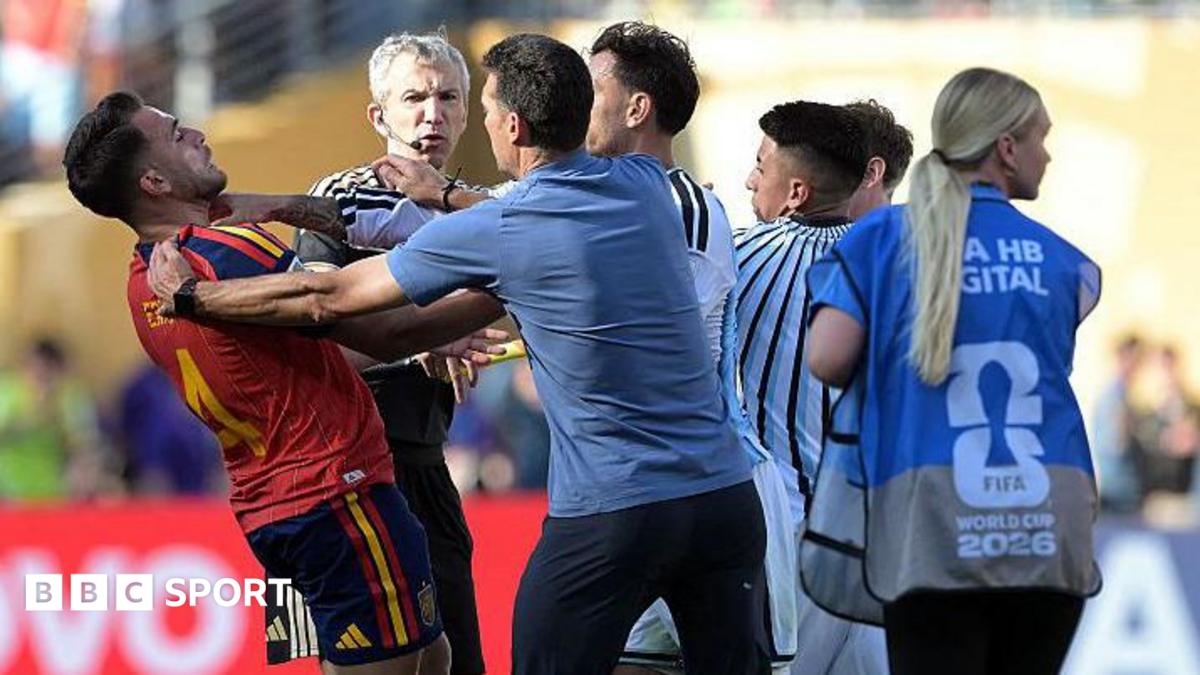
After Spain secured a 1-0 victory over Argentina in the 2026 FIFA World Cup final at New Jersey’s MetLife Stadium, chaotic post-match violence has triggered an official disciplinary probe from global football’s governing body. FIFA confirmed Tuesday that its disciplinary committee has named a dedicated disciplinary and ethics prosecutor to examine the full sequence of events that unfolded immediately after the final whistle, with potential sanctions ranging from player and coach suspensions to heavy fines for the Argentine Football Association (AFA).
The trouble ignited when Spain’s Rodri, a substitute who had already been pulled from the game in extra time, ran past Argentina defender Nahuel Molina while heading to join his celebrating teammates. Molina appeared to punch the Manchester City midfielder in the arm or torso, setting off a chain of aggressive confrontations that quickly spread across the pitch. When Spain’s Eric Garcia stepped in to support Rodri, Argentina’s Leandro Paredes intervened and jabbed Garcia in the throat. Unused Spain substitute Gavi attempted to de-escalate the clash, only to be thrown to the ground by Argentina’s Thiago Almada, before Paredes pushed Gavi further by shoving his hand into the player’s face. Argentine assistant coach Roberto Ayala was also filmed appearing to grab Garcia around the throat and strike Spain midfielder Dani Olmo.
Early erroneous reports circulated via FIFA’s commentator information system claimed Paredes had been sent off during the incident by referee Slavko Vincic for the altercation with Garcia. FIFA later clarified to BBC Sport that no on-field disciplinary action was issued against any player during the chaos, and the incorrect red card entry was quickly removed from official records. Argentina already had one player sent off during the match itself, with Enzo Fernandez receiving a second yellow card in second-half stoppage time.
This is not the first time the AFA has faced FIFA scrutiny over controversial player behavior at this tournament. Following Argentina’s 2-1 semi-final win over England, several players displayed a banner asserting Argentina’s territorial claim to the Falkland Islands, a move that already triggered preliminary disciplinary proceedings. The AFA has a long pattern of similar incidents in recent years: after the 2022 World Cup final win over France, the organization was fined £18,300 for unsporting behavior that included a lewd gesture from goalkeeper Emiliano Martinez and a mocking post-match video aimed at Kylian Mbappe. In 2024, Enzo Fernandez was forced to apologize for a racist, discriminatory chant referencing the 2022 final, and Martinez received a two-game ban for offensive behavior during World Cup qualifiers. A 2014 friendly against Slovenia also resulted in a £20,000 fine when Argentine players displayed the same Falklands banner currently under investigation.
FIFA’s disciplinary framework gives the appointed prosecutor broad authority to review all conduct related to the final brawl, beyond just violent behavior. Under Article 13 of FIFA’s disciplinary code, the actions of Argentine players and staff could be ruled a violation of fair play principles, offensive conduct, and bring the sport of football into disrepute. The prosecutor will weigh both aggravating and mitigating circumstances before issuing charges, and any guilty ruling can result in globally enforced suspensions. Precedent for harsh sanctions exists: former Spanish Football Federation president Luis Rubiales received a three-year global ban for non-consensually kissing player Jenni Hermoso after the 2023 Women’s World Cup final, while Uruguay striker Luis Suarez was handed a four-month suspension for biting Giorgio Chiellini at the 2014 World Cup. Analysts do not expect the Argentine individuals involved in the 2026 final brawl to receive bans of that length, however.
FIFA has not set a public deadline for the investigation to conclude, referencing past disciplinary probes that have taken months to reach a final ruling. For context, a recent investigation into alleged homophobic abuse by a Benfica player against Real Madrid’s Vinicius Jr. took more than two months to result in a six-match ban. The ongoing probe adds another layer of controversy to a World Cup final that already saw Spain claim its latest major trophy, cementing its status as one of the world’s dominant men’s football nations.