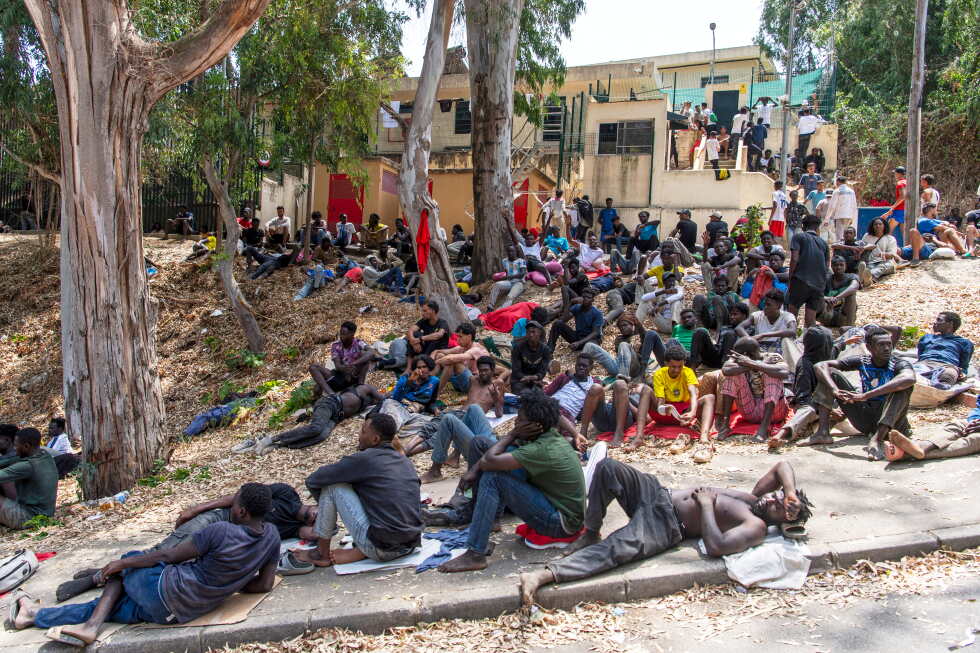
The mass arrival of around 60,000 migrants at the border of Ceuta, Spain’s small North African enclave, has ignited a flood of unproven claims and speculative narratives surrounding what triggered the unprecedented surge, along with the potential geopolitical and domestic fallout of the crisis. To put the scale of this incident in perspective, the number of migrants who crossed into Ceuta over just two days — Thursday and Friday — equals roughly 70% of the enclave’s permanent resident population. At least 41 people have been confirmed dead, killed either by drowning during the dangerous crossing attempt or in a chaotic stampede at the frontier. What follows is a fact-based breakdown of the most widespread claims circulating about this crisis.
### Claim: Spain’s recent immigrant amnesty policy directly caused the border rush
Critics including former U.S. President Donald Trump and his administration have argued that the Spanish government’s new amnesty program signaled to migrants that Spain has lax border policies, prompting the mass crossing. Trump explicitly blamed Spain’s “weak law, bad management” for the incident, while the U.S. State Department amplified this stance in a post on social platform X, claiming the crisis was “the direct result of the Spanish Government’s deliberate efforts to enable and facilitate mass illegal migration into Europe.”
In response, the Spanish government has firmly rejected this narrative, pointing instead to transnational criminal smuggling networks as the primary drivers of the crisis. Madrid notes that it has maintained strict enforcement against unauthorized border crossings while creating legal pathways for migrant workers that the country’s growing economy depends on.
Under the amnesty policy, migrants without residency permits can legalize their status if they can prove continuous residence in Spain for at least five years and entered the country before January 1, 2026. More than 1 million people submitted applications before the application window closed at the end of last month. Broader structural factors also push migration from Morocco: widespread poverty and extremely high youth unemployment, particularly outside of Morocco’s developed coastal tourist hubs, fueled widespread Gen Z-led pro-reform protests last year, pushing many young Moroccans to seek better economic prospects in Europe. Even with these context factors, the exact trigger for the sudden, massive surge remains unconfirmed.
### Claim: A misinterpreted Spanish Supreme Court ruling sparked the crossings
Spanish Prime Minister Pedro Sánchez has argued that a recent Supreme Court ruling was deliberately misrepresented by human smugglers to convince thousands of migrants to cross the border by swimming around the fixed border fence. The ruling in question established that migrants arriving by sea cannot be immediately deported without due process, a different standard from that applied to migrants who cross over land or climb the physical border barrier.
Human rights and migration activists corroborate that misinformation spread on social media played a major role in encouraging the mass departure. Achraf Maimouni, a Moroccan human rights activist, explained: “The departures were promoted in a certain way. At first, people were hearing that the border was open, and then everyone started referring to the Spanish court decision. That contributed to the crossings.”
### Claim: Morocco intentionally opened the border to enable the surge
The context of this incident traces back to a 2021 border crisis, when more than 8,000 migrants crossed into Ceuta after Moroccan border officials relaxed security checks, a move widely seen as diplomatic retaliation for Spain allowing a Western Saharan pro-independence leader to receive medical treatment in a Spanish hospital. That crisis was defused after Spain shifted its decades-long policy on the disputed Western Sahara region, and Sánchez met with Moroccan King Mohammed VI the following year.
In this far larger 2025 crisis, initial statements from Spanish officials confirmed that Moroccan authorities were collaborating to halt the surge. However, those initial efforts failed to stop thousands of migrants from crossing over the two-day period. An Associated Press freelance photographer based in Ceuta witnessed Moroccan gendarmes standing by without intervening as thousands of migrants passed near their posts to enter Ceuta on Thursday. It was only on Friday that Moroccan security forces escalated their response, deploying tear gas, batons and water cannons to disperse large crowds of migrants gathering at the border.
Morocco’s ambassador to Spain stated that the crisis unfolded against Rabat’s wishes and expressed hope that most migrants would return to Morocco. Notably, Morocco has never formally recognized Spanish sovereignty over Ceuta and its sister enclave Melilla, despite the territories having been under Spanish control for centuries.
### Claim: The surge is retaliation for Spain’s positions on Gaza and Iran
Unsubstantiated conspiracy theories have circulated online claiming that the U.S. under the Trump administration and Israel encouraged Morocco to allow the mass crossing, in retaliation for Spain’s criticism of Israel’s military campaign in Gaza and the joint U.S.-Israeli attack on Iran. While Trump has publicly attacked Spain for months and threatened to end trade with the country, and Israeli Prime Minister Benjamin Netanyahu has accused Spain of waging a diplomatic war against Israel, there is no verifiable evidence linking either country to the Ceuta border crisis.
### Claim: Most crossing migrants will eventually reach mainland Europe
Political leaders in neighboring Italy and France have already taken restrictive measures in response to the crisis, framing the moves as preparations to block migrants from entering their countries. Italian Prime Minister Giorgia Meloni even threatened to suspend Italy’s participation in the Schengen Area’s open border agreement with Spain, despite the fact that Italy shares no land border with Spain and is itself a major entry point for tens of thousands of Mediterranean migrants each year. French Interior Minister Laurent Nunez also announced that France would strengthen border controls with Spain.
In reality, the impact of the surge will remain largely contained to Ceuta, with minimal spillover into mainland Spain or the rest of Europe. The Spanish government has confirmed it reached an agreement with Morocco to repatriate all migrants who entered Ceuta illegally. By Friday afternoon, more than half of the migrants who crossed had already returned to Morocco voluntarily. Those who remain in Ceuta will either be repatriated in the coming days or face extended periods of legal uncertainty, often in government-run detention centers.
Associated Press journalist Akram Oubachir contributed reporting from Casablanca, Morocco.