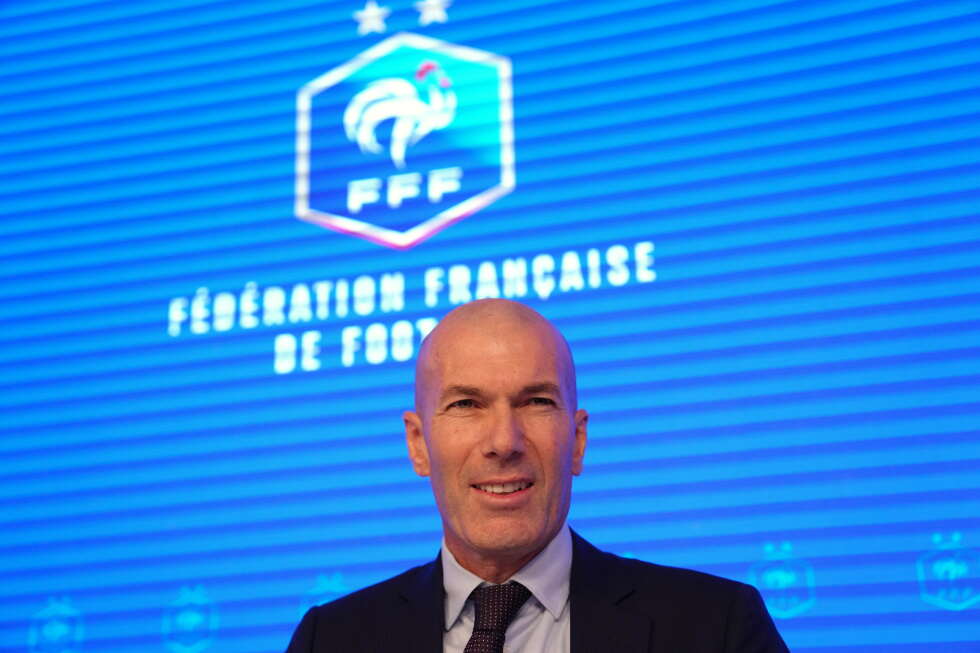
PARIS (AP) — When French Football Federation (FFF) president Philippe Diallo officially named Zinedine Zidane the new head coach of the French men’s national soccer team at the federation’s Paris headquarters on Tuesday, the 54-year-old legend could barely contain his emotion. With his fist clenched and his typically calm voice shaking slightly, Zidane opened his first public address by admitting his long-held dream of leading Les Bleus had finally come true.
“I’m excited,” Zidane said. “The France team makes you dream. We have extraordinary players, an extraordinary group of staff and talent.”
The appointment ends Didier Deschamps’ 12-year tenure at the helm of the national side, coming after Deschamps confirmed he would step down following France’s 2024 European Championship semifinal exit against Spain. For Zidane, the role is the culmination of a half-decade of patience: after departing his post as Real Madrid head coach in 2021, he rejected every club offer that came his way, holding out exclusively for the chance to lead his home nation.
“I’ve waited five years for this chance, so that’s why I’m a bit emotional,” Zidane noted, calling the announcement the happiest day of his coaching career to date. “I’ve always watched this side as a fan and also as a future coach, I won’t hide it. That’s why I didn’t take a club side. I told myself that the only thing I wanted to do after Madrid was taking the France team.”
Diallo confirmed that Zidane has signed a four-year contract with the FFF, framing the hiring as a landmark moment for French soccer. “This is an exceptional moment, exceptional because of the person sat next to me,” Diallo said. “Zidane is one of the legends of French soccer, there is no other way to put it.”
Zidane was quick to pay tribute to his predecessor, who led France to a 2018 World Cup title and a 2022 World Cup final finish. Deschamps faced growing criticism in his final years in charge, with some pundits arguing he underperformed with the talented squad at his disposal, and the outgoing coach himself referenced an “unbreathable atmosphere” in his final months in the role. Still, Zidane praised Deschamps’ legacy.
“Today I have the opportunity to be in charge of this team and I will give everything so that this team can win,” Zidane said. “I would also like to congratulate DD for these remarkable years at the helm.”
FFF leadership first opened talks with Zidane in February 2025, shortly after Deschamps confirmed he would step down after the 2026 World Cup. When it comes to on-pitch identity, Zidane made clear his approach will differ from Deschamps’ pragmatic style. A creative attacking playmaker during his own playing career, Zidane framed his coaching philosophy around attacking, entertaining soccer.
“What motivates me is the game, I was a No. 10, I like goals,” he said. “I was a leader on the field and now I want to be a leader by experience.”
Zidane’s first match in charge will be a Nations League away fixture against Turkey on September 25, followed by a second away match against Belgium three days later. French supporters will get their first chance to see Zidane at the Stade de France on October 2, when France hosts Italy — a fixture that carries particular personal weight for the new coach. It was exactly 20 years prior that Zidane’s international career ended in infamy at the 2006 World Cup final in Berlin, when he was sent off for headbutting Italian defender Marco Materazzi in the tournament’s deciding match.
“Italy is special, because I played there, because I know people, because I speak Italian. All of those things,” Zidane said of the October fixture, adding that he has already memorized the details of his first four matches in charge. Following Tuesday’s announcement, Zidane stepped outside FFF headquarters to greet a large crowd of cheering fans, who welcomed their new coach with loud chants and applause.
Zidane and Deschamps have long been tied to French soccer glory: the pair were key parts of the 1998 World Cup and 2000 Euro winning squads, with Deschamps serving as the hardworking captain and Zidane as the team’s mercurial creative superstar. No one embodied the 1998 triumph more than Zidane: he scored two iconic headers in the 3-0 final win over Brazil at the Stade de France, and his face was projected onto the Arc de Triomphe during the nation’s victory celebrations that night. He would go on to win the Ballon d’Or that same year.
Born in Marseille to Algerian parents, Zidane built a legendary club career across top European sides, starting with stints at Cannes and Bordeaux before moving to Italian giant Juventus and eventually Real Madrid. He made his international debut in 1994, announcing his arrival on the national stage by scoring two stunning goals as a second-half substitute against the Czech Republic in Bordeaux. He won multiple domestic league titles at both Juventus and Real Madrid, and scored one of the most iconic goals in Champions League history — a stunning volley in the 2002 final against Bayer Leverkusen — to secure the trophy for Los Blancos.
Zidane retired from international soccer after the 2006 World Cup, capping a 12-year international career with 108 caps and 31 goals, including that opening penalty in the 2006 final against Italy. As a coach, he built an equally impressive legacy at Real Madrid, leading the Spanish giants to three consecutive Champions League titles between 2016 and 2018 before departing and returning for a second stint that ended in 2021.
For Zidane, leading France is the final chapter of his historic relationship with the national side, a role he has spent half a decade working toward. “I have so many emotions, I am ready for the challenge,” he said. “That’s what motivates me.”