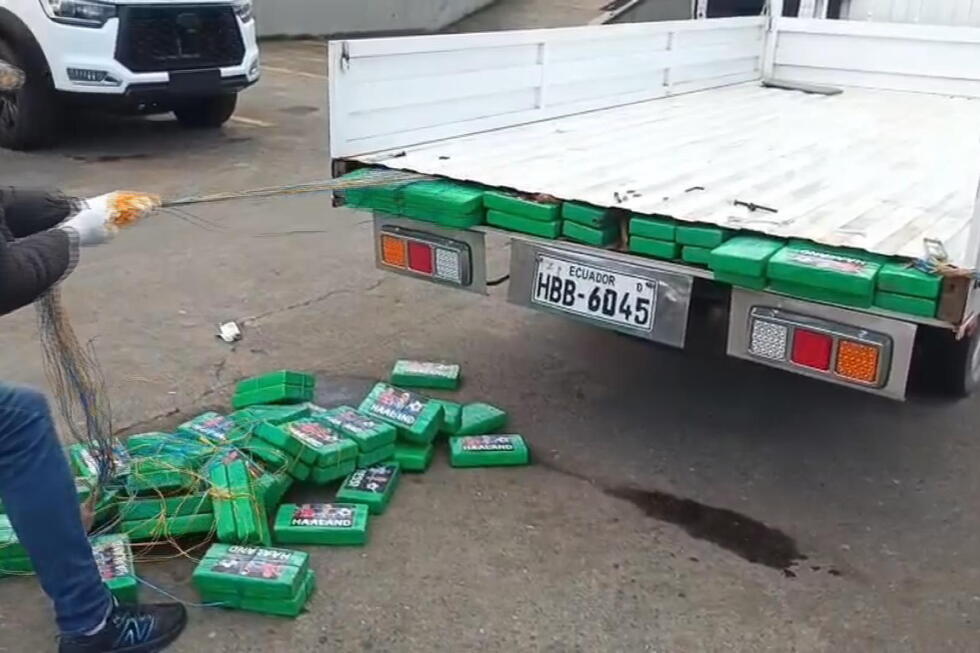
QUITO, Ecuador — Global soccer superstar Erling Haaland has built an iconic public profile in recent years, his face gracing everything from billboards and collectible trading cards to global television broadcasts. The Norwegian striker became a viral social media sensation after netting seven goals across four matches at the 2026 FIFA World Cup, spawning endless memes and fan content across platforms. Now, law enforcement in Ecuador has found his likeness in an entirely unexpected context: printed on packaging for a massive cocaine shipment seized near the country’s northern border with Colombia.
Ecuadorian national police confirmed Wednesday that anti-narcotics officers arrested a truck driver following the seizure of 469 kilograms (1,034 pounds) of high-purity cocaine. The seizure unfolded along the Pan-American Highway, where agents launched a stop and search after receiving an anonymous tip about suspicious activity early Tuesday. A search of the vehicle uncovered 370 green rectangular drug packages hidden in a custom-built false compartment in the truck’s bottom. Law enforcement has so far offered no official explanation for why traffickers chose to adorn the packages with stickers of the golden-haired Norwegian striker, but the practice is well-documented in international drug trafficking circles.
Criminal networks commonly label drug shipments with the names and images of high-profile celebrities and star athletes, a tactic used to signal which cartel produced the narcotics and which recipient the shipment is intended for. Police released public footage of the seizure showing packages pouring out of the truck’s hidden compartment, with Haaland’s face clearly visible on the packaging stickers. The striker, who is affectionately nicknamed “pretty princess” and “babygirl” by legions of his online fans, was one of the breakout stars of the 2026 World Cup co-hosted by the United States, Mexico, and Canada. His combination of imposing physical stature, dead-eye finishing, and playful, goofy sense of humor turned him into a global viral favorite, with thousands of creative fan videos and memes circulating online in the months following the tournament.
Haaland is far from the first top soccer player whose image has been co-opted by drug smuggling operations. Law enforcement officials have previously found cocaine shipments marked with images of Argentine captain and eight-time Ballon d’Or winner Lionel Messi, confirming the trend of traffickers using high-profile sports figures for shipment branding.
The seizure, which took place in the Guagua Negro region near the border city of Tulcan, around 153 miles north of Ecuador’s capital Quito, also led to a second arrest. Police took a woman identified only as María R., who holds Colombian identity documents, into custody as part of the operation. According to drug enforcement estimates, the seized shipment carries a street value of nearly $842,000 in Ecuador, but would be worth more than $11 million if it reached the U.S. market, and upwards of $19.6 million (17 million euros) if distributed across Europe.
Ecuador has long served as a key logistical hub for international drug trafficking. Criminal networks based in the country stockpile, store, and ship narcotics north through Central American routes primarily to consumer markets in the United States, though significant volumes are also trafficked to Europe. Local Ecuadorian gangs work in alliance with major Colombian and Mexican cartels to manage these trafficking routes. Roughly 80% of all narcotics trafficked through Ecuador originate in Colombia, with the remaining 20% coming from neighboring Peru.
Data from Ecuadorian law enforcement shows consistent large-scale drug seizures across recent years. In the first half of this calendar year, police have already seized 80 tons of illicit drugs. In 2025, authorities confiscated nearly 215 tons of narcotics, the vast majority of which was cocaine, while seizures reached almost 295 tons in 2024.