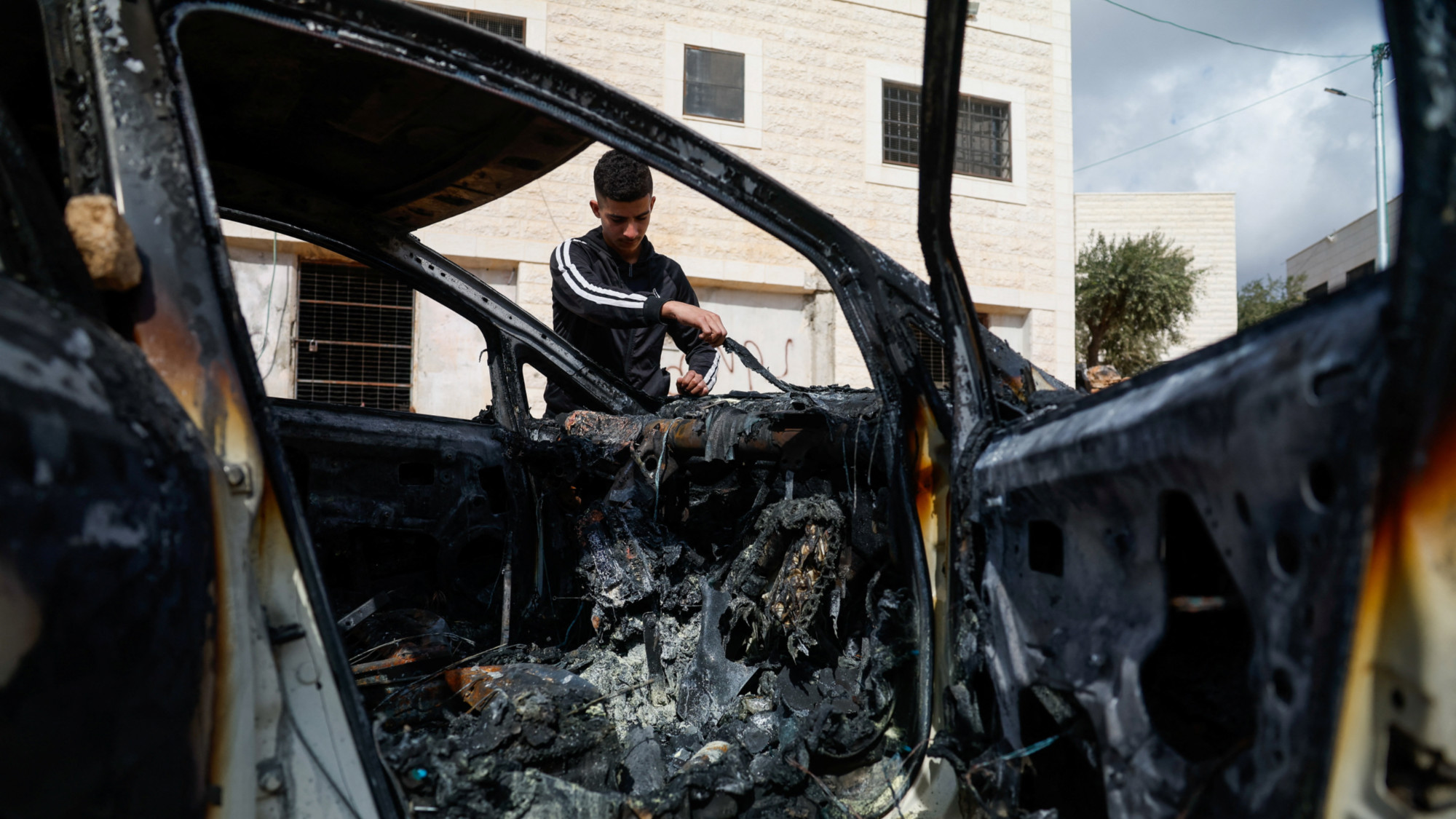
Overnight between Monday and Tuesday, a coordinated wave of violent unrest carried out by dozens of Israeli settlers spread across multiple locations in the occupied West Bank and East Jerusalem, leaving Palestinian property destroyed and families displaced once again, just hours after a court-ordered return to their seized land.
The most high-profile incident unfolded shortly after midnight in the village of Jalud, located south of the northern West Bank city of Nablus, where roughly 100 settlers launched a targeted raid on properties belonging to the Toubasi Palestinian family. The Toubasi family had originally been forced to abandon their land in July, after repeated incursions by settlers intent on seizing their home. In a rare ruling, an Israeli court had ordered the Israeli military to guarantee the family’s safe return to their property — and the family had only been back for several hours when the large group of settlers arrived.
By the time the violence ended, the settlers had set ablaze two separate homes owned by members of the Toubasi family, forcing the entire clan to flee their land for a second time. Mahmoud Toubasi, one of the property owners, told reporters that when he was eventually able to return to assess the damage, his family was stunned by the scale of the destruction. He confirmed that the fire had completely gutted the home, destroyed all of the family’s belongings, and left the structure completely uninhabitable.
Multiple local media reports indicate that when Israeli military forces finally arrived at the scene, they did not take action to halt the settler attack. Instead, witnesses claim troops provided a security cordon for the settlers, and the Toubasi family was ultimately forced to evacuate their property at gunpoint. The Israeli army later reported that clashes broke out between troops and some settlers as forces attempted to disperse the large crowd. Army officials confirmed that three officers were injured after settlers blocked local roads, ignited tire fires, and threw rocks at responding troops.
Israeli political leaders have publicly condemned the violence between settlers and troops, but notably failed to address the attacks on Palestinian people and property. President Isaac Herzog described the intra-settler clashes as a “moral stain and an attack on the rule of law and our most basic values as a nation”, but made no mention of the displacement of the Toubasi family or the destruction of their homes. Prime Minister Benjamin Netanyahu echoed that framing, arguing that the “small number of rioters does not represent the law-abiding settler community” and also omitted any reference to the violence targeting Palestinians.
The violence in Jalud was not an isolated incident. Across the occupied West Bank, other settler attacks were reported overnight. In the village of al-Mughayyir, located northeast of Ramallah, settlers set fire to a Palestinian home and multiple civilian vehicles. Large groups of settlers also entered Beitunia and the Jaryout Road west of Ramallah under Israeli military protection, where local sources report they attacked passing Palestinian vehicles, stoned cars, and instilled widespread fear among local civilian residents.
In occupied East Jerusalem, the violence spilled over into the Old City, where dozens of settlers assaulted two Palestinian men near the Damascus Gate late Monday. Graphic footage of the attack, which showed Israeli youth pushing the two men to the ground and repeatedly kicking them, was later shared publicly on social media. The attack came as thousands of Israelis gathered in and around the Old City’s Muslim Quarter, including areas adjacent to the Al-Aqsa Mosque compound, to mark the Jewish religious holiday of Sukkot. Israeli forces imposed sweeping restrictions on Palestinian residents ahead of the holiday, ordering dozens of Palestinian-owned shops to close and forcing local residents to remain confined to their homes to make way for Jewish religious processions through the Old City’s narrow alleyways.
Settler violence against Palestinian communities has been a persistent reality for residents of the occupied West Bank and East Jerusalem for decades, but international monitors and humanitarian groups have recorded a dramatic, sustained surge in attacks since the start of Israel’s military campaign in Gaza in October 2023. Today, settlers carry out near-daily attacks targeting Palestinian towns and villages, including arson, property vandalism, physical assault, and efforts to forcibly displace Palestinian communities from their land. Humanitarian data shows that most of these attacks take place under explicit military protection from Israeli forces. Since October 2023, more than 1,300 Palestinians have been killed in attacks and unrest in the occupied West Bank alone.
Earlier this year, the United Nations’ Independent International Commission of Inquiry on the Occupied Palestinian Territory labeled the escalation in settler violence “unprecedented and sustained”, and concluded that the Israeli government actively enables these attacks through financial backing, logistical support, and ongoing military protection. “Violence by settlers is the direct outcome of Israeli policies that support, enable and protect their actions,” explained Srinivasan Muralidhar, chair of the commission.
Data from the UN Office for the Coordination of Humanitarian Affairs (OCHA) confirms the steep upward trend in attacks. Between the start of January and 14 September of this year, OCHA recorded more than 1,600 separate settler attacks that resulted in Palestinian casualties, damage to Palestinian property, or both. That works out to an average of 6.7 attacks per day, up from five attacks per day in 2025, when 1,836 total attacks were recorded for the full year. Annual totals have risen steadily year over year: 1,500 attacks were recorded in 2024, compared to 1,291 in 2023, and just 853 in 2022.