As the high-stakes November 2025 US midterm elections approach, President Donald Trump has sharply escalated a familiar political playbook: rolling out headline-grabbing stunts to redirect public attention away from issues weighing on his approval ratings and toward his preferred political narrative. The 80-year-old former reality television star, who has long relied on the tactic of shifting conversations when headlines turn unfavorable, is now targeting his diversions with unusual precision to drown out coverage of the ongoing Iran conflict and economic anxiety hitting American households.
“This president specializes in diversions,” William Galston, a senior fellow at the Brookings Institution, told Agence France-Presse. After six months of open conflict, the Iran war has emerged as a major drag on Trump’s approval numbers, with independent polling consistently placing his support in the low 30s. With no clear end to the conflict in sight, The Atlantic has reported that the White House’s core strategy is to push the war out of public consciousness: avoiding large new military deployments and instead focusing on low-profile economic sanctions against Tehran, while creating new newsworthy moments to draw the press and voters elsewhere.
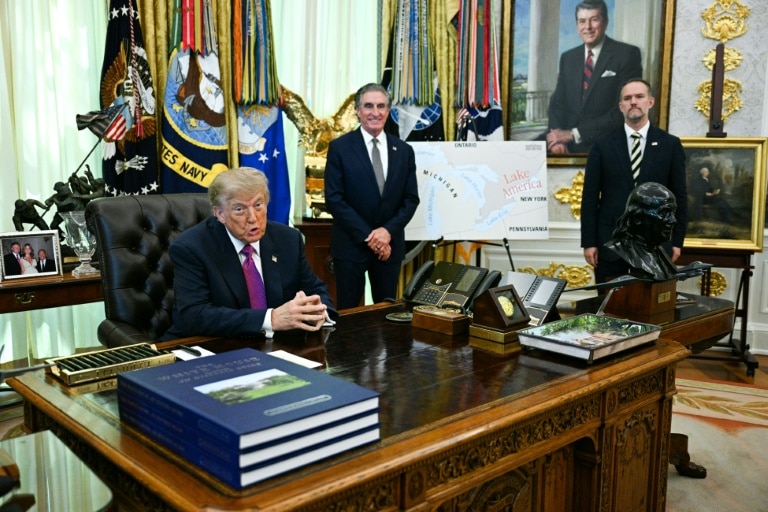
The most striking of these diversions came last Thursday, when Trump summoned reporters to the Oval Office to make an unprecedented announcement: he had signed an executive order to rename Lake Ontario—the shared transboundary water body between the United States and Canada—”Lake America.” The provocative move comes on the heels of a days-long, headline-dominating trade dispute with Ottawa, and fits neatly into the “America First” messaging that Trump has centered for his core political base.
Democrats across the Capitol were quick to condemn the action as a juvenile, transparent bid to distract from pressing national issues. “It’s a pathetic attempt at distraction, and it’s working families who are paying the price,” Senate Minority Leader Chuck Schumer said in a formal statement following the announcement.
The Lake Ontario renaming is far from an isolated incident. Just a week earlier, Trump unexpectedly revived discussions of potential new talks with North Korean leader Kim Jong Un—a topic he had not addressed publicly since his second inauguration in January 2025. He heaped praise on Kim, whom he met three times during his first term, while criticizing US long-time ally South Korea and announcing further cuts to joint military exercises with Seoul. He has also leaned into more personal, viral-friendly topics, sharing frequent updates on his planned renovations to the White House on his Truth Social platform—most recently posting about “cleaning and regrouting the Granite” at the building’s main entrance, a move Democrats argue highlights how out of touch he is with everyday voter concerns.
Beyond diverting attention from problematic issues, Trump’s stunts also serve a second goal: keeping all political focus centered on himself ahead of the midterms. After his hand-picked endorses won a string of key Republican primaries, the two-term president has publicly argued he is the GOP’s biggest asset in the upcoming vote. “Pretend I’m on the ballot,” he told Fox News in a recent interview. Drawing from a $400 million campaign war chest, Trump is also set to roll out a national television ad campaign touting his own presidential record, as many within the party fear Republicans could lose their narrow control of both chambers of Congress.
The White House has also amplified a curated list of administration wins this week, highlighting 14 policy achievements ranging from new restrictions on mail-in voting to expanded migrant deportations to energize the base.
Even with these aggressive tactics, Trump faces significant barriers to shifting the national conversation to his preferred ground. The Iran conflict remains a persistent political quagmire for a president who campaigned on keeping the United States out of costly new foreign wars. If global oil prices remain elevated, driving up overall cost of living for households, economic issues will likely remain the top priority for voters regardless of viral stunts. “It’s hard to change people’s minds when you’re talking about things they’re experiencing directly,” Galston noted.
The White House has also recently lost one of its most effective communications leaders, after popular Press Secretary Karoline Leavitt stepped down to spend more time with her children, leaving a gap in the administration’s ability to message around key issues. After the midterms, Trump is also set to enter the lame-duck phase of his presidency, which could dim his political star unless he finds new ways to stay in the national spotlight.
One potential path to remaining center stage is building suspense around his 2028 political plans. Trump has already dropped repeated hints that he could run for a third presidential term—a move barred by the 22nd Amendment to the US Constitution, but political observers have long learned that betting against Trump’s willingness to challenge established norms is rarely a safe wager.