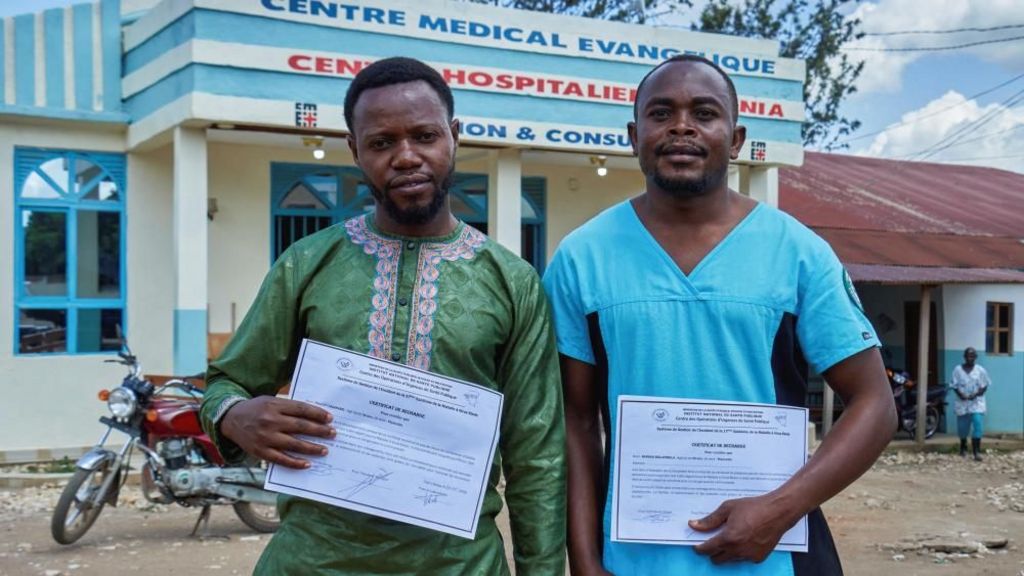
In a hopeful turning point for the ongoing Ebola outbreak centered in the Democratic Republic of the Congo’s (DRC) eastern Ituri province, five infected patients have officially recovered and been discharged from medical care, drawing praise from global and national health authorities. Four of the newly discharged survivors are frontline nurses, honored at a public ceremony held Sunday in Bunia, Ituri’s provincial capital, while the first recovered patient – a laboratory worker – was released last week.
Speaking directly to the four nurse survivors during his visit to Bunia, World Health Organization (WHO) Director-General Dr. Tedros Adhanom Ghebreyesus highlighted the profound symbolic power of their recovery. “You are living proof that this outbreak can be stopped,” he told the group, which includes three men and one woman. Acknowledging the heavy toll the outbreak has already taken on frontline medical staff, Dr. Tedros added, “It pains me to see health workers who have already died because of Ebola while serving others… this is the risk which comes with the profession, but your commitment to coming back to serve means a great deal.” Each survivor received a formal certificate recognizing their recovery at the ceremony.
For the survivors, the experience of infection and isolation was deeply challenging. Nurse Etienne Ezo, one of the discharged nurses, shared his candid reflection with Reuters, saying, “We were really demoralized because we thought at any moment we would die. If you have never been isolated, you cannot understand how hard that experience is.”
National health officials echoed Dr. Tedros’ optimism, framing the recoveries as a clear validation of existing response strategies. DRC’s Institute of Public Health wrote on social media that this encouraging milestone confirms the effectiveness of core field interventions: early detection of cases, timely clinical care, comprehensive contact tracing, and active community engagement. The institute’s director, Dr. Mwamba Kazadi, called the recoveries a victory worth celebrating, emphasizing that early diagnosis and high-quality care directly improve patient outcomes. Health officials stress this outcome should encourage anyone who suspects they have contracted Ebola to seek medical care immediately.
The latest outbreak, the 17th recorded Ebola outbreak in DRC history, is caused by the Bundibugyo strain of the virus, for which no widely approved vaccine currently exists – though development of targeted vaccines is ongoing. As of the latest update, more than 1,000 suspected cases have been recorded in DRC, with at least 246 deaths linked to the outbreak. The virus has spread beyond DRC’s borders: neighboring Uganda has confirmed nine cases and one death, including cases in the capital Kampala, and suspected cases have even been identified outside of Africa. On Saturday, Brazilian health authorities announced they were investigating two potential Ebola cases in São Paulo state.
Despite this small win, major challenges remain for the outbreak response. Dr. Tedros highlighted persistent barriers including gaps in early case detection and isolation, incomplete contact tracing, difficulties implementing safe and dignified burial practices, infection control gaps in health facilities, and low community awareness in some affected areas. Most notably, community resistance has emerged in some regions, sparked by public health rules that ban traditional family handling of Ebola victims’ bodies to prevent transmission – a regulation that directly clashes with long-held local burial customs. This tension has already led to attacks on health centers by local residents.
Addressing these challenges, Dr. Tedros and the Congolese government released a joint statement Sunday emphasizing that local communities are “at the heart of the solution” to the outbreak, and that successful response depends on earning community trust and active participation. The joint statement calls on all communities to adopt sustained protective behaviors, including regular hand washing, seeking early medical care at approved facilities when symptoms appear, and sharing accurate public health information to counter misinformation.
Frontline health workers have borne the brunt of the outbreak’s risk, with many contracting the virus while caring for patients. The recovery of five infected patients, four of them health workers, offers a rare moment of optimism amid a crisis that has already claimed hundreds of lives, and serves as a reminder of the importance of rapid access to care for those exposed.