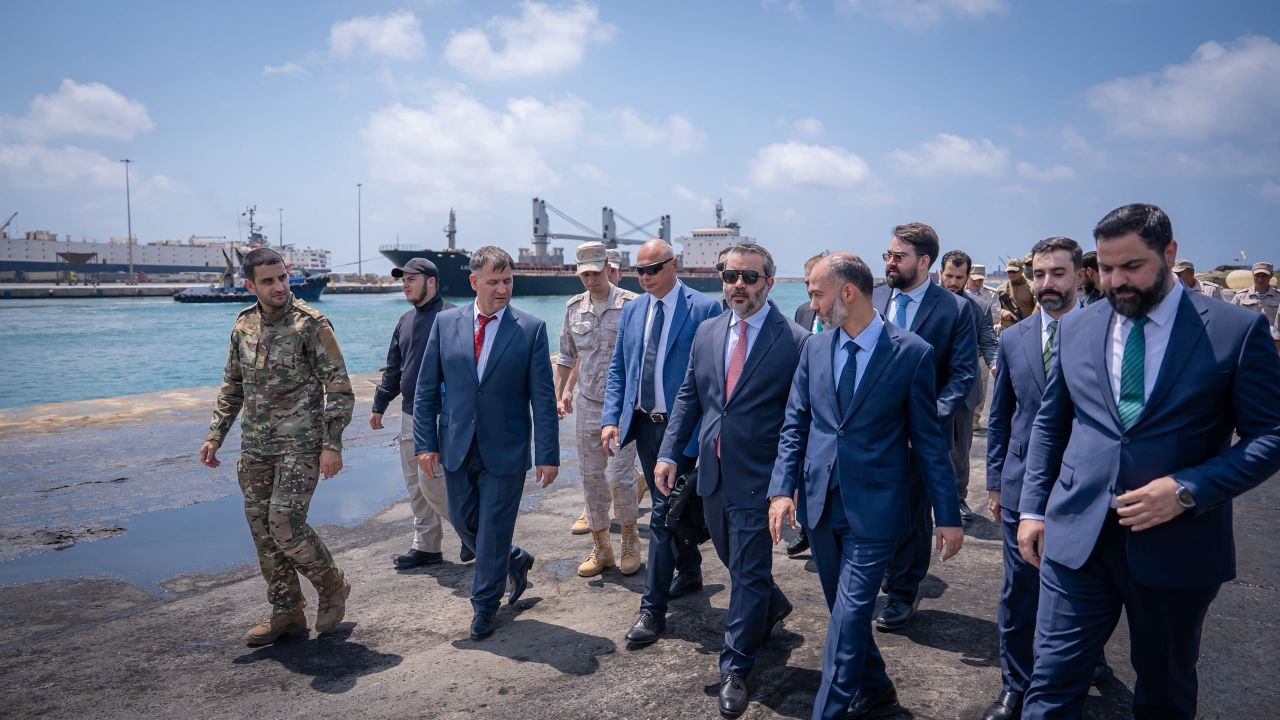
After 18 months of rigorous negotiations centered on the future of Russia’s key military installations along Syria’s Mediterranean coast, Damascus and Moscow have finalized a landmark memorandum of understanding that will scale back Russia’s military footprint in the region.
The Syrian foreign ministry made the announcement of the bilateral agreement public on Sunday, noting that the pact was the product of 18 months of targeted negotiations and intensive high-level discussions led by the ministry itself. Details of the agreement, shared by Syrian state news agency SANA, outline a clear transition plan for the two strategic sites: the Hmeimim airbase and the Tartus naval facility.
Under the terms of the memorandum, the Syrian state will assume full management of all civilian infrastructure at both locations, including Hmeimim airport and Tartus’s fourth commercial pier. These assets will be gradually integrated into Syrian civilian national administration over the coming months. Military components of the sites will be reorganized into joint Syrian-Russian training and qualification centers, a structure designed to protect the core strategic interests of both nations. The full transition of all assets is scheduled for completion within a three-month window, per the Syrian foreign ministry’s timeline, which frames the shift as a deliberate “reorganisation of the Russian presence” along Syria’s coastline.
This diplomatic breakthrough marks the most substantial progress in bilateral talks since they launched 18 months ago, opening a new chapter in the evolving relationship between Damascus and Moscow. On the same day the agreement was announced, Syrian Foreign Minister Asaad al-Shaibani led a delegation to inspect the sites at Latakia International Airport (the civilian counterpart to Hmeimim) and the Port of Tartus, with government officials describing the memorandum as a historic milestone for Syrian sovereignty.
The deal comes as the most visible indicator of shifting Syrian-Russian relations in the months following the December 2024 toppling of former president Bashar al-Assad. Russia stood as one of Assad’s most critical international allies during his decades in power: its 2015 military intervention turned the tide of Syria’s long-running civil war in Assad’s favor, and the Tartus and Hmeimim facilities formed the backbone of Moscow’s military deployment in the country.
For more than half a century, Tartus has held unique strategic value for Russia: it is Moscow’s only permanent naval facility outside the territory of the former Soviet Union, and has served as a critical resupply hub for Russian Mediterranean naval forces while enabling Moscow to project military power across the Middle East and North Africa. Hmeimim, meanwhile, became the central hub for Russian air operations in Syria immediately following the 2015 intervention. Together, the two bases granted Russia a enduring strategic foothold on the Mediterranean Sea that supported its broader regional geopolitical ambitions.
Under the new arrangement, Russia will no longer operate the bases independently as it did during the Assad era, but it will not withdraw entirely from the strategic coastline. According to reporting from Al Jazeera’s Damascus correspondent Obaida Hitto, the Syrian government has framed the deal as a clear assertion of full national sovereignty over all territory and assets within its borders, emphasizing that “its national sovereignty is not up for negotiation.”
Since taking office, current Syrian President Ahmed al-Sharaa has traveled to Moscow twice to hold direct talks on the future of the bases with Russian President Vladimir Putin, a series of diplomatic overtures that align with the new Syrian government’s broader foreign policy goals: pursuing much-needed sanctions relief from the United States and strengthening economic and political ties with France. As of Sunday evening, Moscow had not released any public official response to the finalization of the agreement.
The restructuring of Russian military presence also coincides with a broader push by Damascus to redevelop Syria’s Mediterranean coastline as a global trade and investment hub. Just this year, the Syrian government has already signed two major long-term concession agreements with international firms to unlock coastal economic potential. In May 2025, Damascus renegotiated its operating contract for the Latakia container terminal with French shipping giant CMA CGM, agreeing to a new 30-year concession that includes $265 million in planned investment and the construction of a new deep-water berth. Two months later, in July 2025, the government signed an $800 million, 30-year concession handing management of Tartus’s main commercial port to Dubai-based logistics firm DP World. DP World CEO Sultan Ahmed bin Sulayem has described Tartus as an “essential hub for trade and exports” for the entire region, and the port has already emerged as a key focus of foreign direct investment in Syria following the collapse of the Assad government.