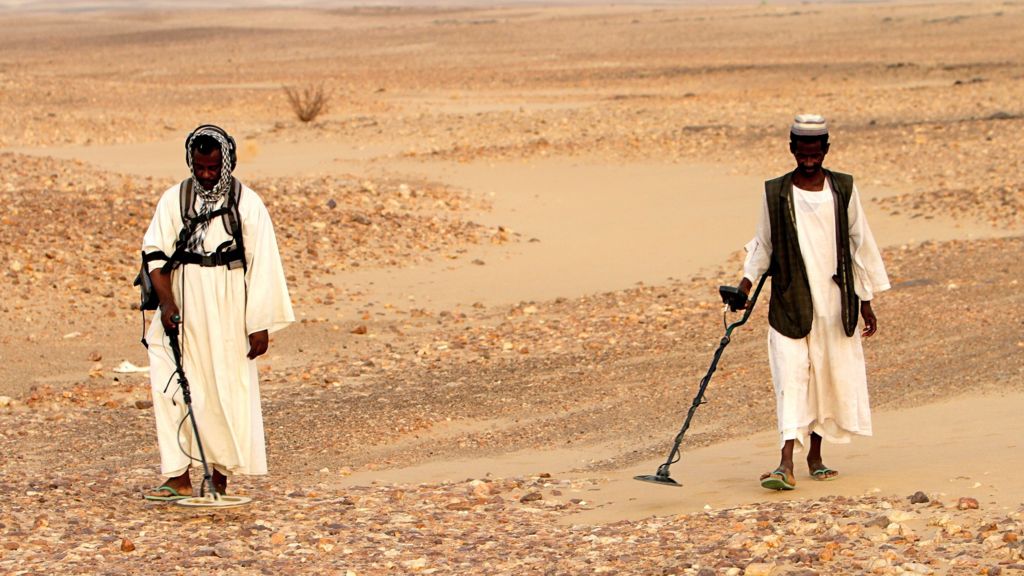
A deadly air strike targeting civilian gold prospectors in a remote border area of Sudan has left at least 72 people dead, according to a regional human rights organization.
Khartoum-based rights group Emergency Lawyers confirmed that military jets struck informal artisanal miners at a busy gold mining location in Sudan’s Red Sea State on Saturday. As of Monday morning, neither Egypt’s government nor Sudan’s de facto ruling administration has issued a public response to the allegations of the attack.
This incident is not the first time Cairo has been accused of launching lethal strikes against gold prospectors along Egypt’s southern border with Sudan, as part of a broader campaign to curb cross-border illegal activity. Emergency Lawyers emphasized in a Sunday statement that these repeated alleged incursions violate Sudan’s territorial sovereignty, while also exposing the inability of Sudan’s current leadership to exert control over its border regions.
“The intentional targeting of unarmed, civilian prospectors directly contravenes international humanitarian law and the fundamental human right to life,” the group stated. “These actions may meet the legal definition of war crimes.” The organization added that the current death toll is considered provisional, and the final number of fatalities could climb as search and recovery efforts continue.
The Paris-based independent publication Sudan Tribune, which has long covered Sudanese affairs, reported that the actual death toll could be far higher than the figure shared by Emergency Lawyers. The outlet spoke with a survivor of Saturday’s attack, who confirmed that dozens more people were wounded in the strikes.
Eyewitness accounts shared with the newspaper detail that the assault began around 6:00 a.m. local time (4:00 a.m. GMT). The attacking aircraft launched more than five missiles directly at the makeshift miner encampments in the Shamal al-Wadi area, reducing the camps and active excavation pits to rubble while workers were still inside the pits.
This latest incident follows similar allegations reported in June, when Sudanese sources claimed Egyptian forces deployed drones and artillery to target artisanal mining sites in this same border region, killing multiple prospectors. Prior to that June incident, Egyptian border guards had been involved in repeated lower-level confrontations, including burning miners’ excavation equipment, destroying temporary makeshift shelters, and firing live rounds to disperse workers from the border zone.
Shortly after the June allegations surfaced, Egypt’s border authority confirmed that it had launched a large-scale joint security operation with the Egyptian military along the shared border with Sudan. The stated goal of the operation was to disrupt three key cross-border criminal activities: illegal migration, drug trafficking, and unauthorized gold mining.
For its part, Sudan’s de facto leadership launched an official investigation into the alleged June strikes, which were reported to have killed dozens of civilian prospectors at that time.
Gold mining has become a flashpoint for rising cross-border tensions between the two nations in recent years, particularly amid Sudan’s ongoing civil conflict that broke out in 2023. The widespread instability caused by the civil war has led to a massive surge in unregulated artisanal gold mining across the country. This informal mining practice relies on basic hand tools, is done without official government permits, and disproportionately takes place in remote, ungoverned border regions.
Many of the most gold-rich deposits in the area are located along the unpatrolled, porous border between Sudan and Egypt, in terrain that has long been used for cross-border smuggling routes. Unregulated gold extracted by artisanal miners is often trafficked across these borders through existing smuggling networks. In June alone, Egypt’s border forces announced they had seized 86 tonnes of illegally mined gold ore along with hundreds of pieces of unauthorized prospecting equipment.
Unregulated artisanal mining has continued to operate uninterrupted in Sudan’s active conflict zones, and there are widespread reports that smuggled Sudanese gold generates critical revenue for armed opposition groups operating in the border regions. This has created growing concern in Cairo that large volumes of illicit Sudanese gold are entering the Egyptian market, undercutting legal, regulated domestic gold trade.
A correction was issued by the original reporting outlet on October 12, clarifying that the strike location was misidentified as River Nile state in early reports, and has been corrected to Red Sea state.