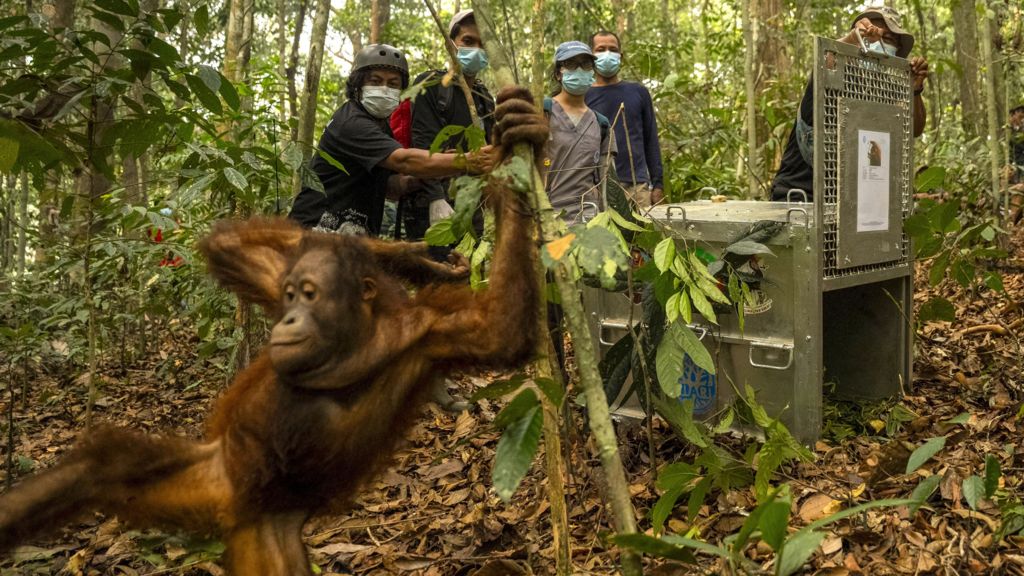
On the Indonesian island of Borneo, eight critically endangered orangutans that survived a devastating season of intensified wildfires have successfully been reintroduced to a protected natural reserve, marking a small victory for conservation efforts amid growing threats to the great apes’ survival. The group of released primates includes three adult females, three infant offspring, and two adult males, all of which were rescued over the course of late summer 2024 when out-of-control blazes destroyed large swathes of their native forest habitat.
The release, which coincided with ongoing conservation work led by International Animal Rescue Indonesia (IAR Indonesia, locally referred to as Yiari) in partnership with Indonesia’s Ministry of Forestry, took place on Friday in a protected reserve in Borneo’s western region. This release follows a broader rescue operation that pulled 46 orangutans out of fire-stricken areas across Borneo between August and September, when this year’s dry season blazes reached their peak.
While seasonal wildfires are a recurring natural event in Indonesia’s annual climate cycle, 2024’s fires were far more severe and widespread than average. Climate scientists have linked this intensification to the current strong El Niño event, a Pacific ocean warming pattern that alters global weather systems and amplifies drought and heat conditions across Southeast Asia. This year’s El Niño ranks as the most intense ever recorded, and experts warn its disruptive climate impacts will persist into 2025.
Beyond El Niño-driven weather extremes, human land use practices have further exacerbated fire risk across Borneo. Large-scale land clearing for commercial agricultural plantations, including oil palm, rubber, and acacia operations, has replaced dense, naturally fire-resistant old-growth rainforest with open, flammable vegetation that allows blazes to spread far more quickly than they would in intact ecosystems. This habitat fragmentation has also left orangutan populations isolated in small pockets of forest, with no safe escape routes when fires break out.
Orangutans, a species classified as Critically Endangered by the International Union for Conservation of Nature (IUCN), have seen their population plummet over the past century. Data from global conservation group WWF shows that just 104,000 orangutans remain across Borneo and Sumatra, down from more than 230,000 individuals 100 years ago. Last month, the IUCN issued an urgent warning that wildfires this year have already burned through habitats that support 52% of Borneo’s remaining wild orangutan population. If current rates of climate change continue, the organization warns, a large share of the apes’ remaining range will become uninhabitable within decades.
Each of the eight orangutans released Friday had unique stories of displacement after losing their forest homes. Among them was the family group led by Mama Nopi, whose offspring Nopi, Naufal, and Nopan were forced to take shelter in a commercial coconut and rubber plantation after fires burned through their surrounding forest in early September. With their natural food sources destroyed, the group was forced closer to human settlements, putting them at risk of conflict and starvation.
Another rescued orangutan, Mama Lifa, and her infant were found trapped in a tiny stand of acacia trees completely surrounded by oil palm plantations. Habitat degradation from nearby fires and a total lack of accessible natural food led conservation teams to extract the pair in mid-September. The third mother-infant pair, Mama Man and her baby, had been monitored by rescuers since June as they lived in a plantation bordering a small fragment of remaining forest. When fires spread toward the area in early September, the group’s roaming range was cut off entirely, forcing an emergency evacuation before the blazes reached their location.
The protected reserve selected for the orangutans’ reintroduction was specifically vetted to meet the species’ long-term survival needs. Unlike the fragmented, fire-prone landscapes the apes were rescued from, the reserve has abundant natural food and water sources, and is connected to larger contiguous blocks of intact forest, allowing the orangutans to range naturally and integrate with existing wild populations.
Argitoe Ranting, a senior conservation specialist with IAR Indonesia, emphasized that the goal of the release goes beyond simply moving displaced animals out of harm’s way. “We want to ensure that rescued orangutans are not simply moved from one place to another, but actually have a chance to survive in their natural habitat,” Ranting explained. Karmele Llano Sanchez, CEO of IAR Indonesia, called the relocation of the eight orangutans a “necessary step” after their original habitats became too dangerous to support the primates.
Conservation officials note that while this release is a positive milestone for protecting individual orangutans, it is only a temporary solution to a growing systemic threat. Without urgent action to curb climate change, end destructive land clearing, and protect remaining intact rainforest habitat across Borneo, the species faces growing risk of extinction in the wild.