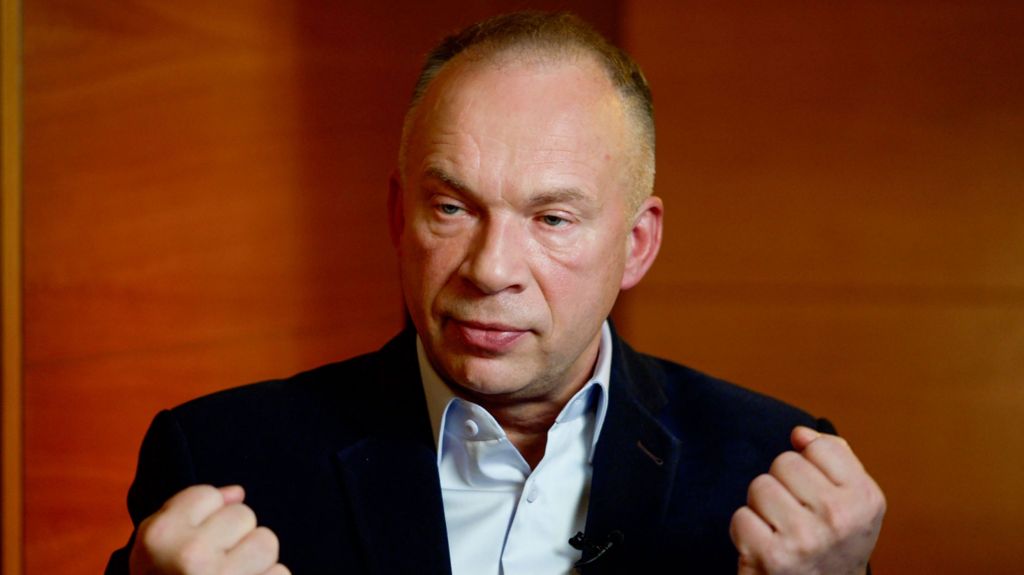
In his first public interview since his abrupt removal from office earlier this summer, former Ukraine Commander-in-Chief General Oleksandr Syrskyi has laid out his assessment of the ongoing war with Russia, addressed longstanding criticisms of his leadership, and pushed back against narratives that led to his dismissal in an exclusive conversation with the BBC.
Syrskyi, who rose to national prominence in 2022 for his successful defense of Kyiv and leadership of the breakthrough Kharkiv counteroffensive before being appointed top commander in 2024, claims Ukraine has now effectively stabilized the entire front line and broken Russia’s capacity to make large-scale territorial advances, largely thanks to the massive casualties Ukrainian forces have inflicted on invading troops. According to Syrskyi’s calculations, Russia’s total war deaths are up to 11 times higher than Ukraine’s, with overall Russian casualties across killed and wounded outpacing Ukraine’s by a factor of six. While neither warring party publishes official verified casualty figures, UK intelligence estimates put Russian killed-in-action deaths at roughly 500,000 since the 2022 full-scale invasion, with US think tank the Center for Strategic and International Studies projecting Ukrainian troop deaths will reach up to 150,000 by 2026. The general notes that this lopsided casualty ratio, paired with Ukraine’s evolving tactical approach of targeting Russian weak points while containing advances elsewhere, has created the current frontline stalemate. He added that Russia only managed to seize 61 square kilometers of territory in the first half of 2026 — a rate of advance so slow it confirms the front has effectively held, a trend independently echoed by the U.S.-based Institute for the Study of War, which recently reported Russia lost more territory than it gained in September 2026.
Syrskyi’s removal from office this summer capped a very public, high-stakes disagreement with then-Ukrainian Defense Minister Mykhailo Fedorov, a popular young leader known for his push to modernize Ukraine’s military with digital and drone technology. The dispute erupted into public view when Fedorov accused Syrskyi’s army command of blocking his reform initiatives, refusing to adapt to the changing nature of modern war. After the disagreement went public, President Volodymyr Zelensky initially removed Fedorov, but widespread public protests forced Zelensky to also dismiss Syrskyi, replacing the veteran commander with 43-year-old Major General Mykhailo Drapatyi.
In the interview, Syrskyi pushed back hard against the two most common criticisms leveled against him: that he was an outdated “old school” commander unfit to lead Ukraine’s increasingly technology-driven military, and that his order to hold frontline positions at all costs led to unnecessary heavy Ukrainian casualties in multiple engagements, including the withdrawals from Avdiivka, Vuhledar, and Pokrovsk, as well as the 2025 retreat from the August 2024 Kursk incursion into Russian territory.
Addressing claims he was a technologically out-of-touch commander, Syrskyi argued it was under his leadership that Ukraine expanded drone use to unprecedented levels, including launching deep strike operations more than 2,000 kilometers behind Russian lines. It was also during his tenure that Ukraine became the first country in the world to stand up a separate branch of the armed forces dedicated entirely to unmanned systems. He noted that drones are currently responsible for 80% of Russia’s combat losses, contradicting claims that he resisted technological innovation. Syrskyi also explained the root of his dispute with Fedorov: the former defense minister created dangerous supply imbalances by prioritizing drones over critical frontline equipment including unmanned ground vehicles, pickup trucks, and motorbikes, leaving frontline units receiving only half the drone supplies they required even as other essential gear was sidelined, he said.
Responding to allegations that his hold-at-all-costs orders trapped Ukrainian troops and led to unnecessary deaths, Syrskyi acknowledged chaotic frontline situations occur but framed them as an unavoidable consequence of fighting a materially superior adversary. As of 2025, he said Russia held an 18-to-1 advantage in combat aircraft and aerial bombs, a two-and-a-half-to-one advantage in artillery and artillery shells, and access to a reserve pool of four million militarily trained personnel to mobilize for frontline operations. Against that disparity, hard choices about holding positions are unavoidable, he argued.
On the controversial 2024 Kursk incursion, which critics described as ending in a catastrophic retreat, Syrskyi defended the operation as a strategic necessity. In summer 2024, he explained, Russian forces were pushing along every major frontline axis with up to six times the troop strength of Ukrainian defenders. The incursion into Kursk disrupted Moscow’s planned offensive and forced Russian command to redirect thousands of troops away from Ukraine’s eastern and southern front lines, giving Ukraine’s overstretched brigades critical time to regroup and reposition.
Looking ahead, Syrskyi warned European allies against clinging to illusions that Russia’s territorial ambitions end at Ukraine’s borders, urging them to begin immediate preparations for potential future conflict. He also laid out his vision for the future of the war, predicting it will become even more technology-reliant, with growing integration of robotics, automated systems, and artificial intelligence that can upgrade the capabilities of even conventional weapons such as main battle tanks. Even so, he stressed that the role of human soldiers will remain decisive on future battlefields, as people will always be required to command and control automated systems.