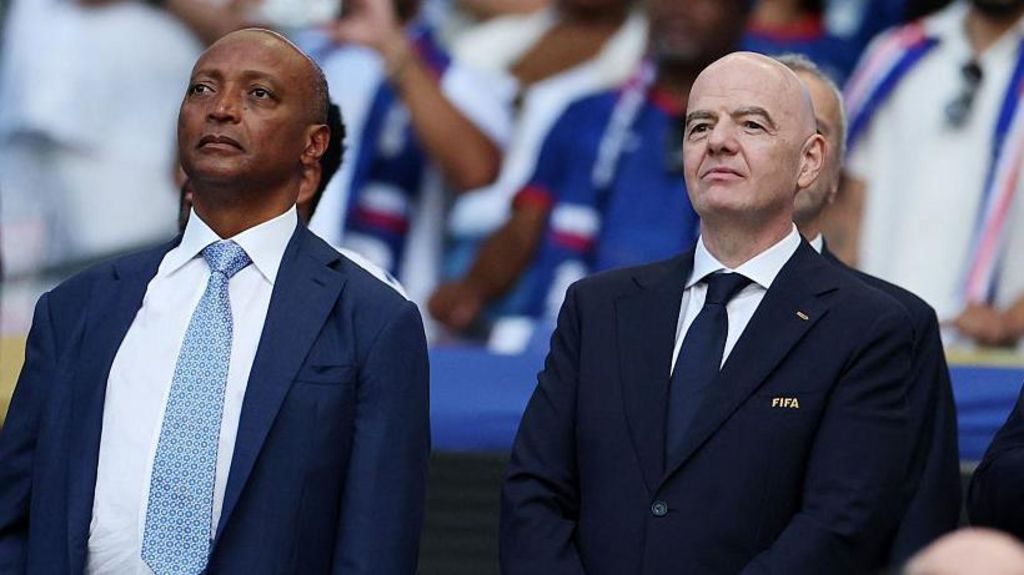
FIFA President Gianni Infantino, whose leadership has been thrown into the global spotlight following the collapse of his controversial private stake sale plan for FIFA’s international competitions, continues to hold firm allies across the global football landscape – particularly in Africa, where dozens of lower-resource national associations have reaped tangible benefits from his decade in office.
Infantino’s position has faced intense scrutiny since the unpopular FIFA Forward Enterprise (FFE) proposal was pulled after fierce pushback from multiple regional football governing bodies. While the Confederation of African Football (CAF) has not yet released an official institutional position, a large bloc of senior African football leaders have publicly thrown their weight behind the FIFA president, with five of the seven African seats on the FIFA Council – representing Egypt, Morocco, Niger, Mauritania and Comoros – already declaring open support.
This widespread backing across the continent traces directly to FIFA’s Forward programme, the landmark funding initiative Infantino launched in 2016 that has become a critical financial lifeline for many African federations. In regions where commercial investment and government sports funding are severely limited, the scheme has underwritten grassroots and high-performance football projects across the continent.
### Morocco: A Key Strategic Partner Reaffirms backing
Morocco, one of Africa’s most high-profile modern football success stories, has built deep ties with FIFA alongside its domestic government-driven growth. The North African nation hosts FIFA’s regional African office in Rabat, has staged multiple FIFA tournaments including the Club World Cup and 2022 Women’s U-17 World Cup, and is set to co-host the 2030 men’s World Cup with Spain and Portugal.
Fouzi Lekjaa, president of the Royal Moroccan Football Federation (FRMF), reaffirmed his support for Infantino in the wake of the FFE proposal’s withdrawal last week. In an official statement, Lekjaa called Infantino’s choice to pull the plan “wise”, noting that the decision prioritized unity across FIFA’s 211 member associations. Senior African football executives also formally backed Infantino at a closed-door meeting held in Morocco on Wednesday, wrapping a turbulent period triggered by the failed proposal.
### Egypt: A Staunch Institutional Ally With Growing Expectations
As the host nation of CAF’s headquarters, Egypt stands as one of Infantino’s most reliable institutional allies on the continent. This close partnership has been strengthened by Hany Abo Rida, a long-serving FIFA Council member and one of Africa’s most influential football administrators, who has maintained close working ties with Infantino since the latter was first elected in 2016.
Over Infantino’s tenure, Egypt has benefited substantially from Forward programme funding, which has supported major infrastructure projects, youth talent development, coach training programs and the expansion of women’s football. Like other African member associations, the Egyptian Football Association has also received increased development grants under FIFA’s expanded investment strategy, while new and expanded regional competitions have opened up additional commercial and competitive opportunities for Egyptian clubs and national teams.
Even as support holds firm, Egyptian football stakeholders say expectations for deeper engagement are growing. Many officials and observers argue that FIFA’s work in Africa must move beyond direct financial assistance, with greater priority placed on improving governance, increasing transparency, advancing long-term sustainable development, and granting CAF more autonomy to set the continent’s own football priorities.
### DR Congo: Full Public Commitment to Infantino’s Leadership
The Congolese Football Federation (Fecofa) was among the first African bodies to praise Infantino’s decision to withdraw the FFE proposal, calling the move “wise” in an early August statement. The federation emphasized that the controversy around the abandoned plan should not overshadow Infantino’s 10-year track record of expanding football access and support, particularly for lower-resourced African nations.
Fecofa noted that it has “greatly benefited” from FIFA’s development programs, citing major investments in local football infrastructure and grassroots growth. The statement was signed by Véron Mosengo‑Omba, who was elected Fecofa president in May 2026, ending a five-year period of institutional uncertainty that followed the 2021 resignation of Constant Omari Selemani and the 2023 appointment of a FIFA-run normalization committee. Mosengo‑Omba confirmed Fecofa’s “full support” for Infantino will extend beyond the 2027 FIFA presidential election, aligning DR Congo firmly with the FIFA leadership at a time of deep global divisions over the organisation’s future.
### Nigeria: Support Anchored by Critical Development Funding
Despite widespread global backlash against Infantino’s proposal, the Nigeria Football Federation (NFF) has also aligned with the pro-Infantino bloc. For the NFF, which has long struggled with chronic funding shortages and massive unmet infrastructure needs, Infantino’s investment-focused agenda has been difficult to reject.
Amaju Pinnick, former NFF president and current deputy chairman of FIFA’s Men’s National Teams Competitions Committee, has argued that Infantino’s plans would deliver much-needed financial support to every member association, reducing overreliance on underfunded local governments. Nigeria qualifies for up to $8 million in current Forward programme funding, even after missing out on qualification for the last two men’s World Cup tournaments. The largest ongoing Forward project in the country is the $4.88 million redevelopment of the NFF Technical Centre in Abuja, which includes rebuilding training pitches and constructing a modern accommodation complex for all of Nigeria’s national teams.
### Broader African Backing and Isolated Opposition
Across the continent, other senior political and sports leaders have added their voices to the support for Infantino. South African Sports, Arts and Culture Minister Gayton McKenzie wrote on social media platform X that Infantino “has been very good to African football”, urging the continent to avoid joining what he called a “public lynching” of the FIFA president. “We can debate his ideas but let’s not forget who has been a friend to us. Many of those calling for his head want the old status quo back too,” McKenzie wrote.
In interviews with the BBC after the FFE proposal was made public, senior officials from Malawi and Uganda said FIFA investment has transformed football on and off the pitch across Africa, noting that this funding is irreplaceable given the severe budget constraints most African nations face. “Malawi needs money. Malawi needs stadiums, our government cannot manage to give us even $1m every year for football,” Malawi Football Association president Fleetwood Haiya told BBC Newsday. “Our government is not able to make sure that they have medical supplies in hospitals [and] at the same time to look at football.”
Lamin Kaba Bajo, president of the Gambia Football Federation, told BBC Sport that most African federations support Infantino remaining in office and plan to back his re-election in 2027. “As far as I’m concerned, most of my colleagues are concerned, we’ll encourage him [Infantino] to stay, and we’ll do everything within our means to ensure that he is re-elected come next year, 2027,” Bajo said. “That’s my personal opinion as president of the federation, and a good number of African memberships also stand on that line. He is here to stay.”
Support for Infantino is not universal across Africa, however. Former Sierra Leone FA president and ex-FIFA Council member Isha Johansen was one prominent African voice to oppose the FFE plan, warning that it risked pushing excessive commercialization into African football. “What price does one have to pay in order to get to this elevated development for football in Africa?” Johansen asked, urging African football leaders to carefully consider the long-term future of the sport on the continent.
CAF president Patrice Motsepe has also publicly praised Infantino, calling his work after this year’s World Cup “excellent” and describing him as a loyal friend to Africa in a late July statement. “He is loyal to Africa,” Motsepe said. “When people have been loyal to you, you never stab them in the back.”
A number of prominent African football nations, including Senegal – which boasts the second-highest ranked men’s national team on the continent, behind only Morocco – have not yet issued a public position on Infantino’s leadership.