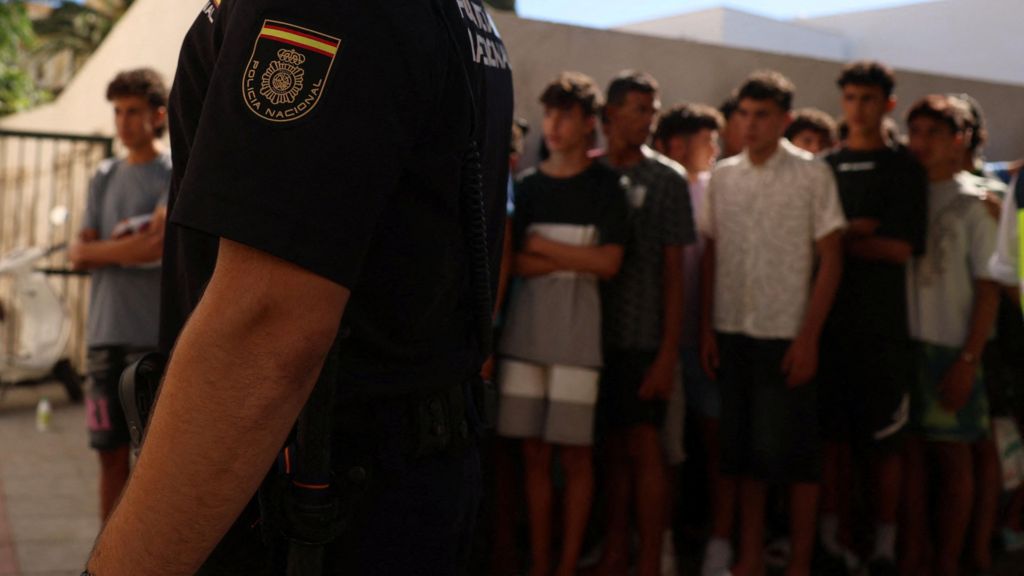
Last week, a historic mass migration event unfolded across the waters separating Morocco from the Spanish North African exclave of Ceuta, when approximately 78,000 migrants crossed into Spanish territory over a 48-hour window, leaving behind a devastating humanitarian and political crisis that has rippled across the European Union. The crossing left at least 100 people dead, a toll Ceuta’s conservative leader Juan Jesús Vivas described as an “irreparable tragedy” during an address to the European Parliament this week, where he voiced profound sorrow over the loss of life and slammed the national Spanish government’s response to the emergency.
In the days following the mass crossing, roughly 75,000 migrants have returned to Morocco, but Vivas confirmed that between 3,000 and 5,000 people remain in Ceuta, thousands of whom are unaccompanied migrant children. The Ceuta mayor-president told lawmakers that the inability of local officials to produce an exact count of remaining migrants demonstrates how severely under-resourced local authorities are to handle the ongoing crisis, adding that repeated prior warnings from local officials about an impending surge in irregular sea crossings were ignored by the national Socialist government led by Prime Minister Pedro Sánchez. Vivas personally warned Sánchez of the growing risk weeks before the influx, he said, and called the government’s eventual deployment of support late and insufficient. Even with the large-scale returns that have “considerably alleviated” pressure on the small exclave, Vivas added, Ceuta has not returned to normal, with a ongoing humanitarian emergency and persistent disruptions to public order.
The most pressing unaddressed issue centers on the thousands of migrant children remaining in Ceuta. Spanish authorities have confirmed that €25 million ($28.8 million) in emergency funding has been allocated to support minor migrants in the exclave, but reporting from Spanish outlet El Mundo found volunteer groups have already registered 4,860 migrant children — double the number counted in official government estimates. Local community members have stepped in to house unaccompanied children, volunteers told the outlet, but the current arrangement is unsustainable. To date, no children have been transferred to mainland Spain, according to El País, as right-wing regional authorities across the country have refused to accept the new arrivals. While a bilateral cooperation agreement with Morocco requires joint work to return migrant children to their home families, conservative leaders of Ceuta’s sister exclave Melilla have called for mainland Spain to show solidarity and accept the children instead.
The root cause of the unprecedented mass crossing remains a matter of dispute between all parties involved. EU and Spanish leaders have pointed to the role of criminal smuggling networks spreading disinformation to encourage migrants to attempt the crossing, a narrative that follows a recent Spanish Supreme Court ruling that barred authorities from summarily returning migrants intercepted at sea trying to reach Ceuta and Melilla to Morocco. Morocco, which does not recognize Spanish sovereignty over the two North African exclaves, has blamed the court ruling itself for the crisis. An unnamed Moroccan government source told local media that the ruling “collapsed the deterrent element of the system, and the dam gave way, not under the weight of the criminals, but of a judge’s decision.”
Vivas has gone further, framing the mass crossing as an “unequivocal attack” on Spanish territory, questioning why Moroccan border forces did not intervene to stop the thousands of swimmers from crossing. Spanish Interior Ministry officials say they are working firmly with Moroccan counterparts to prevent future irregular crossings and aim to return all remaining migrants in Ceuta to Morocco as quickly as possible. EU Migration Commissioner Magnus Brunner has called for the bloc to use all available policy leverage, including trade and visa arrangements, to force Morocco to deepen cooperation on irregular migration. While the European Commission has commended Spain’s swift response to the crisis, which included deploying armed forces to both Ceuta and Melilla, the emergency has exposed deep rifts between EU member states over migration policy. Italy, backed by Finland and Denmark, has suspended its Schengen Area border arrangements with Spain, while the Czech Republic called for Spain’s temporary suspension from the open-border bloc — a move Prime Minister Sánchez pushed back on, noting that Ceuta is not part of the Schengen Area.
Adding to ongoing tensions, Moroccan media is now reporting that fresh calls for a second mass crossing are circulating across social media platforms. Local news outlet Hespress documented posts and invitations to join closed WhatsApp groups for people planning new crossing attempts, paired with hashtags promoting migration to Spain in search of work. Moroccan authorities have warned that anyone promoting irregular migration faces criminal prosecution, but the new calls have amplified fears among Ceuta’s population that a second surge could overwhelm the exclave’s already stretched resources. Vivas noted that local residents already feel “sad, helpless, anxious, fearful and worried,” with widespread uncertainty over whether another mass influx will occur in the coming weeks.