LUANDA, Angola — During his landmark multi-nation tour across Africa, Pope Leo XIV has emerged with a forceful rebuke of long-standing oppression holding the continent back, but his blunt words have ignited a transatlantic firestorm tied to the ongoing U.S.-Israeli war in Iran and escalating tensions with the Trump administration.
The pontiff, a reserved Midwestern Augustinian, drew global attention for denouncing the “handful of tyrants” and “chains of corruption” that have kept African nations trapped in instability for centuries. While many observers framed this address as a direct rebuke of former President Donald Trump and Vice President JD Vance’s inflammatory rhetoric around the Iran conflict – particularly after Trump’s unprecedented social media attacks and Vance’s claims of American theological superiority – Vatican insiders insist the message was crafted long before the current controversy flared.
Cardinal Michael Czerny, a senior Vatican official and close aide to Pope Leo, told the Associated Press that the pope’s homilies and public remarks during the Africa trip were developed well in advance, tailored specifically to local contexts and the lived experiences of African Catholic communities. “If they seem relevant to the current wars, controversy, this reminds us of Jesus saying, ‘Whoever has ears to hear, let them hear!’” Czerny said, adding in a colloquial addendum: “Or in popular idiom, ‘If the shoe fits, wear it!’”
Pope Leo himself pushed back against the narrative of a public feud with Trump during his flight from Cameroon to Angola on April 18, arguing that his criticism of tyrannical rule and religiously justified war had been misinterpreted. He clarified that his remarks were intended specifically to address the long-running separatist conflict in western Cameroon, and broader systemic harms across Africa, not the U.S. president or the Iran conflict.
Yet analysis from leading Vatican observers suggests the pontiff is walking a careful line between addressing local African issues and making clear his long-held opposition to Trump’s approach to the Iran war. Long before arriving in Africa, Pope Leo had already publicly broken with Trump over the conflict. Two weeks prior to the Africa tour, during an appearance at his Castel Gandolfo country residence, the pope called Trump’s threat to annihilate Iranian civilization “truly unacceptable,” and issued an unprecedented call for Catholic faithful across the world to pressure their elected representatives to end the war.
Massimo Faggioli, a theology professor at Trinity College Dublin, described that public appeal to voters as “the Vatican’s nuclear option.” Never before in modern history has a pope directly urged American citizens to pressure their lawmakers over an ongoing conflict – not even during the 1962 Cuban Missile Crisis, when Catholic U.S. President John F. Kennedy stood on the brink of nuclear war with the Soviet Union. At that time, Pope John XXIII issued a public plea for peace and worked behind the scenes through diplomatic channels to de-escalate tensions, but never called on American voters to take sides between their president and the church. Faggioli noted that the current unprecedented approach stems from genuine Vatican alarm that Trump is prepared to escalate the Iran war into a catastrophic conflict.
Faggioli added that Pope Leo’s attempt to distance himself from interpretations linking his Africa remarks to Trump was a deliberate de-escalation tactic: the Vatican aims to preserve diplomatic space to push for a ceasefire, and avoid an open public clash that would undermine that goal. He also noted that the ongoing tension between the American pope and American political leaders will create lasting complications for Catholic politicians seeking national office on both sides of the aisle, from Republican JD Vance to Democratic California Governor Gavin Newsom, as long as Pope Leo leads the church.
Kathleen Sprows Cummings, director of the Global Catholic Research Initiative at the University of Notre Dame, observed that many American Catholics are unaccustomed to seeing the Vatican frame foreign policy as a core moral issue, having grown accustomed to church leadership focusing primarily on social issues like abortion, gender and sexuality. When Vance argues the pope should “stick to morality,” Cummings points out that war and peace have been central moral questions for the faith for millennia.
Vatican officials emphasize that Pope Leo has not shifted his stance or adopted a new, more confrontational approach – the shift is in the context, not the man. Rev. Antonio Spadaro, secretary of the Vatican’s culture department, said the pontiff is simply continuing the long-standing papal tradition of preaching the Gospel’s call to peace. The reaction, he said, originated from Washington, not the Vatican.
“It’s very dangerous to imagine that the pope is fighting with Trump, because it means demeaning the pope to a level of contrast, one against the other, which Trump may want but that the pope has no intention of doing,” Spadaro said. From his perspective working alongside Pope Leo, the pontiff remains the same steady, direct leader he has always been – it is the chaotic global political backdrop that makes his calm, unflinching words stand out so sharply today.
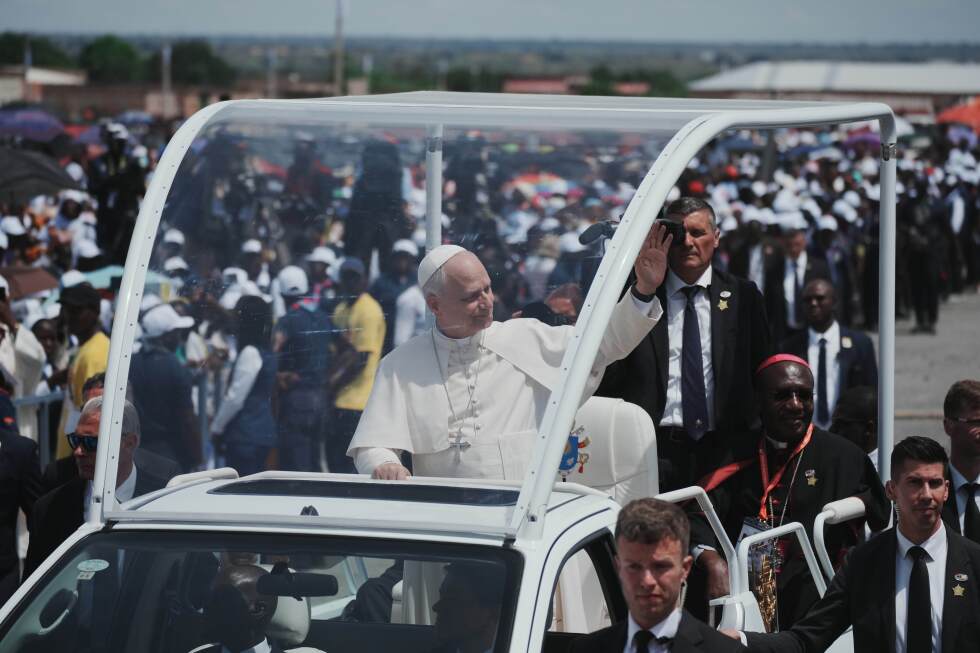
Amid the transatlantic political firestorm, the core purpose of Pope Leo’s four-nation Africa tour has not been overshadowed for the millions of African Catholics who have turned out to greet the first American pope in history. The polyglot pontiff has adapted his messaging to local communities, delivering speeches, homilies and prayers in French for Algerian audiences, English and French for Cameroonians, Portuguese for Angolans, and will switch to Spanish for his upcoming stop in Equatorial Guinea.
Thirty-thousand pilgrims gathered at Angola’s iconic Shrine of Mama Muxima on Sunday to join Pope Leo for a rosary prayer. Lucineia Francisco, one of the pilgrims in attendance, left her children at home to make the spiritual journey alone. “My kids were crying to come, but I said no,” she explained from the crowded pilgrimage field. “This is a spiritual journey that I’m really going to face on my own.”