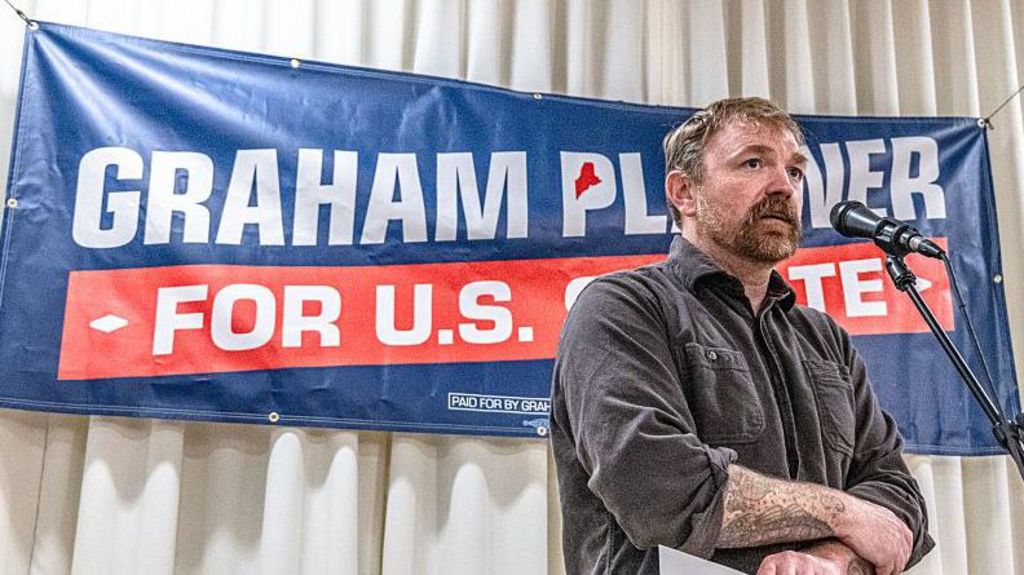
A sudden political upheaval has shaken the critical race for a U.S. Senate seat in Maine, as Democratic hopeful Graham Platner announced the suspension of his campaign amid cascading scandals topped by a sexual assault allegation that collapsed his support within party ranks.
Platner, an oyster farmer and military veteran whose anti-establishment populist campaign had quickly turned him into the Democratic Party’s front-runner, shared his decision in an 11-minute video posted to the social platform X. He pushed back hard against the assault claim, calling it entirely fabricated, and emphasized that his choice to step aside was not an admission of any wrongdoing. Instead, he blamed unified pressure from national and state Democratic leaders, who had threatened to cut off all financial and organizational campaign support if he remained in the race against incumbent Republican Susan Collins.
“This has been an incredibly difficult decision, one that my wife and I have wrestled with over the course of several days,” Platner said in the address. “Over the past couple days I have faced some very serious allegations, and I just want to make it clear, this is all false. The things that have been claimed did not happen. It’s not real.”
Per Maine state election law, Platner needed to formally withdraw by July 13 to allow state Democrats to place a replacement candidate’s name on the general election ballot this November. He confirmed he will file official withdrawal paperwork only after confirming the process to select his successor will follow “transparent and democratic” protocols.
Platner’s rapid rise in Maine Democratic politics was unprecedented just months ago. Running on a progressive platform that included pushing for universal healthcare and expanded affordable housing, he tapped into widespread voter frustration with the party’s established leadership, propelling him past initial rivals including Maine Governor Janet Mills, who ultimately suspended her own nomination bid. His campaign received high-profile endorsements from leading progressive voices Senators Bernie Sanders and Elizabeth Warren, building momentum that appeared to put the competitive seat within Democratic reach.
That momentum unraveled rapidly over the past week, however, after a new sexual assault allegation became public. By Monday, Warren had joined a growing chorus of top Democrats calling for Platner to exit the race, and three of his most prominent congressional backers — Representatives Ro Khanna and Senators Ruben Gallego and Martin Heinrich — pulled their endorsements entirely. Both the Democratic Senatorial Campaign Committee, which invests millions of dollars in party nominees across the country, and the Maine Democratic Party cut all ties and ended their support.
The Maine race is widely viewed as one of the most critical pickup opportunities for Democrats as they pursue an uphill bid to flip majority control of the U.S. Senate in this year’s midterm congressional elections. No Republican presidential candidate has carried Maine since 1988, leading Democratic strategists to conclude a well-supported Democratic nominee could defeat Collins, a longtime moderate Republican incumbent.
This isn’t the first string of scandals to hit Platner’s campaign. Prior controversies began emerging last October, when U.S. media reported he had a tattoo bearing a resemblance to a Nazi-era symbol, which he said he obtained during a drinking trip with fellow Marines in Croatia in 2007 and had since covered up. Later, old posts from the social platform Reddit were unearthed showing Platner arguing that sexual assault victims should “take some responsibility for themselves” by avoiding extreme intoxication, a comment for which he later apologized and asked voters for forgiveness.
In June, The New York Times reported that Platner had exchanged sexually explicit messages with multiple women outside his marriage, a report he acknowledged was accurate, noting his wife had previously warned his campaign team about the risk of the story becoming public. The Times followed that report with additional accounts from three former girlfriends, who accused Platner of patterns of erratic, angry behavior.
Jenny Racicot, the 41-year-old woman who made the latest sexual assault allegation, spoke first to Politico and later CNN, confirming she was one of the former girlfriends quoted in the Times report but chose to go public with the assault claim after previously declining to be named for the story to avoid being publicly labeled as a rape victim.
Platner is the second high-profile Democratic candidate to suspend a campaign this year following sexual misconduct allegations. In April, Congressman Eric Swalwell dropped out of the race for California governor and resigned his seat in the U.S. House after multiple women brought forward claims of inappropriate behavior, which Swalwell has repeatedly denied.