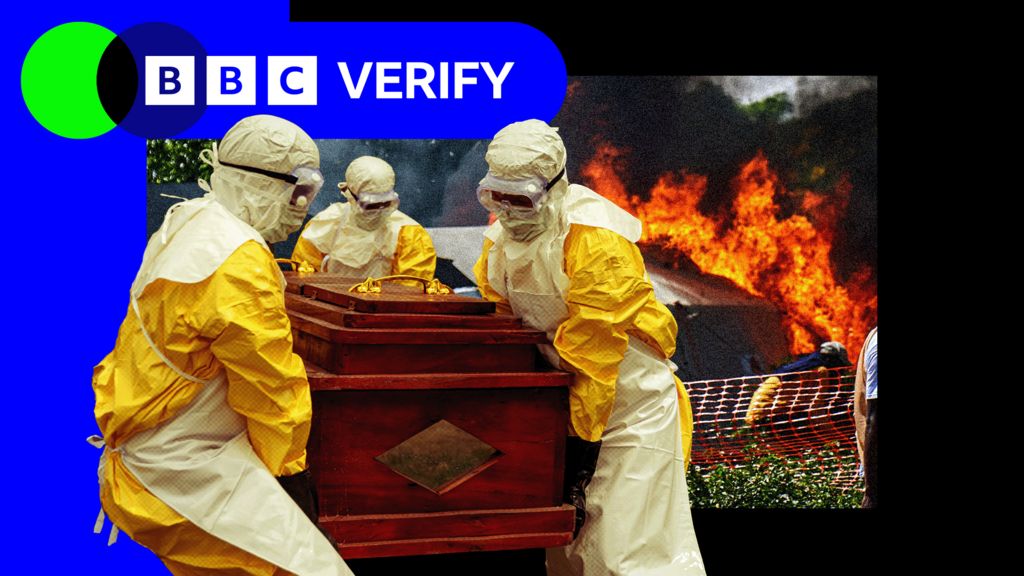
In the eastern Democratic Republic of the Congo, a rapidly spreading Ebola outbreak is facing an unprecedented threat not just from the virus itself, but from rampant misinformation that has turned local communities against the frontline healthcare workers trying to save lives. Among the countless stories of violence is the account of 27-year-old Daniel Uyirwoth Welo, a Red Cross volunteer who survived a brutal assault while carrying out a critical safe burial of an Ebola victim at a Bunia cemetery last month. Welo recounted how a crowd, driven by false rumors that the Ebola victim’s coffin was empty, seized him from behind, beating him with punches, spades, and machetes alongside three of his colleagues. The attack was sparked by widespread false narratives that have circulated both in local communities and online: that Ebola does not exist at all, or that the international Red Cross response is nothing more than a scheme to siphon public funds. This attack is far from an isolated incident.
Official government data confirms that since the outbreak began in mid-May, more than 1,700 people have been infected, and 580 have lost their lives. BBC Verify’s investigation into resistance to Ebola control measures has identified 12 documented incidents of community unrest, seven of which have been confirmed via social media footage. These incidents include coordinated attacks on treatment centers, physical assaults on healthcare and aid workers, and repeated efforts to disrupt safe burials — a core intervention to stop Ebola spread. Experts warn the true number of unreported incidents is almost certainly higher, as many violent clashes occur in remote, hard-to-reach regions with limited access for monitors.
The most recent major attack took place on July 1, when arsonists burned an Ebola treatment center to the ground in Bafwabango, located in Ituri province — the geographic epicenter of the current outbreak. Local media reports confirm one police officer was killed during clashes that erupted after community members attempted to seize the body of a suspected Ebola victim for traditional burial. Ebola is transmitted through direct contact with infected bodily fluids, and the bodies of deceased victims remain highly contagious for days after death. For this reason, supervised safe burials that eliminate close contact with the body are a cornerstone of outbreak control; traditional funeral practices involving washing, touching, and viewing the body were a major driver of transmission in past Ebola outbreaks across Central Africa.
Despite this life-saving necessity, misinformation has repeatedly derailed these efforts. In late May, rioters burned medical equipment and two isolation tents at a treatment center in Rwampara after staff prevented relatives from removing a young Ebola victim’s body for traditional burial. Since that incident, at least three more medical facilities have been attacked or vandalized, according to on-the-ground reports.
To understand the roots of this resistance, experts point to the deep cultural and social importance of traditional multi-day funeral rites in Congolese communities, which carry profound spiritual meaning. Julienne Anoko, an anthropologist working as a community engagement officer with the World Health Organization (WHO), explained that funerals are not merely end-of-life rituals but celebrations of a person’s journey to the afterlife, with practices that have been passed down through generations. Even so, misinformation and long-standing systemic distrust have amplified resistance beyond cultural differences to life-saving public health measures.
On-the-ground responders report that widespread misconceptions have left many patients avoiding early medical care, drastically reducing their chances of survival when they finally do seek treatment. Dr Aimé Mbonda Noula, of the International Federation of Red Cross and Red Crescent Societies (IFRC), explained that many families flee their homes and abandon Ebola victims’ bodies entirely rather than alert authorities, out of fear of being forced into quarantine. “Most of the people in these communities think that these treatment centres are places where, when you go, you die,” he said. “So, you usually run away from these places and run away from the health workers.” For those who remain, resistance to changing funeral practices runs deep: “They don’t believe that safe, dignified burials could really help,” said Dr Babou Rukengeza of the charity Save The Children. “They say: ‘this is my family member, I need to honour him… this is the last time that I can touch him.’”
The violence has spread beyond Ituri to neighboring North Kivu province, where two Ebola response workers were attacked by mobs that blamed them for community deaths. Video verified by BBC Verify shows a female health worker fleeing a group of men who strike her with wooden planks, while another clip captures a medical worker crawling along a road as the crowd throws stones at him.
A recent community assessment by the charity ActionAid in Ituri found that nearly one-third of respondents do not believe Ebola is a real disease, instead attributing deaths to sorcery or spiritual curses. Public health experts have labeled misinformation as the outbreak’s most dangerous ally. “False rumours delay care for people who need help and fuel attacks on health workers and health facilities, disrupting outbreak control and giving the virus more opportunities to spread,” explained Dr Wessam Mankoula of the Africa Centres for Disease Control and Prevention.
This deep-seated distrust did not emerge overnight. Experts trace it back to decades of violent unrest in eastern DR Congo, shaped by prolonged civil conflict, foreign interference, and brutal competition over lucrative mineral resources including gold and coltan. “You have a very strong base of being very distrustful of anything coming from outside, including the central government,” said Dr Jean-Vivien Mombouli, a former Ebola response advisor to governments across the region.
The current outbreak is caused by the Bundibugyo Ebola species, for which no approved vaccine or specific treatment currently exists. The WHO has launched clinical trials for two promising experimental treatments, but experts caution it will take months to complete testing and confirm their effectiveness. With no quick medical fix on hand, health leaders emphasize that containing the outbreak depends as much on rebuilding community trust as it does on medical intervention. “Mistrust is the real battleground,” WHO Director-General Dr Tedros Adhanom Ghebreyesus wrote on social media in June. “Win trust, and we win this.”