Two of the world’s most iconic waterfront metropolises, Shanghai sitting on the banks of the Huangpu River and New York along the Hudson, have renewed their cross-Pacific cultural connection through a landmark humanities dialogue that deepens mutual understanding between young people of China and the United States.
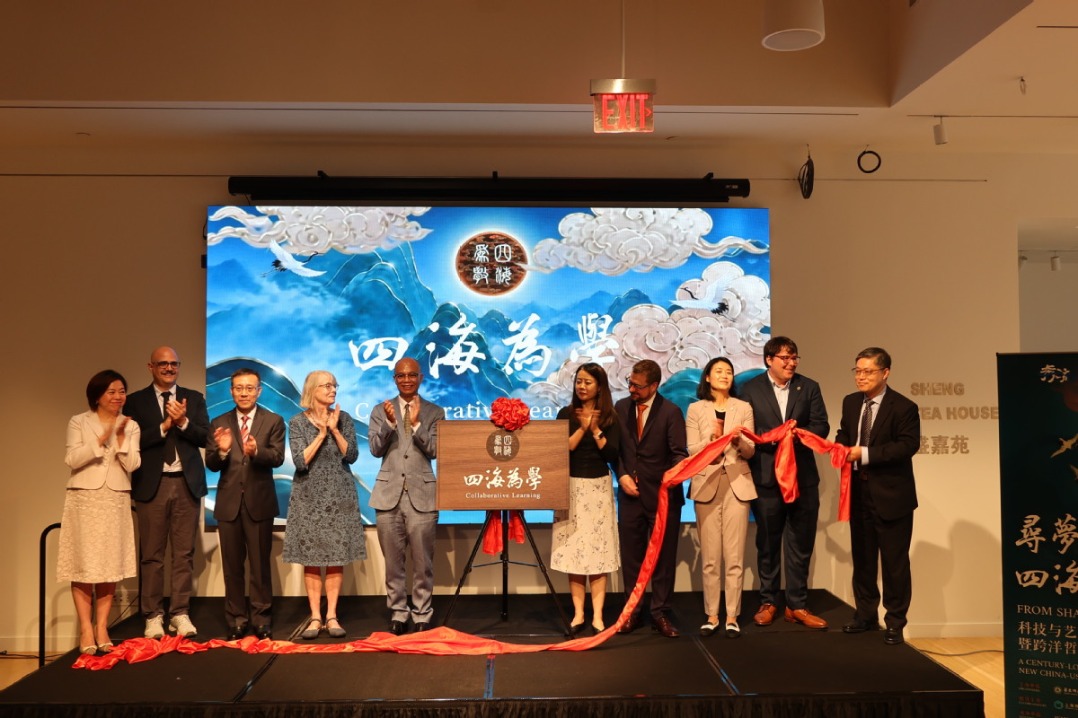
On June 29, the core session of the third season of “Bund: A Global Urban Humanities Dialogue between Shanghai and New York” — titled “From Shanghai to New York: A Century-Long Cultural Journey Inspiring New China-US Dialogue” — took place at the China Institute of America in Manhattan, bringing together emerging scholars, artists and academic leaders from both nations to explore the intersections of technology, art and cross-cultural philosophy.
The gathering builds on decades of people-to-people exchange between the two port cities, which share a foundational identity shaped by water and a shared ethos of openness and inclusiveness. Unlike formal high-level diplomatic talks, this dialogue centered on elevating youth engagement and bridging cultural divides through creative and intellectual collaboration, creating a dedicated space for younger generations to exchange ideas and advance cross-cultural mutual learning.
Yu Yougen, education counselor at the Chinese Consulate General in New York, emphasized that the event represents far more than a cross-border academic exchange. “This is not only an academic dialogue across geographical boundaries, but also a cultural exchange that connects history with the future,” he said. Noting the decades of close, productive exchange between the two cities, Yu added that what travels across the Pacific Ocean between the Huangpu and Hudson extends far beyond exhibitions and discussions: it carries the shared desire of people from both countries to learn from one another.
Yu Jin, president of the China Institute of America, framed the gathering as both a reflection on a century of people-to-people connection and a stepping stone for future collaboration. Founded in New York in 1926 by pioneering figures including Chinese scholar Hu Shih and leading American educators John Dewey and Paul Monroe, the China Institute is one of the oldest non-profit organizations in the U.S. focused on advancing U.S.-China understanding through cultural and educational programming. Yu Jin expressed hope that through deepened partnerships with East China Normal University and other collaborating institutions, the dialogue will help more young people develop cross-cultural awareness and build lasting connections across borders.
Zhang Huihong, deputy chair of the University Council of East China Normal University, echoed that sentiment, noting that the two cities share far more than their status as leading global hubs. “Shanghai and New York are both cities shaped by water and recognized as international metropolises. Although they are thousands of miles apart, they share similar city spirits of openness and inclusiveness,” she said, adding that the event aims to unlock new opportunities for people-to-people exchange between the two nations through collaborative cultural creation and transoceanic dialogue.
Complementing the core dialogue, a companion art exhibition will run at the China Institute gallery from July 9 to 30, featuring more than 100 works created by students and faculty from East China Normal University. The exhibition draws direct inspiration from Mei Lanfang’s historic 1930 tour of the United States, a landmark moment that introduced Chinese Peking Opera to American audiences and cemented its place as a foundational milestone in U.S.-China cultural exchange.
Spanning prints, paintings, illustrations, animations and AI-generated works, the exhibition explores how contemporary creators can reimagine traditional Chinese art and intangible cultural heritage through modern design principles and emerging digital technologies. Wei Shaonong, a professor in the School of Design at East China Normal University, explained that the project encourages young creators to reconnect with their cultural roots while reinterpreting traditional motifs for contemporary audiences. “Traditional Chinese culture contains rich artistic elements, and we hope students can reinterpret them through today’s artistic language and creative approaches. In this process, they learn from tradition while exploring how traditional art can remain connected to contemporary life,” he said.
Reflecting on Mei Lanfang’s enduring legacy, Wei noted that the legendary performer offered a timeless lesson for cross-cultural communication. Even though Peking Opera operated within a cultural context far removed from most 1930s American audiences, Mei’s tour was a resounding success because he grasped a core principle: when introducing art and culture to a new audience, creators must adapt their storytelling to resonate with shared understanding. “The great inspiration we gained from Mei Lanfang’s visit is that cultural communication requires translating not only language, but also the way stories are told and the cultural context behind them,” Wei added.
The event also included the launch of “Collaborative Learning,” an in-person intercultural roundtable discussion initiated by Paul J. D’Ambrosio, a professor of Chinese philosophy at East China Normal University. D’Ambrosio emphasized that cultural exchange thrives through diverse, accessible forms of engagement beyond traditional academic scholarship. “As scholars, we should remember that cultural exchange happens through many different forms,” he said. “It can happen through films, music, entertainment and many other creative expressions. While academic research and focused discussions remain important, we also need to stay open to broader forms of communication.”