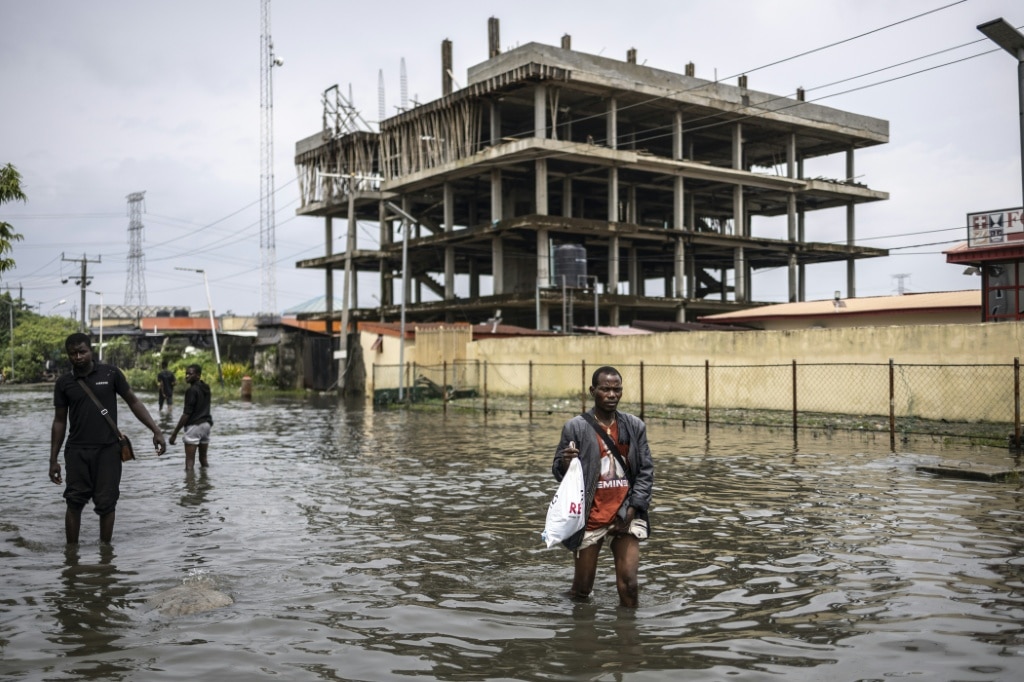
Nigeria’s bustling commercial hub Lagos, a low-lying coastal mega-city home to roughly 20 million people, is facing an escalating flood crisis driven by overlapping forces of climate change and uncontrolled rapid urbanization, experts and local residents confirm. The disaster, which has destroyed homes, religious spaces, and personal property across the city, has become an annual threat that grows more severe with each rainy season.\n\nThe crisis hit close to home for 42-year-old Samuel Akpan, a pastor at the Apostolic Church of Nigeria in Lagos’ upscale Lekki district. After hours of relentless overnight torrential rain swept through the region recently, Akpan spent the entire following day pumping floodwater out of his church parsonage. Inside the sanctuary, sodden chairs and waterlogged cushions sat piled in knee-high water that completely engulfed the building, while Akpan’s children’s ruined schoolbooks lay scattered across the waterlogged grounds. \n\nLagos’ natural geography already puts it at high risk: its entire coastal territory sits barely above sea level, with 180 kilometers of shoreline and a sprawling network of internal waterways. But scientists and environmental analysts say human-driven factors have turned periodic flood risk into a chronic emergency. The World Economic Forum lists Lagos as one of the world’s fastest sinking cities, dropping at a rate of up to 87 millimeters per year. This sinking is accelerated by two key urban trends: unregulated groundwater extraction to serve a booming population, and rising sea levels driven by global climate change.\n\nMore than half of Lagos’ households lack access to treated piped water, forcing most residents to drill private boreholes to access drinking water. This constant removal of groundwater disrupts the geological stability of the ground, worsening the city’s sinking rate. Meanwhile, Lagos draws thousands of new migrants from across Nigeria every day, all drawn by the promise of better economic opportunity. The United Nations estimates the city’s annual population growth rate at 6 percent, one of the fastest in the world. This rapid growth has spurred unplanned, widespread construction of residential, commercial, and industrial developments across previously undeveloped land — particularly in Lekki, which hosts a special free trade zone and is slated to host a new international airport. \n\nClimate data confirms that the risk is growing. Nigeria’s rainy season runs from May to November, and official forecasts show total annual rainfall has climbed well above the 2012–2022 average of 1,721 millimeters. Last year’s total rainfall hit 1,952 millimeters, and this year’s forecast projects between 1,650 millimeters and 3,030 millimeters. Scientific analysis also confirms that rainstorms hitting Lagos are now far more intense than they were just a decade ago. A late June extreme weather event that swept across West Africa, from Ivory Coast to Nigeria, killing roughly 100 people in flooding, was explicitly “supercharged” by human-caused climate change, according to World Weather Attribution, a global coalition of climate scientists.\n\nCompounding the natural and climate-driven risks are crippling infrastructure gaps and poor waste management. Indiscriminate dumping of plastic and solid waste clogs open drainage channels, preventing floodwater from draining into the Lagos Lagoon. It is common to see heaps of rotting garbage piling along sidewalks — garbage bins remain a rarity across most of the city — while discarded plastic bottles and bags float freely in waterways. Development has also destroyed much of Lagos’ natural flood defense: widespread destruction of coastal wetlands, unregulated land reclamation, and the replacement of permeable natural terrain with concrete and asphalt have drastically reduced the land’s ability to absorb excess rainwater during heavy storms. \n\n”Annual flooding in Lagos is caused by heavy rainfall, inadequate drainage, clogged gutters laden with debris, and fast urban growth that hinders natural water absorption,” explained independent environmentalist Olumide Idowu. Tokunbo Wahab, Lagos state’s top environmental official, echoed that assessment, noting that “illegal dredging and land reclamation” have created “significant environmental challenges” as the city struggles to accommodate its exploding population.\n\nThe crisis has sparked local controversy over the government’s flagship 700-kilometer Lagos-Calabar coastal highway project, which will connect Lagos to the city of Calabar near the Cameroon border. Many Lekki residents say construction of the highway has dramatically worsened flooding in their neighborhoods. “Water has never entered the house before,” said Babatunde Vaughn, a technology consultant whose apartment sits just 150 meters from the highway project. Vaughn noted the highway was the only major new development between last year’s rainy season and this year’s, adding “it didn’t flood this way” before construction began. \n\nBut Nigeria’s Minister of Works Dave Umahi and Hitech, the Nigerian construction firm building the highway, reject those claims. Umahi recently told residents that the highway actually acts as a buffer, protecting nearby communities from coastal flooding. \n\nEnvironmental advocates say many solutions to the crisis are readily achievable for the Lagos state government. Key recommendations include updating outdated building codes to reflect increasing rainfall risk, enforcing stricter regulation of unplanned urban development, and expanding and upgrading the city’s drainage network to handle heavier storms. For residents like Uche Adibua, a 46-year-old Okota resident whose apartment has flooded repeatedly since the start of this year’s rainy season, the new normal is untenable. “It is like we are under siege with the flood,” Adibua said. “It didn’t happen before.”