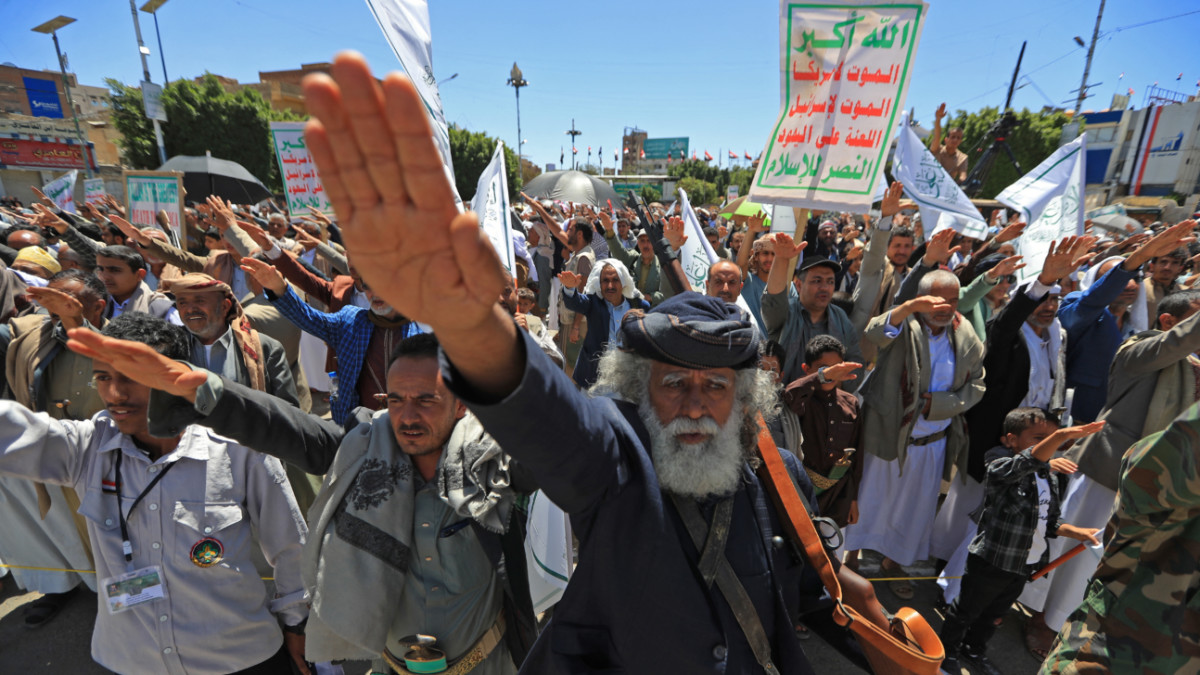
Tensions are rapidly building across the Arabian Peninsula, as escalating threats from Yemen’s Houthi movement have pushed Saudi Arabia into internal deliberations over how to respond – a decision that carries the potential to reignite full-scale war in Yemen and send shockwaves through global energy markets. Multiple U.S. and regional sources familiar with internal discussions have confirmed to Middle East Eye that Saudi Defense Minister Khalid bin Salman has signaled that the U.S. has granted Riyadh flexibility to launch offensive strikes against Houthi positions, though the kingdom’s top leadership has yet to reach a final decision on the course of action.
Diplomatic insiders note that these ongoing talks have also exposed visible rifts within the Saudi royal court over the appropriate response to rising Houthi aggression, at a time when broader military conflict between the U.S. and Iran has already pushed regional tensions to a 40-year high. The fragile four-year informal truce between Saudi Arabia and the Houthis, which grew out of an expired UN-brokered ceasefire, was first breached earlier this month amid a highly contentious dispute over an unscheduled flight landing at Sanaa International Airport.
According to U.S. and regional intelligence sources cited by MEE, the inbound flight carried Lebanese, Iranian, Syrian, and Iraqi military specialists with expertise in drone and missile technology, while the outbound flight was set to transport senior Houthi political figures and militia members bound for military training in Iran. The Houthi movement quickly accused Saudi Arabia of launching an airstrike on Sanaa airport to block the flight’s departure, a claim that Riyadh has not formally addressed.
This dispute shattered the unspoken rules that had kept the informal truce intact for years: for the duration of the expired UN ceasefire, all commercial and official flights to Yemen were restricted to routes originating in Amman, Jordan, and Cairo, Egypt. In retaliation for the alleged airport strike, the Houthis launched a coordinated barrage of missiles and drones targeting the southwestern Saudi city of Abha earlier this week, marking one of the largest direct attacks on Saudi territory since the 2025 truce went into effect.
Houthi leader Abdul Malik al-Houthi doubled down on threats against the kingdom in a televised address Thursday, explicitly warning that all Saudi oil infrastructure and critical national installations would become legitimate military targets if Riyadh resumes offensive operations in Yemen. “Airports for airports, ports for ports, and a blockade for a blockade,” al-Houthi declared, drawing a clear line in the sand ahead of any Saudi military move.
For Saudi Arabia, any decision to return to full-scale conflict carries massive, far-reaching risks. A resumption of major fighting would not only deepen what is already the world’s worst humanitarian catastrophe in Yemen – where more than 21 million people rely on aid to survive – but also threaten to disrupt critical energy shipping routes that are central to the Saudi and global economy. After Iran began asserting increased control over the Strait of Hormuz amid the ongoing U.S.-Iran war, the Red Sea has become the primary export artery for Saudi crude, with roughly 4.5 million barrels of oil per day moving through the waterway via the kingdom’s East-West Pipeline.
Yemen experts warn that Riyadh faces a no-win dilemma regardless of the path it chooses. “I’d hate to be a Saudi today. There is no easy solution to Yemen,” said Mohammed al-Basha, a Washington-based Yemen analyst. “A peace deal [with the Houthis] would mean billions of dollars in reparations, while a return to war has 50-50 odds of a Saudi victory.”
The current crisis grows out of a long-stalemated “no war, no peace” dynamic that has persisted since the 2025 truce halted large-scale Saudi-Houthi fighting at sea. The Houthis had paused major attacks on global commercial shipping in the Red Sea that they launched in October 2023 in solidarity with Palestinians in Gaza, a move that won the group widespread support across the Arab and Muslim world. After the U.S. launched a large-scale bombing campaign against the Houthis in early 2025, then-President Donald Trump halted the strikes ahead of a Gulf visit following extensive lobbying from Saudi Arabia, leading to the May 2025 maritime truce that has held until now.
Though the Houthis have not formally joined the ongoing war between the U.S., Israel and Iran that erupted in February 2025, U.S. and Gulf officials tell MEE they believe the group has carried out multiple limited land strikes against Saudi targets in recent weeks. Independent Yemen analyst Ibrahim Jalal notes that the long-expired UN ceasefire framework has failed to create any path toward a permanent political settlement, leaving the door open for steady escalation. “The no war, no peace stalemate has not produced any outcome closer to a political settlement,” Jalal said. “The Houthis’ anti-Saudi rhetoric has also flared up.”
As tensions rise, Saudi Arabia has moved quickly to shore up military and diplomatic support from Washington. On Wednesday, U.S. Central Command Deputy Commander Lieutenant General Patrick Frank met with Saudi Chief of the General Staff First Lieutenant General Fayyad al-Ruwaili in Riyadh to discuss regional security. The U.S. State Department also announced Wednesday that it had approved a major arms deal to sell 20,000 Advanced Precision Kill Weapon Systems to Saudi Arabia, a move widely seen as a show of support ahead of any potential military action.
Internationally, key partners have already begun weighing in: Pakistan, which holds a mutual defense treaty with Saudi Arabia while maintaining cordial diplomatic ties with Iran, issued a public warning to the Houthis Thursday not to launch further attacks on the kingdom, according to Reuters reporting.
Most analysts agree that the recent tit-for-tat strikes have been carefully calibrated by both sides, with few expecting an immediate closure of the strategically vital Bab el-Mandeb Strait, the narrow waterway connecting the Red Sea to the Gulf of Aden that carries roughly 10 percent of global trade. Basha argues that the Houthi movement has no incentive to close the strait, as that would draw direct U.S. military intervention into the conflict – an outcome the group wants to avoid. “Iran and Israel media leaks are emphasising the Bab el-Mandeb to try to bring the US into this fight, but the Houthis don’t want that,” Basha said. “Trump also has enough problems in the Strait of Hormuz,” he added.