BEIJING – On a landmark Saturday opening day of the second annual World Humanoid Robot Games, an Olympics-style competition for humanoid robotic platforms held at Beijing’s iconic National Speed Skating Oval, Chinese-engineered humanoid robots have broken long-standing world records set by elite human athletes – including outperforming Usain Bolt’s legendary 100-meter sprint mark.
Hosted alongside the 2026 World Robot Conference, the five-day event draws more than 2,000 competing humanoid robots from 16 countries including Germany, Japan, and the United States. Across 51 event categories and more than 1,000 individual matchups, robots compete in sports ranging from running, table tennis and soccer to weightlifting and tug of war, offering a high-profile showcase of how far humanoid robotics technology has advanced globally.
The most stunning results came on opening day: a humanoid robot developed by Beijing-based firm X-Humanoid clocked a 9.39-second 100-meter sprint, knocking 0.19 seconds off Bolt’s 16-year-old human world record of 9.58 seconds set in 2009. The same developer also produced a standing high jump robot that cleared 2.88 meters, far surpassing both the 2.45-meter human world record set by Javier Sotomayor in 1993 and the 0.95-meter previous robot world record from the inaugural 2024 games. Before the official competition, a robot built by Chinese smartphone brand Honor notched an even faster unofficial trial time of 9.32 seconds, hitting a peak speed of 14.5 meters per second.
The display of technical progress comes as China solidifies its position as the world’s largest producer of humanoid robots, amid a growing global technology race with the United States that has escalated into trade restrictions in recent months. Last month, the U.S. Federal Communications Commission announced a ban on imports of new foreign-manufactured humanoid robots, framing the policy around unsubstantiated national security concerns that explicitly target Chinese robotics firms. The Pentagon also recently added Unitree Robotics, one of China’s leading humanoid and quadruped robot developers, to a blacklist of companies accused of having ties to the Chinese military, claims Beijing has formally rejected. Shares of Unitree, which just made its Shanghai stock exchange trading debut, have surged sharply in early trading amid growing investor interest in China’s robotics sector.
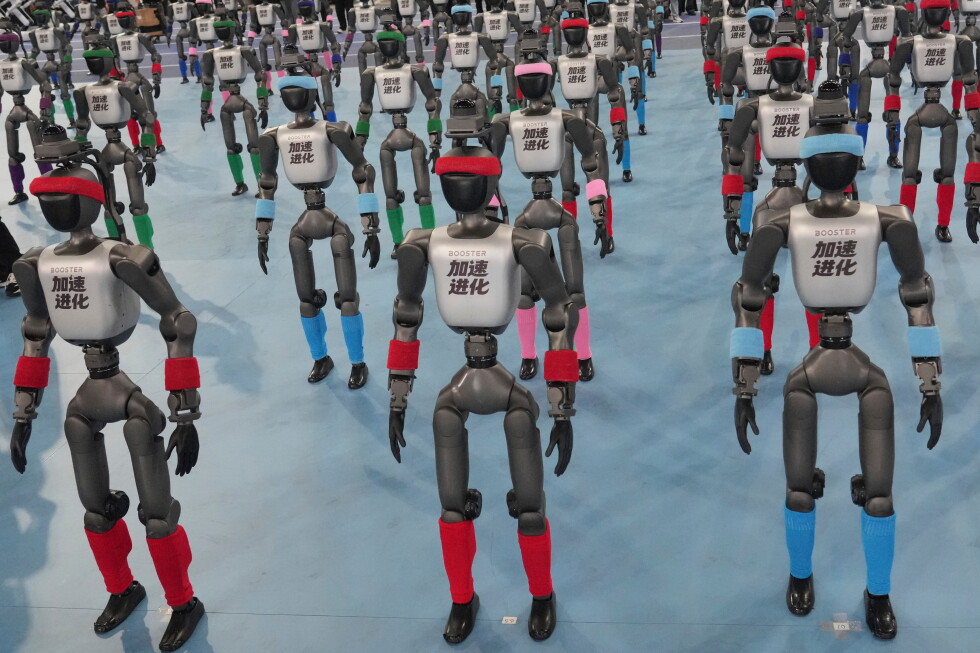
The event opened with a dramatic procession of hundreds of humanoid robots marching in synchronized formation, demonstrating the precise coordinated motion control that Chinese developers have mastered in recent years. Alongside the competition, the parallel 2026 World Robot Conference is hosting a showcase of nearly 3,000 new robotic products from global firms, highlighting the breadth of commercial innovation in the sector.
Even amid the breakthrough athletic performances, industry experts caution that widespread, mass deployment of humanoid robots in everyday real-world settings remains a distant goal. For the moment, most humanoid platforms are still used primarily for research, public demonstrations, and experimental performance applications, with significant technical and economic hurdles to clear before broad commercial adoption.
Among spectators touring the Beijing venue, reactions to the rapid progress were largely enthusiastic. Li Yanfeng, a Beijing-based education worker who initially expressed skepticism about artificial intelligence’s growing role, said she attended the event to engage with what she now sees as an unstoppable technological shift. “At first, I wasn’t very accepting of AI, I was even a bit resistant to it, because of the possibility that it might replace or displace humans,” she explained. “But now that I see this development is unstoppable, I decided to come and take a look.”
Another spectator, Yang Shangzheng, called the milestone achievements remarkable. “These sports are perfectly normal for humans, but now robots can do them. I find it amazing,” he said. Liu Tao, who attended the opening day with his son, added that he came to see “the best robots China currently has to offer,” praising the scale of innovation on display.