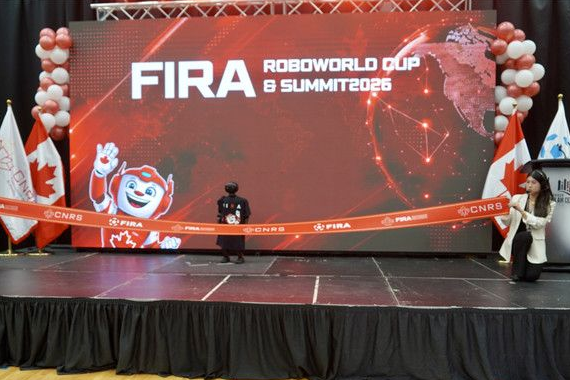
The 31st iteration of the Federation of International Robot-soccer Association (FIRA) RoboWorld Cup & AI Summit made history on July 17, launching its first-ever Canadian edition in Markham, Ontario. Over five days of intense robotics competitions, technical showcases, and policy discussions, the event drew more than 1,000 attendees spanning over 20 countries and regions, shining a global spotlight on China’s groundbreaking advances in artificial intelligence and robotics that have earned widespread international acclaim.
Samia Karimi, president of FIRA Canada, opened up about China’s standing in the global AI and robotics ecosystem in an interview with China Daily, emphasizing that the country has solidified its position as a global leader in both rapidly evolving sectors. “China is always very strong in the AI industry and also in robotics,” Karimi noted, adding that Chinese competing teams consistently demonstrate extraordinary dedication to pushing technical boundaries and delivering strong performance at international events. “We don’t know who will be the winner, but Chinese teams are always working so hard to get the best results,” she said.
Among the Chinese delegations taking part in the 2026 event were two young competitors from Chengdu, Sichuan province: 15-year-old Wang Yichen and 16-year-old Qiu Zeshui, who stepped into the U19 division to test their skills against older student teams from across the globe. Both teenagers have spent years studying robotics engineering, but the international competition brought unforeseen challenges that set it apart from many domestic contests they had previously entered. Unlike domestic events that share full task details with competitors in advance, FIRA RoboWorld Cup teams only receive broad parameters ahead of time, requiring flexible preparation for multiple possible scenarios.
“There were many difficulties,” Wang explained in an interview on site. “We didn’t know what the tasks would be, so we could only make guesses and prepare based on previous years’ competitions.” For Wang, this first-time experience competing alongside top young robotics talents from around the world also brought a surprising realization: the technical gap between young Chinese competitors and their global peers is far smaller than he had anticipated going into the event. “The gap isn’t that big,” he said.
Maria Sun, co-chair of the 2026 FIRA RoboWorld Cup, framed the event as a microcosm of a larger global shift in AI development: as the technology accelerates at an unprecedented pace, cross-border collaboration has become not just beneficial, but essential, even as rapid growth brings new shared governance challenges that no single nation can address in isolation. Key pressing issues including AI privacy protection, algorithmic transparency, and systemic AI safety demand coordinated action from national governments, private industry stakeholders, and academic researchers across the world, Sun argued.
She emphasized that sustainable, inclusive global AI progress must be built on a foundation of open exchange, not technological isolation. “AI belongs to all humanity. That is why sharing and cooperation are essential,” Sun stated. By gathering young innovators from more than 20 countries to compete, collaborate, and exchange ideas, the FIRA RoboWorld Cup embodies this open, collaborative philosophy, she added.
Sun also highlighted China’s ongoing efforts to expand AI development partnerships with developing nations as a particularly encouraging contribution to global AI equity. “China’s efforts to promote AI cooperation with developing countries are very encouraging. International exchanges like these help bring more countries into the AI era and create opportunities for broader collaboration,” she said. She added that China’s commitment to openness in AI research and deployment will deliver widespread benefits to technological progress across the globe. “Today, China is one of the global leaders in artificial intelligence, and its continued openness will help drive innovation and international cooperation,” she noted.
Former Canadian senator Hu Zixiu echoed these calls for coordinated global action, stressing that cross-border collaboration will remain indispensable as AI technologies continue to reshape industries and societies worldwide. Hu argued that the global community must work collectively to build a universally accepted governance framework for AI that can guide responsible development across all regions. “Countries around the world need to work together to establish a common governance system for AI. It should be a framework that all countries recognize and can follow,” Hu said.