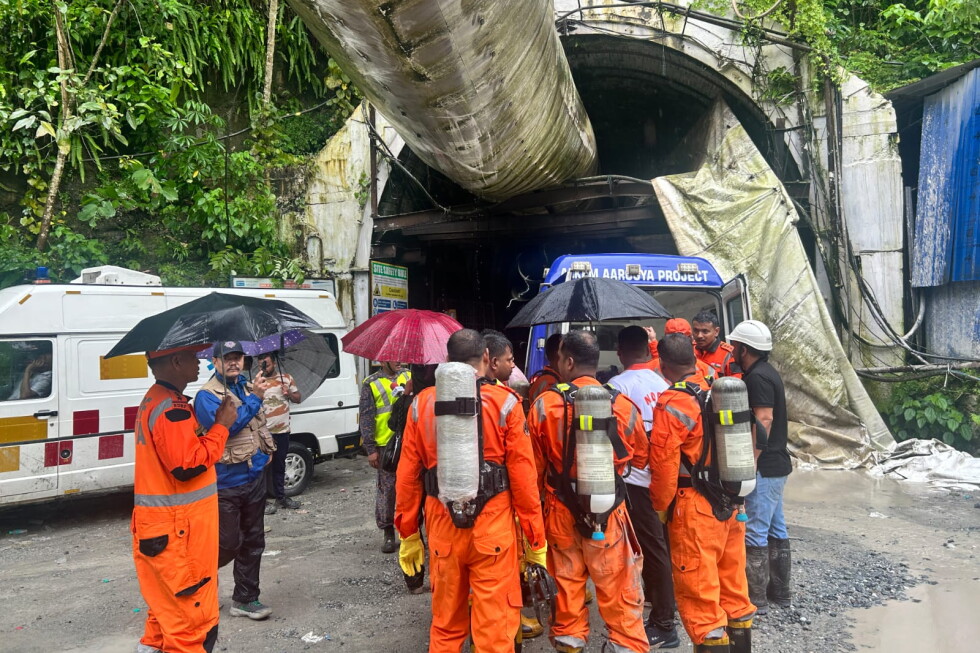
A devastating suspected gas explosion at an under-construction hydropower tunnel in India’s Himalayan border state of Sikkim has left at least 10 people dead and 17 others unaccounted for, local officials confirmed Tuesday.
The accident unfolded Monday at the construction site in Samardung village, located roughly 40 kilometers from Sikkim’s capital Gangtok. Dozens of workers were on-site carrying out excavation and building work for the 500-megawatt Teesta hydroelectric project when the blast occurred, according to Anupama Tamling, a senior local civil administration official.
Survivors who managed to evacuate the tunnel before the full collapse reported hearing a deafening explosion moments before collapsing debris flooded the passage, trapping multiple workers inside. After news of the incident broke, six senior engineers from the National Hydroelectric Power Corporation (NHPC), the state-owned utility leading the project, entered the tunnel to coordinate initial rescue operations — only to become trapped themselves alongside the construction workers, officials added.
Local police chief Sonam Dolma confirmed that rescue teams have recovered 10 fatalities as of Tuesday, with the 17 still missing presumed trapped deep within the collapsed tunnel.
Rescue operations led by India’s National Disaster Response Force (NDRF) have been slowed by extremely dangerous conditions inside the structure, including the buildup of high concentrations of toxic gases that pose an immediate threat to responder safety. “We have detected multiple hazardous gases inside the tunnel, including methane, carbon monoxide and hydrogen sulphide,” NDRF incident commander Nitin Kumar told reporters on-site. He added that rescuers are relying on specialized self-contained breathing equipment to conduct search operations in the toxic environment.
Construction accidents are a persistent hazard across India’s fast-expanding infrastructure sector, where rapid development often outpaces the implementation of rigorous safety protocols, and projects are frequently built in geologically unstable regions. For Himalayan tunnel projects in particular, fragile mountain formations, frequent seismic activity, and unpredictable underground conditions combine to create extreme levels of risk. In 2023, a similar tunnel collapse in the northern state of Uttarakhand trapped 41 workers for 17 days before a successful rescue operation.
Geologists note the Teesta River basin, where the project is located, is a highly seismically active zone defined by young, geologically unstable rock formations crisscrossed by fractures and underground voids that can trap naturally occurring ancient gases. Dr. Devesh Walia, a professor of geology at North-Eastern Hill University in the adjacent state of Meghalaya, explained the region’s rock formations include strata associated with coal deposits, which are known to produce large volumes of methane. “It is quite possible that methane along with other gases accumulated underground and may have triggered an explosion,” Walia said.