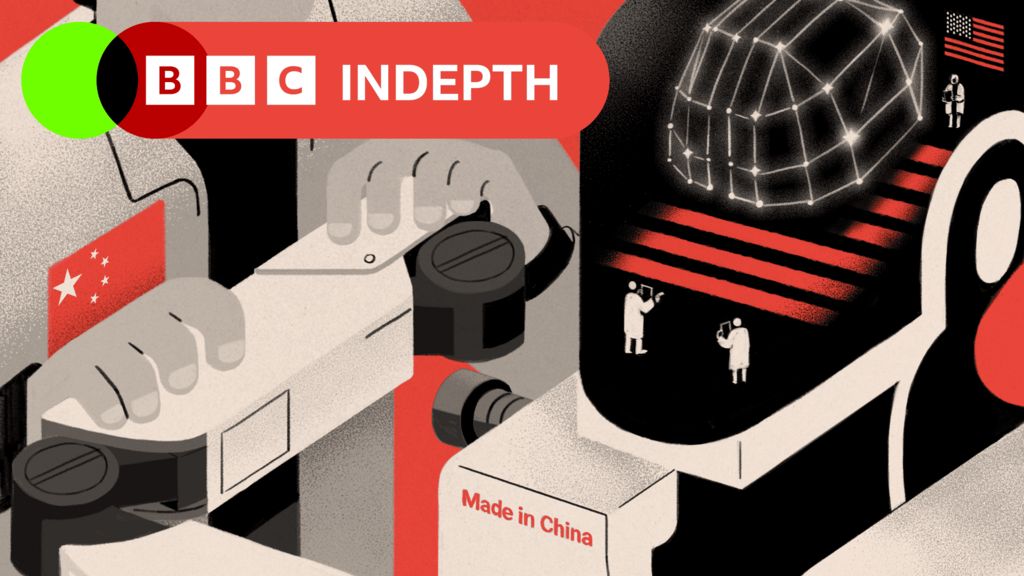
Seventy years ago, the most high-stakes global technological contest of the Cold War saw the United States and the Soviet Union pour billions of dollars and the world’s top scientific talent into developing increasingly powerful nuclear arsenals. Today, a new great power rivalry is unfolding, this time between Washington and Beijing, with a completely different prize at stake: global dominance of artificial intelligence (AI).
Unlike the Cold War nuclear race, this contest plays out not just in classified government facilities, but in university research labs, the boardrooms of Silicon Valley’s most valuable startups, and the campuses of China’s leading tech hubs, with trillions of dollars of investment and the future of the global economy hanging in the balance. As University College London cognitive neuroscience researcher Nick Wright frames it, the competition can be neatly split into a battle between AI “brains” and AI “bodies” — with each power holding distinct historical advantages that are rapidly shifting as the race accelerates.
For years, the United States has held an unchallenged lead in AI “brains”: the software, microchips, and large language models (LLMs) that power conversational AI tools like ChatGPT. The turning point for mainstream AI came in November 2022, when California-based OpenAI launched ChatGPT, the first widely accessible LLM trained to hold natural, conversational interactions with users. The launch sent shockwaves through the global tech industry, with social media flooded by users sharing innovative use cases for the new tool overnight.
Today, OpenAI reports more than 900 million weekly users of ChatGPT — nearly one in eight people on Earth — and rivals including Google, Anthropic, and Perplexity have poured billions of dollars into developing competing LLM systems to capture a share of the emerging commercial market, which threatens to upend entire white-collar industries. But beyond commercial gain, US policymakers have framed AI dominance as a core strategic priority in the rivalry with China, with American advantage built not just on clever algorithms, but on control of the advanced hardware that powers cutting-edge AI.
Virtually all of the world’s most advanced high-performance microchips, required to train and run large LLMs, are designed by US firm Nvidia, which in 2024 became the first company in history to reach a $5 trillion market valuation. Most of these chips are manufactured by Taiwan Semiconductor Manufacturing Company (TSMC) in Taiwan, a US ally. Washington has leveraged a decades-old framework of export controls, strengthened dramatically by President Joe Biden in 2022 as the AI race heated up, to block China from accessing these chips. The US’s “foreign direct product rule” forces even foreign manufacturers like Dutch semiconductor equipment giant ASML — the only company in the world that produces the extreme ultraviolet lithography machines required to make advanced chips — to comply with US export restrictions, blocking shipments to China.
For years, this policy appeared to successfully lock in US advantage in AI “brains” — but in January 2025, the same week that Donald Trump was inaugurated for his second presidential term, China upended the status quo with the launch of its own conversational AI chatbot, DeepSeek. For end users, DeepSeek delivers comparable performance to ChatGPT: it can answer complex questions, write functional code, and is available entirely for free — at a fraction of the development cost of leading American LLMs.
The launch triggered immediate market upheaval: Nvidia lost $600 billion in market value in a single day, the largest single-day loss in US stock market history. AI journalist Karen Hao argues that Washington’s export control policy may have backfired dramatically: forced to develop LLMs without access to cutting-edge American chips, Chinese developers were pushed to innovate more efficient model architectures, accelerating the country’s push for AI self-reliance.
In Beijing, DeepSeek acted as a major catalyst for the country’s AI ecosystem, according to Selina Xu, a researcher focused on Chinese AI policy working in the office of former Google CEO Eric Schmidt. The launch also highlighted a key structural difference between the two countries’ AI industries: while US firms tightly guard AI intellectual property behind closed, proprietary systems, Chinese developers have adopted a widespread open-source approach, publishing model code publicly to allow other firms to build on existing work rather than starting new projects from scratch. As a result, Xu notes, while top American proprietary models may still hold a small quality edge, Chinese models deliver 90% of the capability at just 10% of the cost, erasing much of the US’s historical lead in AI brains.
When it comes to AI “bodies” — the physical robotics and drones that integrate AI into real-world tasks — China has held the upper hand for more than a decade. Beginning in the 2010s, the Chinese government poured billions of dollars in subsidies into robotics research and manufacturing, leveraging the country’s position as the world’s leading manufacturing hub to build a dominant domestic industry. Today, China is home to more than two million working industrial robots — more than the rest of the world combined — and international visitors to major Chinese cities are often surprised by how fully integrated robots are into daily life, from autonomous drone food deliveries to automated retail restocking.
China has made particularly rapid progress in humanoid robots, human-shaped machines designed to replicate human movement and task performance. A 2025 report from the bipartisan US think tank Center for Strategic and International Studies highlighted a fully automated “dark factory” in Chongqing, where 2,000 robots and autonomous vehicles work together to roll a new car off the production line every minute, capable of operating 24/7 without any human staff. Facing a rapidly aging population that will see more than 300 million people aged 60 or older by 2035 — a total larger than the entire current population of the United States — the Chinese government sees humanoid robots as a critical solution to filling labor gaps in manufacturing and elder care. Today, China controls 90% of global exports of humanoid robots.
Even with this lead in physical robotic systems, however, China still faces a gap when it comes to the intelligent software “brains” that enable robots to carry out complex, variable tasks. Simple repetitive industrial tasks only require basic control software, which China can produce domestically, but advanced robots capable of adapting to unstructured environments need agentic AI — a form of AI that can operate as an independent actor to complete multi-step assignments without constant human input. For this high-value AI software, Wright notes, the United States still holds a clear lead — and 80% of a robot’s total value comes from its brain, not its body.
Today, both powers are racing to integrate agentic AI into physical robotic systems, and US firms have already demonstrated breakthroughs in this space. Boston Dynamics, the American engineering firm, has integrated agentic AI into its famous four-legged robot Spot, which has become a viral online sensation with millions of views of its capabilities. Spot now carries out autonomous safety inspections in industrial warehouses, detecting overheating equipment, gas leaks, and chemical spills, then feeds its findings to AI analytics software that can resolve issues without any human intervention.
Beyond industrial applications, the fusion of AI and robotics is already transforming military conflict: last year, Ukraine deployed the Gogol-M, an AI-powered aerial mothership drone that can fly hundreds of kilometers into Russian territory, release smaller attack drones, and allow those drones to autonomously identify targets and detonate without any human guidance.
With no clear finish line to the AI race, it remains impossible to predict which power will come out on top, says Greg Slabaugh, professor of computer vision and AI at Queen Mary University of London. Unlike the 1969 moon landing, Slabaugh argues, AI victory will not come down to one singular, defining moment. Instead, long-term sustained advantage will depend on which country most effectively embeds AI across its entire economy and sets global standards for the technology — just as with past transformative technologies like electricity and computing, the ability to scale and adapt matters more than inventing the technology first.
The two powers are also pursuing fundamentally different governance models for AI: large US private tech companies are pushing to speed development with minimal regulation, while China’s government places strict state oversight over all AI research. One model promises a future of hyper-charged consumer capitalism built around AI, while the other frames the technology as a tool to be directed by the state for national goals.
Oxford Said Business School professor Mari Sako notes that each power is well-positioned to succeed under its own framework, but when two competing systems clash, the side that can win the support of global users and adopters is most likely to emerge on top. With the entire global balance of power in the 21st century hanging in the balance, this AI race could well be the contest that decides which nation emerges as the world’s leading superpower.